
Pulp Fiction, 1928 · page 100 of 150
Argosy All-Story Weekly, July 7, 1928 — page 100: what you’re looking at
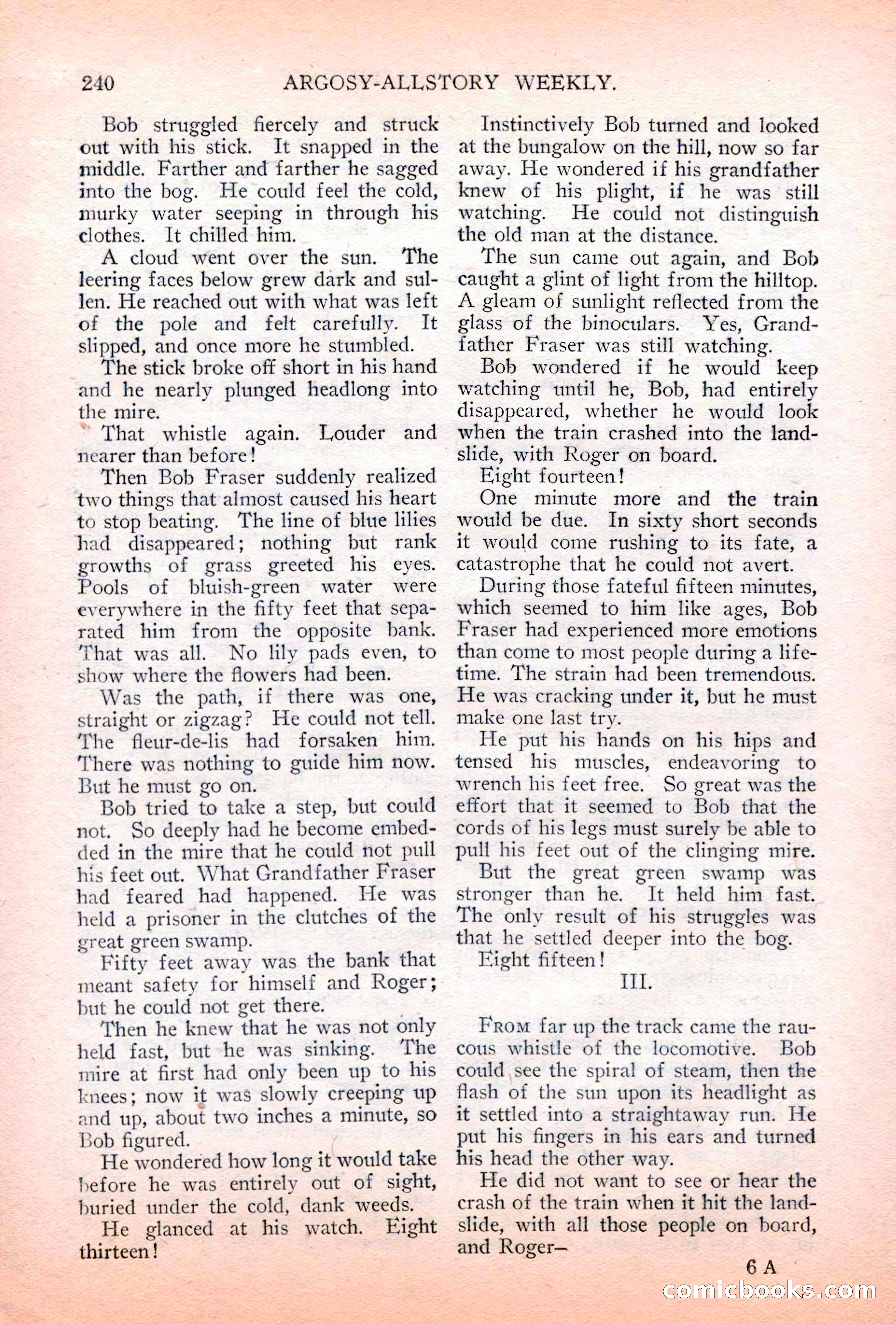
A restored page from Pulp Fiction, 1928. Page through the whole issue in the reader above.
📄 Transcribed text from this page (OCR, searchable)
Machine-transcribed from the original scan — historical spelling and the odd misread are preserved.
240 Bob struggled fiercely and struck out with his stick. It snapped in the middle. Farther and farther he sagged into the bog. He could feel the cold, murky water seeping in through his clothes. It chilled him. A cloud went over the sun. The leering faces below grew dark and sul- len. He reached out with what was left of the pole and felt carefully. It slipped, and once more he stumbled. The stick broke off short in his hand and he nearly plunged headlong into the mire. ~ That whistle again. Louder and nearer than before! Then Bob Fraser suddenly realized two things that almost caused his heart to stop beating. The line of blue lilies had disappeared; nothing but rank growths of grass greeted his eyes. Pools of bluish-green water were everywhere in the fifty feet that sepa- rated him from the opposite bank. That was all. No lily pads even, to show where the flowers had been. Was the path, if there was one, straight or zigzag? He could not tell. The fleur-de-lis had forsaken him. There was nothing to guide him now. But he must go on. Bob tried to take a step, but could not. So deeply had he become embed- ded in the mire that he could not pull his feet out. What Grandfather Fraser had feared had happened. He was held a prisoner in the clutches of the great green swamp. Fifty feet away was the bank that meant safety for himself and Roger; but he could not get there. 3 Then he knew that he was not only held fast, but he was sinking. The mire at first had only been up to his knees; now it was slowly creeping up and up, about two inches a minute, so Bob figured. He wondered how long it would take before he was entirely out of sight, buried under the cold, dank weeds. He glanced at his watch. Eight thirteen! 7 ARGOSY-ALLSTORY WEEKLY. Instinctively Bob turned and looked at the bungalow on the hill, now so far away. He wondered if his grandfather knew of his plight, if he was still watching. He could not distinguish the old man at the distance. The sun came out again, and Bob caught a glint of light from the hilltop. A gleam of sunlight reflected from the glass of the binoculars. Yes, Grand- father Fraser was still watching. Bob wondered if he would keep watching until he, Bob, had entirely disappeared, whether he would look when the train crashed into the land- slide, with Roger on board. Fight fourteen! One minute more and the train would be due. In sixty short seconds it would come rushing to its fate, a catastrophe that he could not avert. During those fateful fifteen minutes, which seemed to him like ages, Bob Fraser had experienced more emotions than come to most people during a life- time. The strain had been tremendous. He was cracking under it, but he must make one last try. He put his hands on his hips and tensed his muscles, endeavoring to wrench his feet free. So great was the effort that it seemed to Bob that the cords of his legs must surely be able to pull his feet out of the clinging mire. But the great green swamp was stronger than he. It held him fast. The only result of his struggles was that he settled deeper into the bog. Fight fifteen ! Il. From far up the track came the rau- cous whistle of the locomotive. Bob could see the spiral of steam, then the flash of the sun upon its headlight as it settled into a straightaway run. He put his fingers in his ears and turned his head the other way. He did not want to see or hear the crash of the train when it hit the land- slide, with all those people on board, and Roger— 6A com cS) .OO