
Pulp Fiction, 1928 · page 65 of 156
Argosy All-Story Weekly, May 5, 1928 — page 65: what you’re looking at
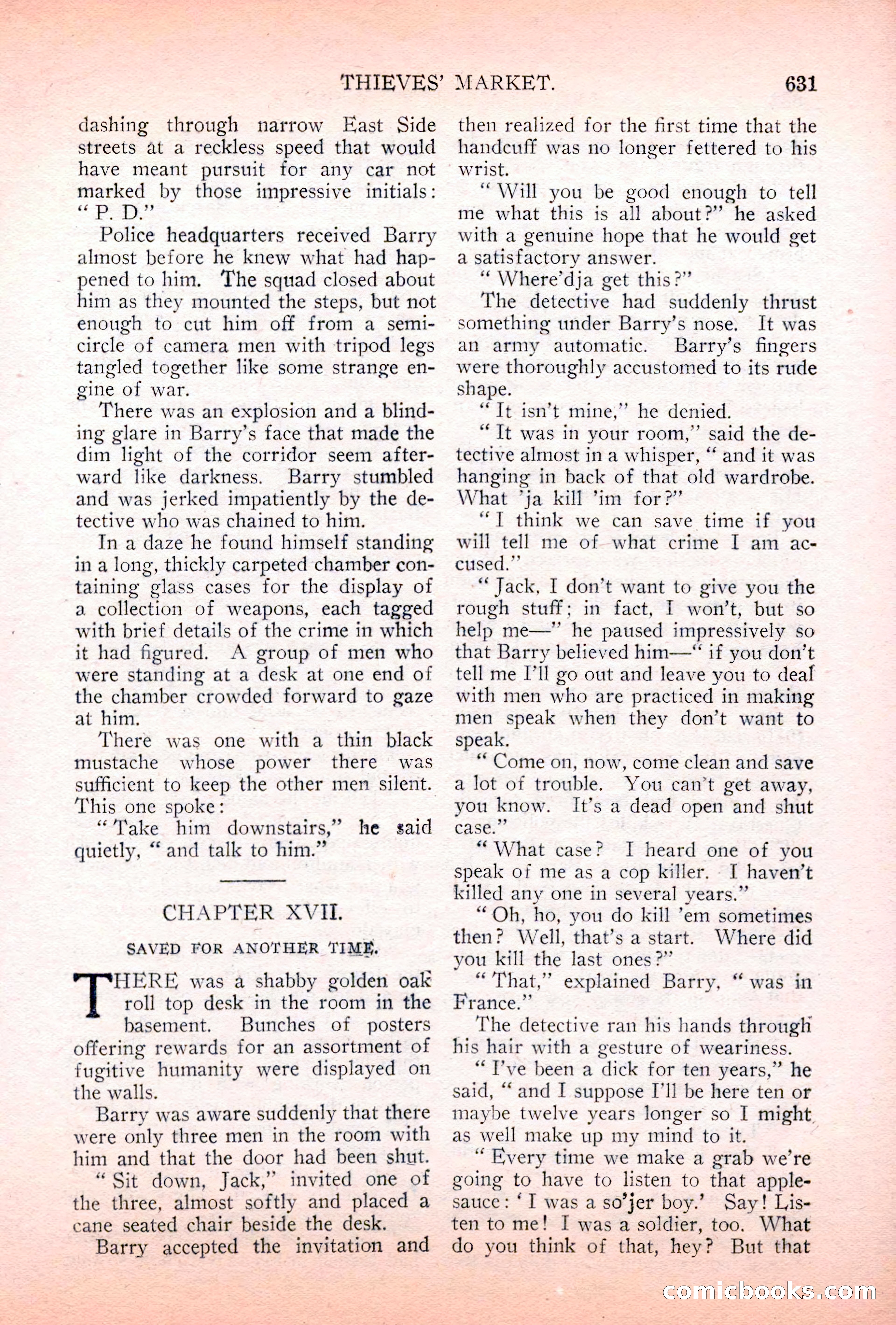
A restored page from Pulp Fiction, 1928. Page through the whole issue in the reader above.
📄 Transcribed text from this page (OCR, searchable)
Machine-transcribed from the original scan — historical spelling and the odd misread are preserved.
THIEVES’ MARKET. dashing through narrow East Side streets at a reckless speed that would have meant pursuit for any car not marked by those impressive initials: 6 P. : ee Police headquarters received Barry almost before he knew what had hap- pened to him. The squad closed about him as they mounted the steps, but not enough to cut him off from a semi- circle of camera men with tripod legs tangled together like some strange en- gine of war. There was an explosion and a blind- ing glare in Barry’s face that made the dim light of the corridor seem after- ward like darkness. Barry stumbled and was jerked impatiently by the de- tective who was chained to him. In a daze he found himself standing in a long, thickly carpeted chamber con- taining glass cases for the display of a collection of weapons, each tagged with brief details of the crime in which it had figured. A group of men who were standing at a desk at one end of the chamber crowded forward to gaze at him. There was one with a thin black mustache whose power there was sufficient to keep the other men silent. This one spoke: : “Take him downstairs,” he said quietly, “ and talk to him.” CHAPTER XVII. SAVED FOR ANOTHER TIME, HERE was a shabby golden oak roll top desk in the room in the basement. Bunches of posters offering rewards for an assortment of fugitive humanity were displayed on the walls. Barry was aware suddenly that there were only three men in the room with him and that the door had been shut. “ Sit down, Jack,’’ invited one of the three, almost softly and placed a cane seated chair beside the desk. Barry accepted the invitation and 631 then realized for the first time that the handcuff was no longer fettered to his wrist. “Will you be good enough to tell me what this is all about?’ he asked with a genuine hope that he would get a satisfactory answer. “Where’dja get this?” The detective had suddenly thrust something under Barry’s nose. It was an army automatic. Barry’s fingers were thoroughly accustomed to its rude shape. “Tt isn’t mine,” he denied. “It was in your room,” said the de- tective almost in a whisper, “ and it was hanging in back of that old wardrobe. What ’ja kill ’im for?” “T think we can save time if you will tell me of what crime I am ac- cused.” “Jack, I don’t want to give you the rough stuff; in fact, I won’t, but so help me—”’ he paused impressively so that Barry believed him—“ if you don’t tell me I’ll go out and leave you to deal with men who are practiced in making men speak when they don’t want to speak, “Come on, now, come clean and save a lot of trouble. You can’t get away, you know. It’s a dead open and shut case.” “What case? I heard one of you speak of me as a cop killer. I haven’t killed any one in several years.” “Oh, ho, you do kill ’em sometimes then? Well, that’s a start. Where did you kill the last ones?” “That,” explained Barry, “ was in France.” The detective ran his hands through his hair with a gesture of weariness. “T’ve been a dick for ten years,” he said, “and I suppose I'll be here ten or maybe twelve years longer so I might as well make up my mind to it. ‘Every time we make a grab we’re going to have to listen to that apple- sauce: ‘I was a so’jer boy.’ Say! Lis- ten to me! I was a soldier, too. What do you think of that, hey? But that COMIC LOO KS (E@)