
Pulp Fiction, 1928 · page 64 of 156
Argosy All-Story Weekly, May 5, 1928 — page 64: what you’re looking at
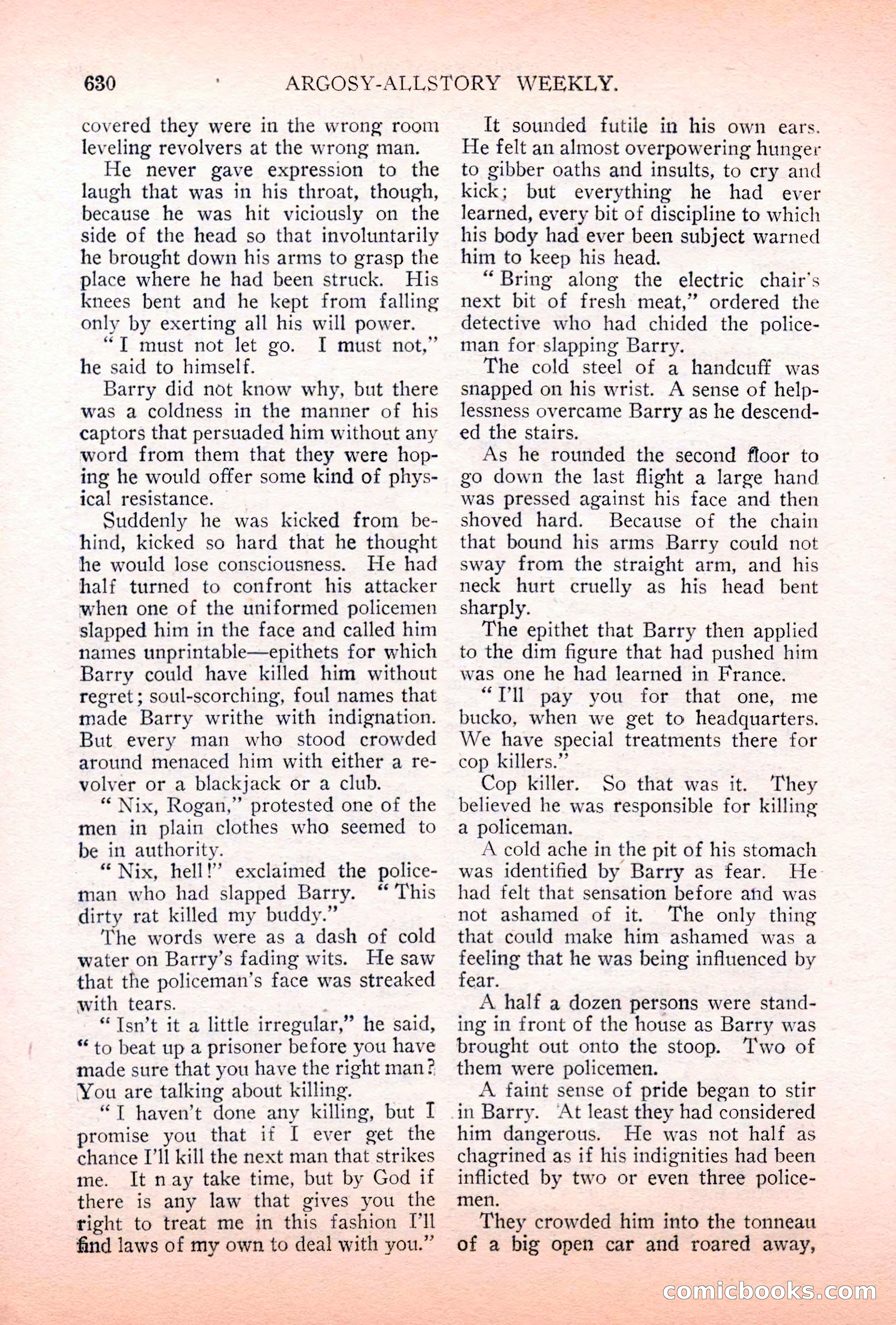
A restored page from Pulp Fiction, 1928. Page through the whole issue in the reader above.
📄 Transcribed text from this page (OCR, searchable)
Machine-transcribed from the original scan — historical spelling and the odd misread are preserved.
630 covered they were in the wrong room leveling revolvers at the wrong man. He never gave expression to the laugh that was in his throat, though, because he was hit viciously on the side of the head so that involuntarily he brought down his arms to grasp the place where he had been struck. His knees bent and he kept from falling only by exerting all his will power. “T must not let go. I must not,” he said to himself. Barry did not know why, but there was a coldness in the manner of his captors that persuaded him without any word from them that they were hop- ing he would offer some kind of phys- ical resistance. Suddenly he was kicked from be- hind, kicked so hard that he thought he would lose consciousness. He had half turned to confront his attacker when one of the uniformed policemen slapped him in the face and called him naines unprintable—epithets for which Barry could have killed him without regret; soul-scorching, foul names that made Barry writhe with indignation. But every man who stood crowded around menaced him with either a re- volver or a blackjack or a club. “ Nix, Rogan,” protested one of the men in plain clothes who seemed to be in authority. “ Nix, hell!’ exclaimed the police- man who had slapped Barry. “ This dirty rat killed my buddy.” The words were as a dash of cold water on Barry’s fading wits. He saw that the policeman’s face was streaked with tears. | “Tsn’t it a little irregular,” he said, “to beat up a prisoner before you have made sure that you have the right man? You are talking about killing. “T haven’t done any killing, but I promise you that if I ever get the chance [’ll kill the next man that strikes me. It nay take time, but by God if there is any law that gives you the right to treat me in this fashion [’ll find laws of my own to deal with you.” ARGOSY-ALLSTORY WEEKLY. [t sounded futile in his own ears. He felt an almost overpowering hunger to gibber oaths and insults, to cry and kick; but everything he had ever learned, every bit of discipline to which his body had ever been subject warned him to keep his head. “Bring along the electric chair’s next bit of fresh meat,” ordered the detective who had chided the police- man for slapping Barry. The cold steel of a handcuff was snapped on his wrist. A sense of help- lessness overcame Barry as he descend- ed the stairs. As he rounded the second floor to go down the last flight a large hand was pressed against his face and then shoved hard. Because of the chain that bound his arms Barry could not sway from the straight arm, and his neck hurt cruelly as his head bent sharply. The epithet that Barry then applied to the dim figure that had pushed him was one he had learned in France. “Tll pay you for that one, me bucko, when we get to headquarters. We have special treatments there for cop killers.” Cop killer. So that was it. They believed he was responsible for killing a policeman. A cold ache in the pit of his stomach was identified by Barry as fear. He had felt that sensation before and was not ashamed of it. The only thing that could make him ashamed was a feeling that he was being influenced by fear. A. half a dozen persons were stand- ing in front of the house as Barry was brought out onto the stoop. Two of them were policemen. A. faint sense of pride began to stir in Barry. ‘At least they had considered him dangerous. He was not half as chagrined as if his indignities had been inflicted by two or even three police- men. They crowded him into the tonneau of a big open car and roared away, GOmIicbooks (E@)