
Pulp Fiction, 1928 · page 96 of 148
Argosy All-Story Weekly, April 28, 1928 — page 96: what you’re looking at
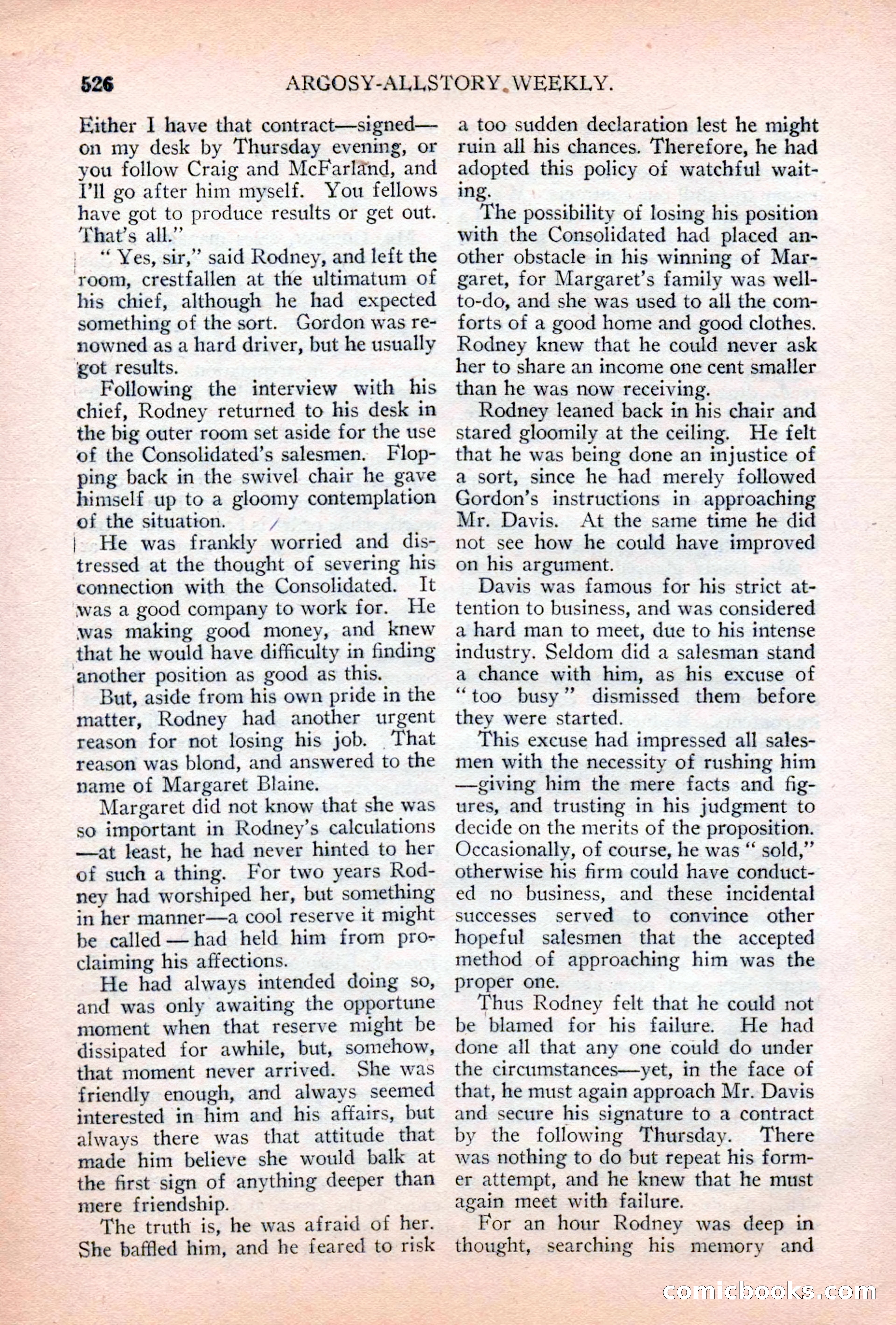
A restored page from Pulp Fiction, 1928. Page through the whole issue in the reader above.
📄 Transcribed text from this page (OCR, searchable)
Machine-transcribed from the original scan — historical spelling and the odd misread are preserved.
526 Either I have that contract—signed— on my desk by Thursday evening, or you follow Craig and McFarland, and I'll go after him myself. You fellows have got to produce results or get out. That’s all.” | “ Yes, sir,” said Rodney, and left the room, crestfallen at the ultimatum of his chief, although he had expected something of the sort. Gordon was re- nowned as a hard driver, but he usually ‘got results. Following the interview with his chief, Rodney returned to his desk in the big outer room set aside for the use of the Consolidated’s salesmen. Flop- ping back in the swivel chair he gave himself up to a gloomy contemplation of the situation. / | He was frankly worried and dis- tressed at the thought of severing his connection with the Consolidated. It was a good company to work for. He was making good money, and knew that he would have difficulty in finding ‘another position as good as this. But, aside from his own pride in the matter, Rodney had another urgent reason for not losing his job. That reason was blond, and answered to the name of Margaret Blaine. Margaret did not know that she was so important in Rodney’s calculations —at least, he had never hinted to her of such a thing. For two years Rod- ney had worshiped her, but something in her manner—a cool reserve it might be called —had held him from pro- claiming his affections. He had always intended doing so, and was only awaiting the opportune moment when that reserve might be dissipated for awhile, but, somehow, that moment never arrived. She was friendly enough, and always seemed interested in him and his affairs, but always there was that attitude that made him believe she would balk at the first sign of anything deeper than mere friendship. The truth is, he was afraid of her. She baffled him, and he feared to risk ARGOSY-ALLSTORY. WEEKLY. a too sudden declaration lest he might ruin all his chances. Therefore, he had adopted this policy of watchful wait- ing. The possibility of losing his position with the Consolidated had placed an- other obstacle in his winning of Mar- garet, for Margaret’s family was well- to-do, and she was used to all the com- forts of a good home and good clothes. Rodney knew that he could never ask her to share an income one cent smaller than he was now receiving. Rodney leaned back in his chair and stared gloomily at the ceiling. He felt that he was being done an injustice of a sort, since he had merely followed Gordon’s instructions in approaching Mr. Davis. At the same time he did not see how he could have improved on his argument. Davis was famous for his strict at- tention to business, and was considered a hard man to meet, due to his intense industry. Seldom did a salesman stand a chance with him, as his excuse of “too busy” dismissed them before they were started. This excuse had impressed all sales- men with the necessity of rushing him —giving him the mere facts and fig- ures, and trusting in his judgment to decide on the merits of the proposition. Occasionally, of course, he was “ sold,” otherwise his firm could have conduct- ed no business, and these incidental successes served to convince other hopeful salesmen that the accepted method of approaching him was the proper one. Thus Rodney felt that he could not be blamed for his failure. He had done all that any one could do under the circumstances—yet, in the face of that, he must again approach Mr. Davis and secure his signature to a contract by the following Thursday. There was nothing to do but repeat his form- er attempt, and he knew that he must again meet with failure. For an hour Rodney was deep in thought, searching his memory and COPMNICLOOOKS (©)