
Pulp Fiction, 1928 · page 95 of 148
Argosy All-Story Weekly, April 28, 1928 — page 95: what you’re looking at
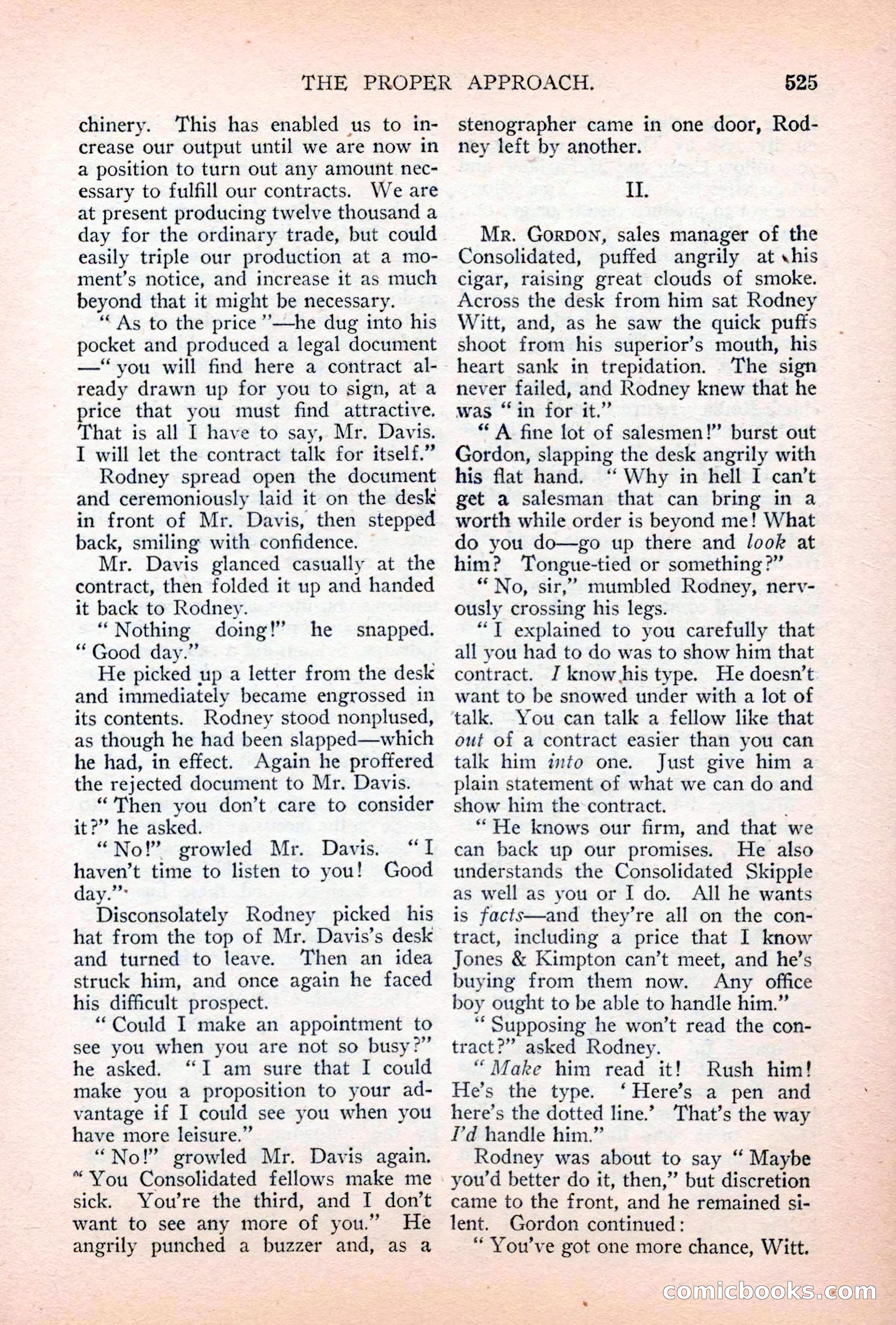
A restored page from Pulp Fiction, 1928. Page through the whole issue in the reader above.
📄 Transcribed text from this page (OCR, searchable)
Machine-transcribed from the original scan — historical spelling and the odd misread are preserved.
THE PROPER APPROACH. chinery. ‘This has enabled us to in- crease our output until we are now in a position to turn out any amount nec- essary to fulfill our contracts. We are at present producing twelve thousand a day for the ordinary trade, but could easily triple our production at a mo- ment’s notice, and increase it as much beyond that it might be necessary. ‘“ As to the price ’’—he dug into his pocket and produced a legal document —“ you will find here a contract al- ready drawn up for you to sign, at a price that you must find attractive. That is all I have to say, Mr. Davis. I will let the contract talk for itself.” Rodney spread open the document and ceremoniously laid it on the desk in front of Mr. Davis, then stepped back, smiling with confidence. Mr. Davis glanced casually at the contract, then folded it up and handed it back to Rodney. “Nothing doing!” he “Good day.” He picked up a letter from the desk and immediately became engrossed in its contents. Rodney stood nonplused, as though he had been slapped—which he had, in effect. Again he proffered the rejected document to Mr. Davis. “Then you don’t care to consider it?’ he asked. “No!” growled Mr. Davis, “I haven’t time to listen to you! Good day.” Disconsolately Rodney picked his hat from the top of Mr. Davis’s desk and turned to leave. Then an idea struck him, and once again he faced his difficult prospect. “Could I make an appointment to see you when you are not so busy?” he asked. “I am sure that I could make you a proposition to your ad- vantage if I could see you when you have more leisure.” “No!” growled Mr. Davis again. “You Consolidated fellows make me sick. You’re the third, and I don’t want to see any more of you.” He angrily punched a buzzer and, as a snapped. 525 stenographer came in one door, Rod- ney left by another. IT. Mr. Gorpon, sales manager of the Consolidated, puffed angrily at xhis cigar, raising great clouds of smoke. Across the desk from him sat Rodney Witt, and, as he saw the quick puffs shoot from his superior’s mouth, his heart sank in trepidation. The sign never failed, and Rodney knew that he was “in for it.” “A fine lot of salesmen!” burst out Gordon, slapping the desk angrily with his flat hand. “ Why in hell I can’t get a salesman that can bring in a worth while order is beyond me! What do you do—go up there and look at him? Tongue-tied or something?” * No, sir,” mumbled Rodney, nerv- ously crossing his legs. “T explained to you carefully that all you had to do was to show him that contract. J know his type. He doesn’t want to be snowed under with a lot of talk. You can talk a fellow like that out of a contract easier than you can talk him into one. Just give him a plain statement of what we can do and show him the contract. “He knows our firm, and that we can back up our promises. He also understands the Consolidated Skipple as well as you or I do. All he wants is facits—and they’re all on the con- tract, including a price that I know Jones & Kimpton can’t meet, and he’s buying from them now. Any office boy ought to be able to handle him.” ‘Supposing he won’t read the con- tract?” asked Rodney. “Make him read it! Rush him! He’s the type. ‘Here’s a pen and here’s the dotted line.” That’s the way Id handle him.” Rodney was about to say “ Maybe you'd better do it, then,” but discretion came to the front, and he remained si- lent. Gordon continued: “You've got one more chance, Witt. COPMNICLOOOKS (€@)