
Pulp Fiction, 1928 · page 115 of 148
Argosy All-Story Weekly, April 28, 1928 — page 115: what you’re looking at
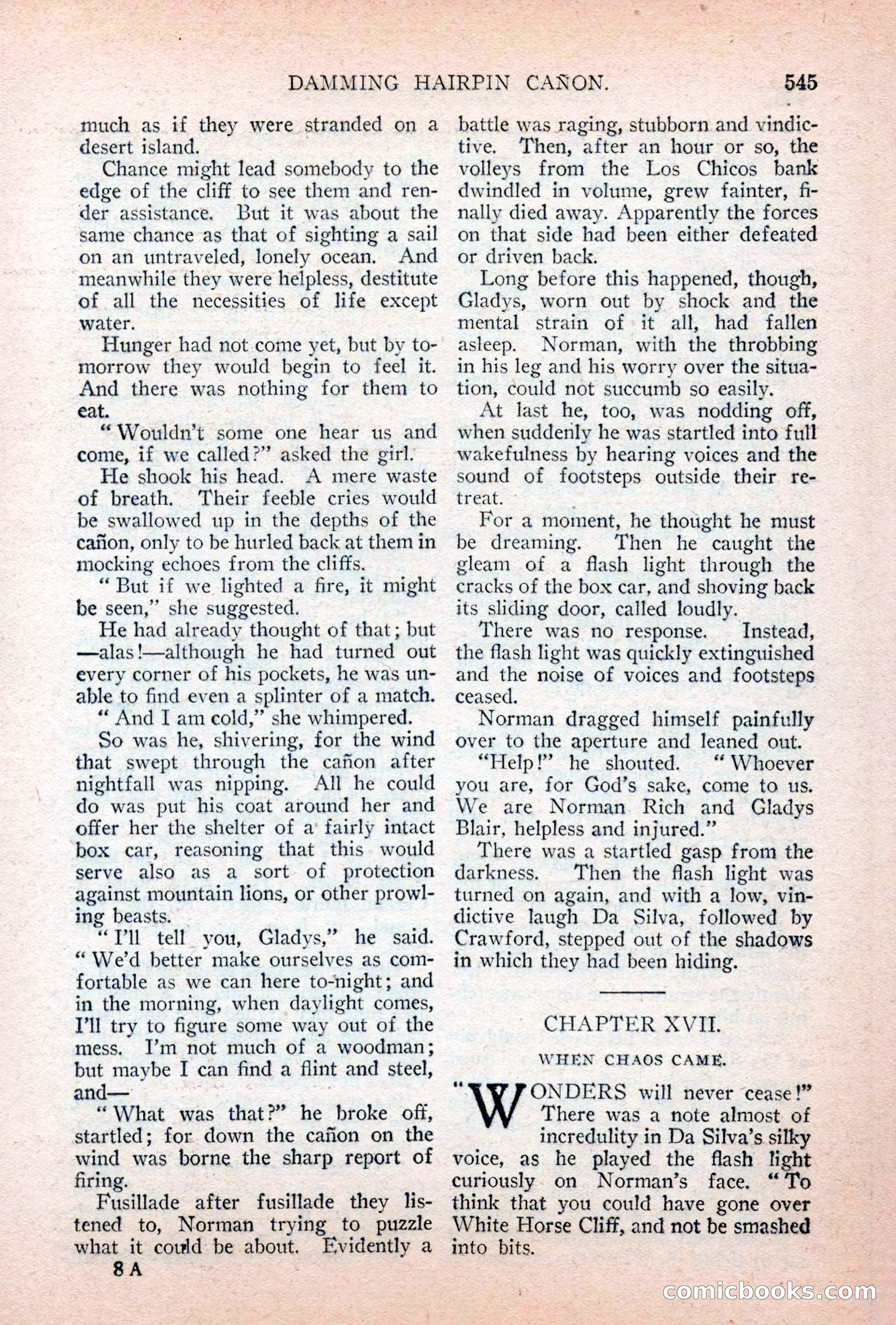
A restored page from Pulp Fiction, 1928. Page through the whole issue in the reader above.
📄 Transcribed text from this page (OCR, searchable)
Machine-transcribed from the original scan — historical spelling and the odd misread are preserved.
DAMMING HAIRPIN CANON. much as if they were stranded on a desert island. Chance might lead somebody to the edge of the cliff to see them and ren- der assistance. But it was about the same chance as that of sighting a sail on an untraveled, lonely ocean. And meanwhile they were helpless, destitute of all the necessities of life except water. Hunger had not come yet, but by to- morrow they would begin to feel it. And there was nothing for them to eat. “Wouldn’t some one hear us and come, if we called?” asked the girl. He shook his head. A mere waste of breath. Their feeble cries would be swallowed up in the depths of the cafion, only to be hurled back at them in mocking echoes from the cliffs. “But if we lighted a fire, it might be seen,”’ she suggested. He had already thought of that; but —alas!—although he had turned out every corner of his pockets, he was un- able to find even a splinter of a match. “ And I am cold,” she whimpered. So was he, shivering, for the wind that swept through the cafion after nightfall was nipping. All he could do was put his coat around her and offer her the shelter of a’ fairly intact box car, reasoning that this would serve also as a sort of protection against mountain lions, or other prowl- ing beasts. “T’ll tell you, Gladys,” he said. “We'd better make ourselves as com- fortable as we can here to-night; and in the morning, when daylight comes, I'll try to figure some way out of the mess. I’m not much of a woodman; but maybe I can find a flint and steel, and— “What was that?” he broke off, startled; for down the cafion on the wind was borne the sharp report of firing. Fusillade after fusillade they lis- tened to, Norman trying to puzzle what it could be about Evidently a 8A 945 battle was raging, stubborn and vindic- tive. Then, after an hour or so, the volleys from the Los Chicos bank dwindled in volume, grew fainter, fi- nally died away. Apparently the forces on that side had been either defeated or driven back. Long before this happened, though, Gladys, worn out by shock and the mental strain of it all, had fallen asleep. Norman, with the throbbing in his leg and his worry over the situa- tion, could not succumb so easily. At last he, too, was nodding off, when suddenly he was startled into full wakefulness by hearing voices and the sound of footsteps outside their re- treat. For a moment, he thought he must be dreaming. Then he caught the gleam of a flash light through the cracks of the box car, and shoving back its sliding door, called loudly. There was no response. Instead, the flash light was quickly extinguished and the noise of voices and footsteps ceased. Norman dragged himself painfully over to the aperture and leaned out. “Help!” he shouted. “ Whoever you are, for God’s sake, come to us. We are Norman Rich and Gladys Blair, helpless and injured.” There was a startled gasp from the darkness. Then the flash light was turned on again, and with a low, vin- dictive laugh Da Silva, followed by Crawford, stepped out of the shadows in which they had been hiding. CHAPTER XVII. WHEN CHAOS CAME. = ONDERS will never cease!” There was a note almost of incredulity in Da Silva’s silky voice, as he played the flash ugut : curiously. on Norman’s face. think that you could have gone over White Horse Cliff, and not be smashed into bits. Gomichbooks (e(0)