
Pulp Fiction, 1928 · page 114 of 148
Argosy All-Story Weekly, April 28, 1928 — page 114: what you’re looking at
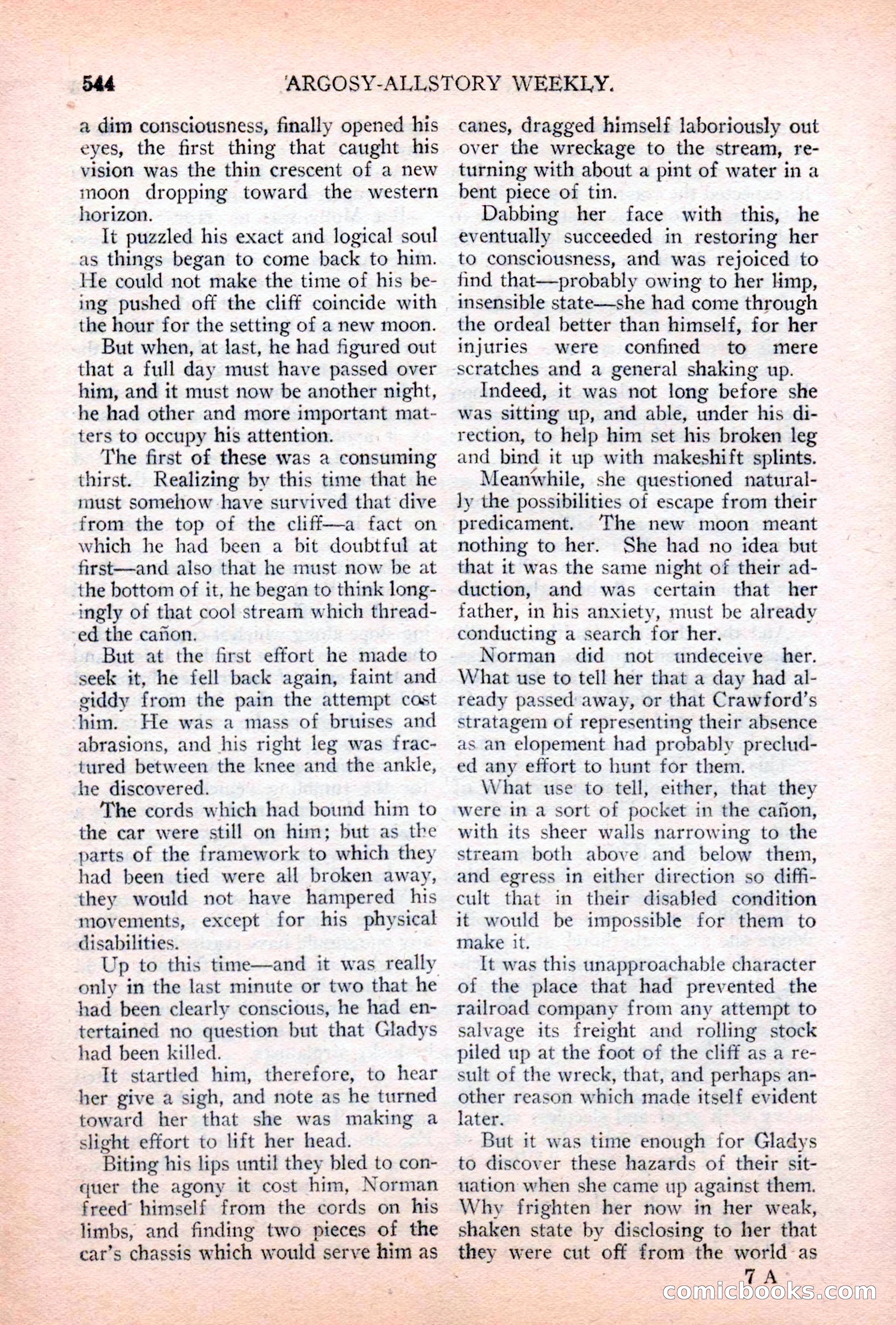
A restored page from Pulp Fiction, 1928. Page through the whole issue in the reader above.
📄 Transcribed text from this page (OCR, searchable)
Machine-transcribed from the original scan — historical spelling and the odd misread are preserved.
bad a dim consciousness, finally opened his eyes, the first thing that caught his vision was the thin crescent of a new moon dropping toward the western horizon. lt puzzled his exact and logical soul as things began to come back to him. He could not make the time of his be- ing pushed off the cliff coincide with the hour for the setting of a new moon. But when, at last, he had figured out that a full day must have passed over him, and it must now be another night, he had other and more important mat- ters to occupy his attention. The first of these was a consuming thirst. Realizing by this time that he must somehow have survived that dive from the top of the cliff—a fact on which he had been a bit doubtful at first—and also that he must now be at the bottom of it, he began to think long- ingly of that cool stream which thread- ‘ed the cafion. But at the first effort he made to seek it, he fell back again, faint and giddy from the pain the attempt cost him. He was a mass of bruises and abrasions, and his right leg was frac- tured between the knee and the ankle, he discovered. The cords which had bound him to the car were still on him; but as tke parts of the framework to which they had been tied were all broken away, they would not have hampered his movements, except for his physical disabilities. Up to this time—and it was really only in the last minute or two that he had been clearly conscious, he had en- tertained no question but that Gladys had been killed. It startled him, therefore, to hear her give a sigh, and note as he turned toward her that she was making a slight effort to lift her head. Biting his lips until they bled to con- quer the agony it cost him, Norman freed himself from the cords on his limbs, and finding two pieces of the car’s chassis which would serve him as ARGOSY-ALLSTORY WEEKLY. canes, dragged himself laboriously out over the wreckage to the stream, re- turning with about a pint of water in a bent piece of tin. Dabbing her face with this, he eventually succeeded in restoring her to consciousness, and was rejoiced to find that—probably owing to her limp, insensible state—she had come through the ordeal better than himself, for her injuries were confined to mere scratches and a general shaking up. Indeed, it was not long before she was sitting up, and able, under his di- rection, to help him set his broken leg and bind it up with makeshift splints. Meanwhile, she questioned natural- ly the possibilities of escape from their predicament. The new moon meant nothing to her. She had no idea but that it was the same night of their ad- duction, and was certain that her father, in his anxiety, must be already conducting a search for her. Norman did not wundeceive her. What use to tell her that a day had al- ready passed away, or that Crawford’s stratagem of representing their absence as an elopement had probably preclud- ed any effort to hunt for them. What use to tell, either, that they were in a sort of pocket in the cafion, with its sheer walls narrowing to the stream both above and below them, and egress in either direction so diffi- cult that in their disabled condition it would be impossible for them to make it. [t was this unapproachable character of the place that had prevented the railroad company from any attempt to salvage its freight and rolling stock piled up at the foot of the cliff as a re- sult of the wreck, that, and perhaps an- other reason which made itself evident later. . But it was time enough for Gladys to discover these hazards of their sit- uation when she came up against them. Why frighten her now in her weak, shaken state by disclosing to her that they were cut off from the world as A soo S COMIC (E@