
Pulp Fiction, 1928 · page 23 of 152
Argosy All-Story Weekly, April 14, 1928 — page 23: what you’re looking at
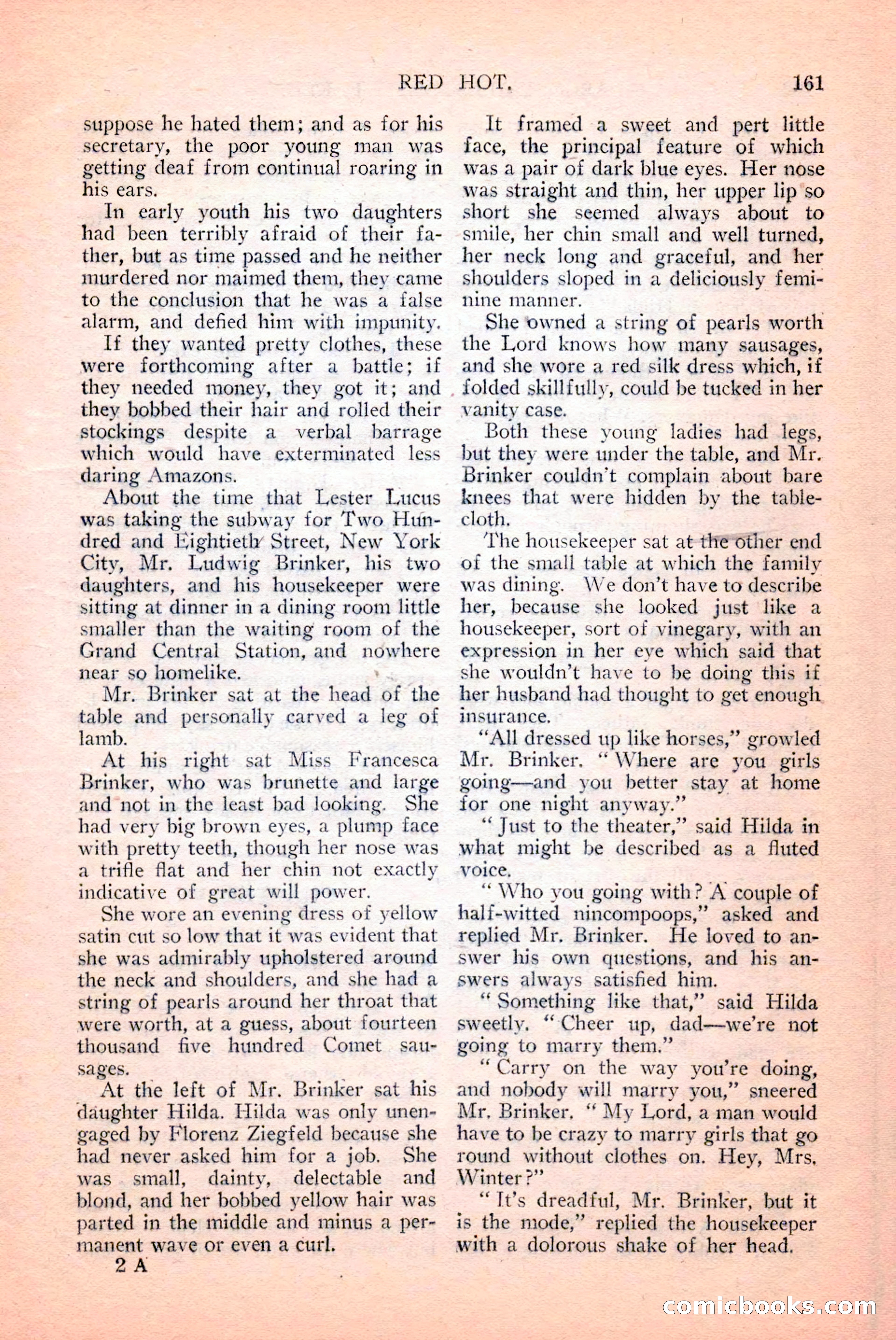
A restored page from Pulp Fiction, 1928. Page through the whole issue in the reader above.
📄 Transcribed text from this page (OCR, searchable)
Machine-transcribed from the original scan — historical spelling and the odd misread are preserved.
RED suppose he hated them; and as for his secretary, the poor young man was getting deaf from continual roaring in his ears. In early youth his two daughters had been terribly afraid of their fa- ther, but as time passed and he neither murdered nor maimed them, they came to the conclusion that he was a false alarm, and defied him with impunity. If they wanted pretty clothes, these were forthcoming after a battle; if they needed money, they got it; and they bobbed their hair and rolled their stockings despite a verbal barrage which would have exterminated less daring Amazons. About the time that Lester Liucus was taking the subway for Two Hun- dred and lightietly Street, New York City, Mr. Ludwig Brinker, his two daughters, and his housekeeper were sitting at dinner in a dining room little smaller than the waiting room of the Grand Central Station, and nowhere near so homelike. Mr. Brinker sat at the head of the table and personally carved a leg of lamb. At his right sat Miss Francesca Brinker, who was brunette and large and not in the least bad looking. She had very big brown eyes, a plump face with pretty teeth, though her nose was a trifle flat and her chin not exactly indicative of great will power. She wore an evening dress of yellow satin cut so low that it was evident that she was admirably upholstered around the neck and shoulders, and she had a string of pearls around her throat that were worth, at a guess, about fourteen thousand five hundred Comet sau- sages. At the left of Mr. Brinker sat his daughter Hilda. Hilda was only unen- gaged by Florenz Ziegfeld because she had never asked him for a job. She was. small, dainty, delectable and blond, and her bobbed yellow hair was parted in the middle and minus a per- manent wave or even a curl. HOT, 161 It framed a sweet and pert little face, the principal feature of which was a pair of dark blue eyes. Her nose was straight and thin, her upper lip so short she seemed always about to smile, her chin small and well turned, her neck long and graceful, and her shoulders sloped in a deliciously femi- nine manner. She owned a string of pearls worth the Lord knows how many sausages, and she wore a red silk dress which, if _ folded skillfully, could be tucked in her vanity case. Both these voung ladies had legs, but they were under the table, and Mr. Brinker couldn’t complain about bare knees that were hidden by the table- cloth. ‘The housekeeper sat at the Other end of the small table at which the family was dining. We don’t have to describe her, because she looked just like a housekeeper, sort of vinegary, with an expression in her eye which said that she wouldn’t have to be doing this if her husband had thought to get enough insurance. “All dressed up like horses,” growled Mr. Brinker, ‘“ Where are you girls going—and you better stay at home for one night anyway.” ‘Just to the theater,” said Hilda in what might be described as a fluted voice, ‘“ Who you going with? A couple of hali-witted nincompoops,” asked and replied Mr. Brinker. He loved to an- swer his own questions, and his an- swers always satisfied him. “Something like that,” said Hilda sweetly. “Cheer up, dad—we’re not going to marry them.” “Carry on the way you're doing, and nobody will marry you,” sneered Mr, Brinker, ‘‘ My Lord, a man would have to be crazy to marry girls that go round without clothes on. Hey, Mrs, Winter ?” “It’s dreadful, Mr. Brinker, but it is the mode,” replied the housekeeper with a dolorous shake of her head, Gomichook (EO)