
Pulp Fiction, 1928 · page 22 of 152
Argosy All-Story Weekly, April 14, 1928 — page 22: what you’re looking at
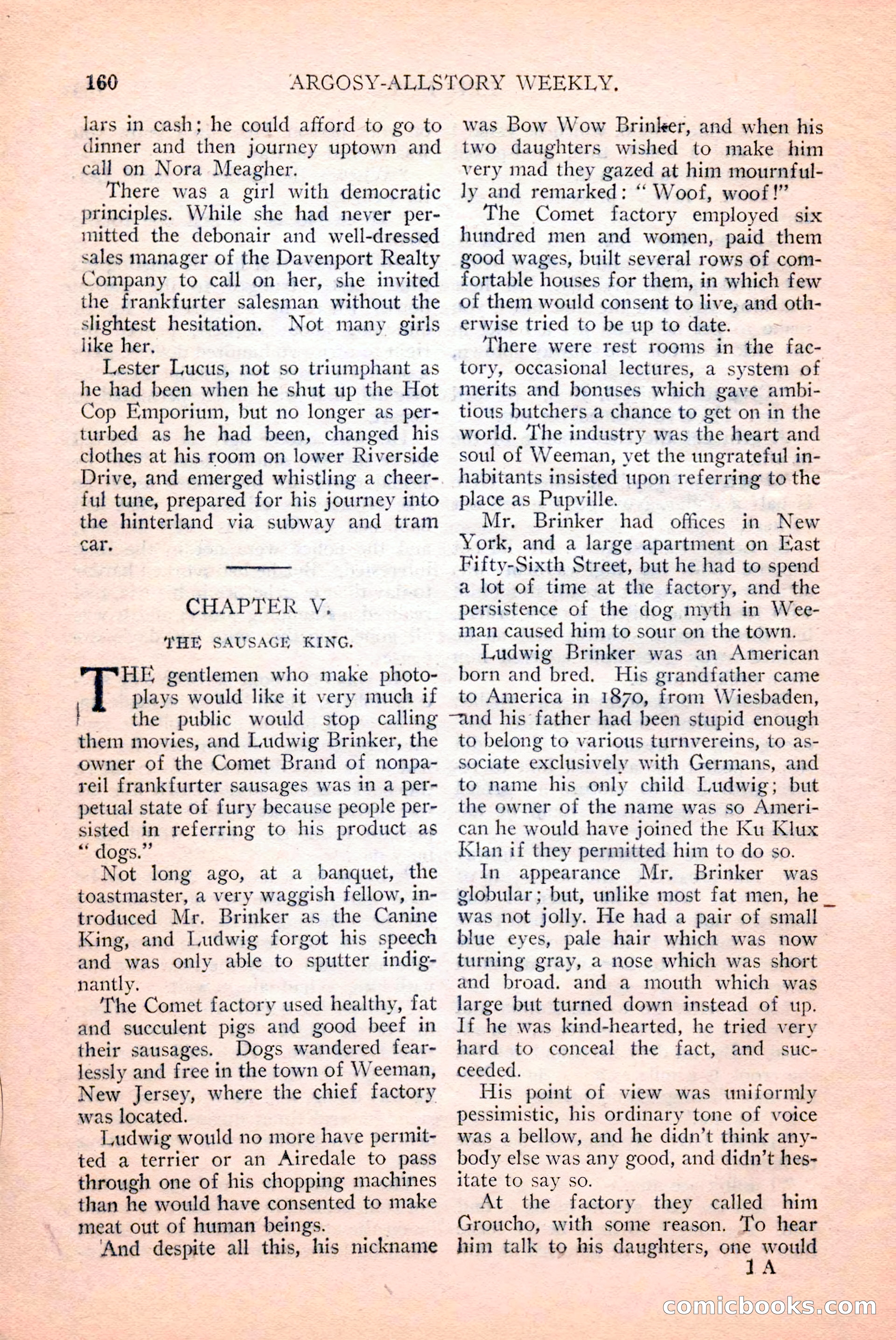
A restored page from Pulp Fiction, 1928. Page through the whole issue in the reader above.
📄 Transcribed text from this page (OCR, searchable)
Machine-transcribed from the original scan — historical spelling and the odd misread are preserved.
160 lars in cash; he could afford to go to dinner and then journey uptown and call on Nora Meagher. There was a girl with democratic principles. While she had never per- mitted the debonair and well-dressed sales manager of the Davenport Realty Company to call on her, she invited the frankfurter salesman without the slightest hesitation. Not many girls like her, Lester Lucus, not so triumphant as he had been when he shut up the Hot Cop Emporium, but no longer as per- turbed as he had been, changed his clothes at his room on lower Riverside Drive, and emerged whistling a cheer- ful tune, prepared for his journey into the hinterland via subway and tram car, CHAPTER V, YHE SAUSAGE KING. HE gentlemen who make photo- plays would like it very much if the public would stop calling them movies, and Ludwig Brinker, the owner of the Comet Brand of nonpa- reil frankfurter sausages was in a per- petual state of fury because people per- sisted in referring to his product as ae dogs.” Not long ago, at a banquet, the toastmaster, a very waggish fellow, in- troduced Mr. Brinker as the Canine King, and Ludwig forgot his speech and was only able to sputter indig- nantly, The Comet factory used healthy, fat and succulent pigs and good beef in their sausages. Dogs wandered fear- lessly and free in the town of Weeman, New Jersey, where the chief factory was located. Ludwig would no more have permit- ted a terrier or an Airedale to pass through one of his chopping machines than he would have consented to make meat out of human beings. 7 ‘And despite all this, his nickname ARGOSY-ALLSTORY WEEKLY. was Bow Wow Brinleer, and when his two daughters wished to make him very mad they gazed at him mournful- ly and remarked: “‘ Woof, woof!” The Comet factory employed six hundred men and women, paid them good wages, built several rows of com- fortable houses for them, in which few of them would consent to live, and oth- erwise tried to be up to date. There were rest rooms in the fac- tory, occasional lectures, a system of merits and bonuses which gave ambi- tious butchers a chance to get on in the world. The industry was the heart and soul of Weeman, yet the ungrateful in- habitants insisted upon referring to the place as Pupville. Mr. Brinker had offices in New York, and a large apartment on East Fifty-Sixth Street, but he had to spend a lot of time at the factory, and the persistence of the dog myth in Wee- man caused him to sour on the town. Ludwig Brinker was an American born and bred. His grandfather came to America in 1870, from Wiesbaden, “and his father had been stupid enough to belong to various turnvereins, to as- sociate exclusively with Germans, and to name his only child Ludwig; but the owner of the name was so Ameri- can he would have joined the Ku Klux Klan if they permitted him to do so. In appearance Mr. Brinker was globular; but, unlike most fat men, he _ was not jolly. He had a pair of small blue eyes, pale hair which was now turning gray, a nose which was short and broad. and a mouth which was large but turned down instead of up. If he was kind-hearted, he tried very hard to conceal the fact, and suc- ceeded. His point of view was uniformly pessimistic, his ordinary tone of voice was a bellow, and he didn’t think any- body else was any good, and didn’t hes- itate to say so. At the factory they called him Groucho, with some reason. To hear him talk to his daughters, me would comichbooks (E@)