
Pulp Fiction, 1928 · page 28 of 160
Argosy All-Story Weekly, April 7, 1928 — page 28: what you’re looking at
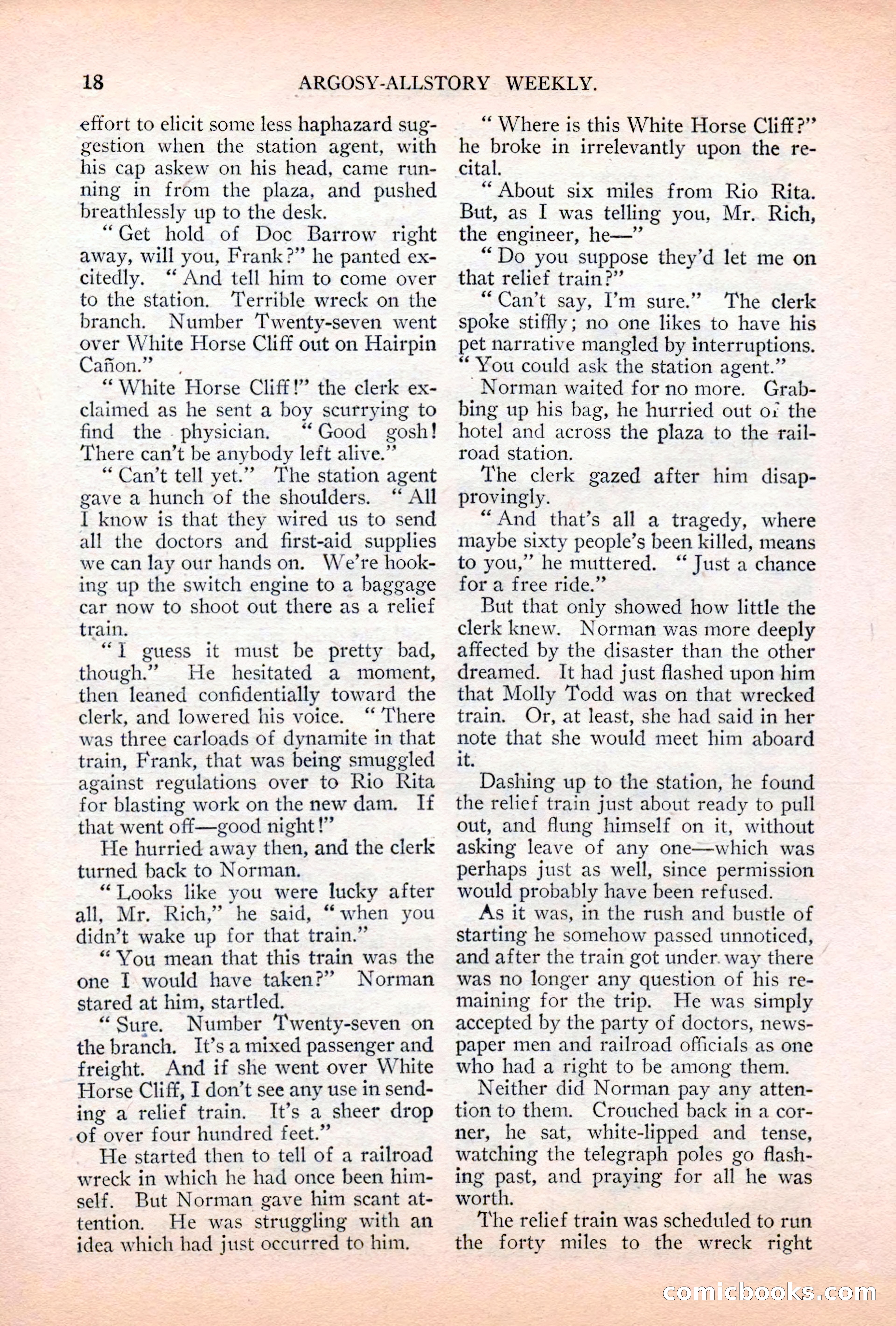
A restored page from Pulp Fiction, 1928. Page through the whole issue in the reader above.
📄 Transcribed text from this page (OCR, searchable)
Machine-transcribed from the original scan — historical spelling and the odd misread are preserved.
18 effort to elicit some less haphazard sug- gestion when the station agent, with his cap askew on his head, came run- ning in from the plaza, and pushed breathlessly up to the desk. “Get hold of Doc Barrow right away, will you, Frank?” he panted ex- citedly. “ And tell him to come over to the station. Terrible wreck on the branch. Number Twenty-seven went over White Horse Cliff out on Hairpin Capen. “White Horse Cliff!” the clerk ex- claimed as he sent a boy scurrying to find the physician. “Good gosh! There can’t be anybody left alive.” “Can't tell yet.” The station agent gave a hunch of the shoulders. “ All I know is that they wired us to send all the doctors and first-aid supplies we can lay our hands on. We're hook- ing up the switch engine to a baggage car now to shoot out there as a relief train. “YT gttess it must be pretty bad, though.” He hesitated a moment, then leaned confidentially toward the clerk, and lowered his voice. “ There was three carloads of dynamite in that train, Frank, that was being smuggled against regulations over to Rio Rita for blasting work on the new dam. If that went off—good night!’ 3 He hurried away then, and the clerk turned back to Norman. “Tooks like you were lucky after all, Mr. Rich,” he said, “when you didn’t wake up for that train.” “Vou mean that this train was the one I would have taken?” Norman stared at him, startled. “Sure. Number Twenty-seven on the branch. It’s a mixed passenger and freight. And if she went over White Horse Cliff, I don’t see any use in send- ing a relief train. It’s a sheer drop of over four hundred feet.” He started then to tell of a railroad wreck in which he had once been him- self. But Norman gave him scant at- tention. He was struggling with an idea which had just occurred to him. ARGOSY-ALLSTORY WEEKLY. “Where is this White Horse Cliff?” he broke in irrelevantly upon the re- cital. “About six miles from Rio Rita. But, as I was telling you, Mr. Rich, the engineer, he—” | “Do you suppose they’d let me on that relief train?” “Can’t say, I’m sure.” The clerk spoke stiffly; no one likes to have his pet narrative mangled by interruptions. “You could ask the station agent.” Norman waited for no more. Grab- bing up his bag, he hurried out or the hotel and across the plaza to the rail- road station. The clerk gazed after him disap- provingly. “And that’s all a tragedy, where maybe sixty people’s been killed, means to you,’ he muttered. “‘ Just a chance for a free ride.” But that only showed how little the clerk knew. Norman was more deeply affected by the disaster than the other dreamed. It had just flashed upon him that Molly Todd was on that wrecked train. Or, at least, she had said in her note that she would meet him aboard it. Dashing up to the station, he found the relief train just about ready to pull out, and flung himself on it, without asking leave of any one—which was perhaps just as well, since permission would probably have been refused. As it was, in the rush and bustle of starting he somehow passed unnoticed, and after the train got under. way there was no longer any question of his re- maining for the trip. He was simply accepted by the party of doctors, news- paper men and railroad officials as one who had a right to be among them. Neither did Norman pay any atten- tion to them. Crouched back in a cor- ner, he sat, white-lipped and _ tense, watching the telegraph poles go flash- ing past, and praying for all he was worth. The relief train was scheduled to run the forty miles to the wreck right COPMIGLOOOKS (E©)