
Pulp Fiction, 1928 · page 27 of 160
Argosy All-Story Weekly, April 7, 1928 — page 27: what you’re looking at
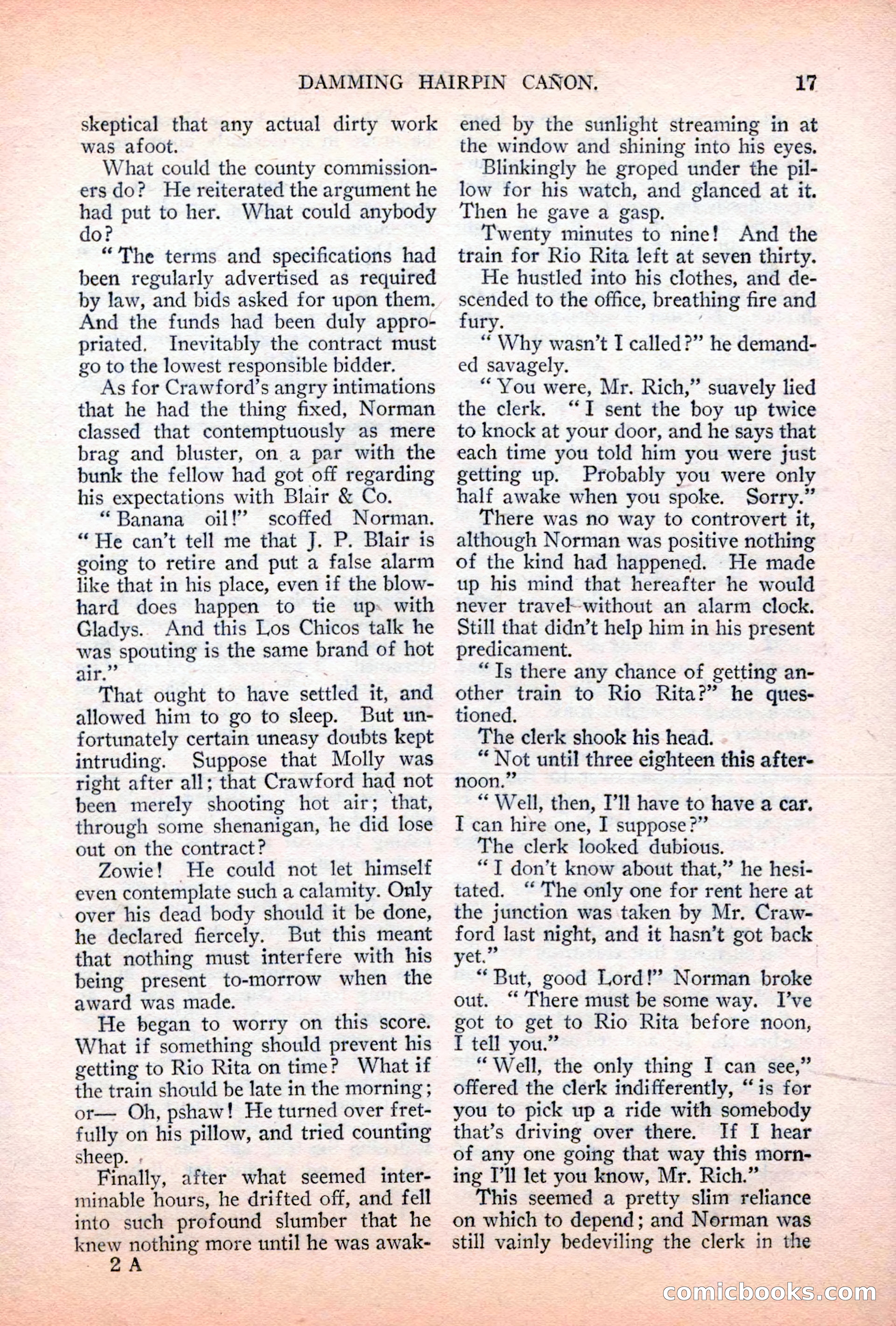
A restored page from Pulp Fiction, 1928. Page through the whole issue in the reader above.
📄 Transcribed text from this page (OCR, searchable)
Machine-transcribed from the original scan — historical spelling and the odd misread are preserved.
DAMMING HAIRPIN CANON. skeptical that any actual dirty work was afoot. What could the county commission- ers do? He reiterated the argument he had put to her. What could anybody do? “The terms and specifications had been regularly advertised as required by law, and bids asked for upon them. And the funds had been duly appro- priated. Inevitably the contract must go to the lowest responsible bidder. As for Crawford’s angry intimations that he had the thing fixed, Norman classed that contemptuously as mere brag and bluster, on a par with the bunk the fellow had got off regarding his expectations with Blair & Co. “Banana oil!’ scoffed Norman. “ He can’t tell me that J. P. Blair is going to retire and put a false alarm like that in his place, even if the blow- hard does happen to tie up» with Gladys.. And this Los Chicos talk he was spouting is the same brand of hot 2 we —— That ought to have settled it, and allowed him to go to sleep. But un- fortunately certain uneasy doubts kept intruding. Suppose that Molly was right after all; that Crawford had not been merely shooting hot air; that, through some shenanigan, he did lose out on the contract? Zowie! He could not let himself even contemplate such a calamity. Only over his dead body should it be done, he declared fiercely. But this meant that nothing must interfere with his being present to-morrow when the award was made. He began to worry on this score. What if something should prevent his getting to Rio Rita on time? What if the train should be late in the morning ; or— Oh, pshaw! He turned over fret- fully on his pillow, and tried counting sheep. ; Finally, after what seemed inter- minable hours, he drifted off, and fell into such profound slumber that he knew nothing more until he was awak- - QA 17 ened by the sunlight streaming in at the window and shining into his eyes. Blinkingly he groped under the pil- low for his watch, and glanced at it. Then he gave a gasp. Twenty minutes to nine! And the train for Rio Rita left at seven thirty. He hustled into his clothes, and de- scended to the office, breathing fire and fury. | “ Why wasn’t I called?” he demand- ed savagely. “You were, Mr. Rich,” suavely lied the clerk. “I sent the boy up twice to knock at your door, and he says that each time you told him you were just getting up. Probably you were only half awake when you spoke. Sorry.” There was no way to controvert it, although Norman was positive nothing of the kind had happened. He made up his mind that hereafter he would never travel-without an alarm clock. Still that didn’t help him in his present predicament. “Ts there any chance of getting an- other train to Rio Rita?” he ques- tioned. The clerk shook his head. “* Not until three eighteen this after- noon.” “Well, then, I'll have to have a car. T can hire one, I suppose?” The clerk looked dubious. *T don’t know about that,” he hesi- tated. “ The only one for rent here at the junction was taken by Mr. Craw- ford last night, and it hasn’t got back et.” “But, good Lord!” Norman broke out. “There must be some way. I’ve got to get to Rio Rita before noon, T tell you.” “Well, the only thing I can see,” offered the clerk indifferently, “‘is for you to pick up a ride with somebody that’s driving over there. If I hear of any one going that way this morn- ing [ll let you know, Mr. Rich.” This seemed a pretty slim reliance on which to depend; and Norman was still vainly bedeviling the clerk in the COPMIC OOO <S (E@)