
Pulp Fiction, 1928 · page 104 of 164
Argosy All-Story Weekly, February 18, 1928 — page 104: what you’re looking at
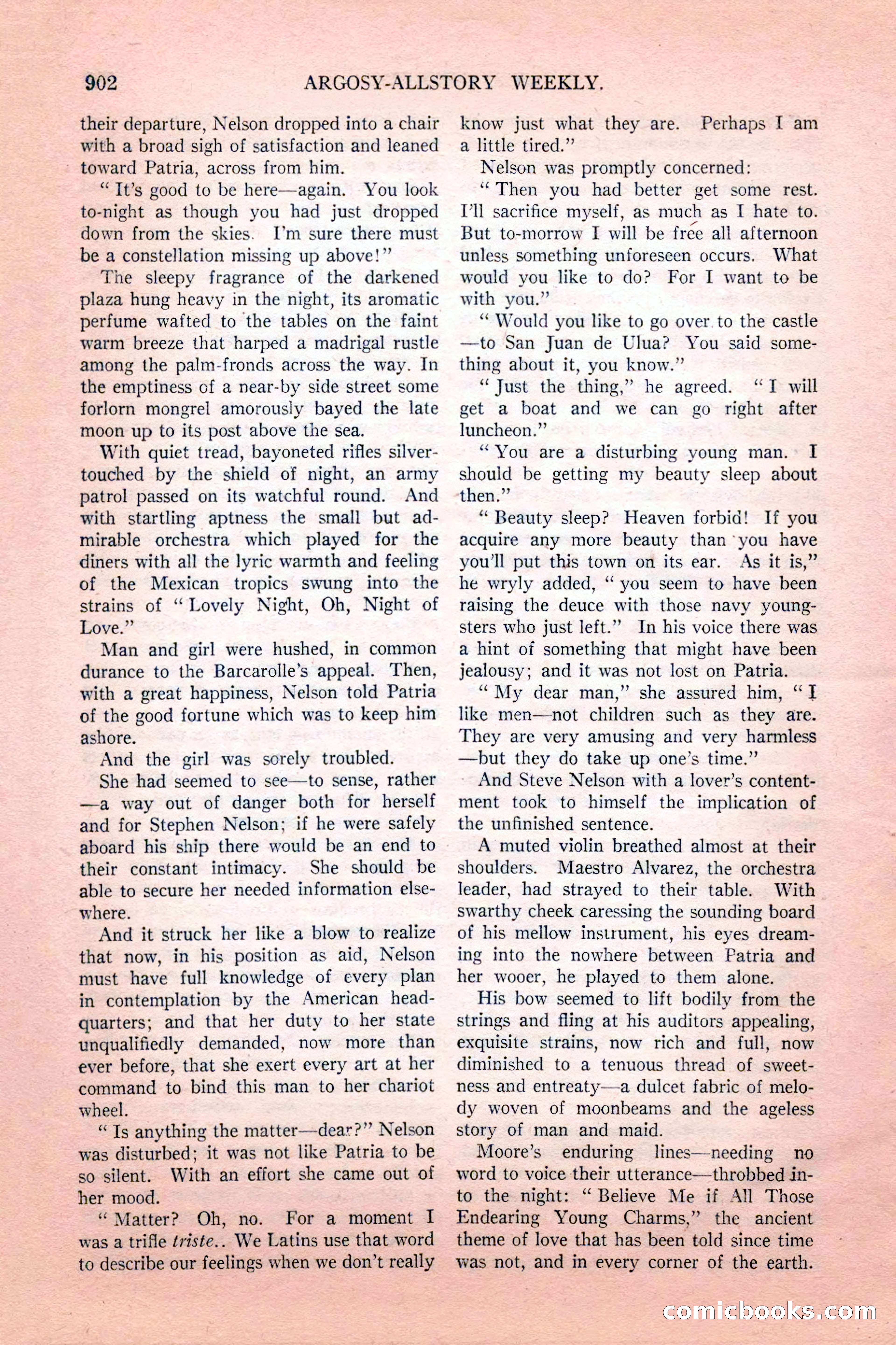
A restored page from Pulp Fiction, 1928. Page through the whole issue in the reader above.
📄 Transcribed text from this page (OCR, searchable)
Machine-transcribed from the original scan — historical spelling and the odd misread are preserved.
902 their departure, Nelson dropped into a chair with a broad sigh of satisfaction and leaned - toward Patria, across from him. “It’s good to be here—again. You look to-night as though you had just dropped down from the skies. I’m sure there must be a constellation missing up above!” The sleepy fragrance of the darkened plaza hung heavy in the night, its aromatic perfume wafted to the tables on the faint warm breeze that harped a madrigal rustle among the palm-fronds across the way. In the emptiness of a near-by side street some forlorn mongrel amorously bayed the late moon up to its post above the sea. With quiet tread, bayoneted rifles silver- touched by the shield of night, an army patrol passed on its watchful round. And with startling aptness the small but ad- mirable orchestra which played for the diners with all the lyric warmth and feeling of the Mexican tropics swung into the strains of “ Lovely Night, Oh, Night of Love.” Man and girl were hushed, in common durance to the Barcarolle’s appeal. Then, with a great happiness, Nelson told Patria of the good fortune which was to keep him ashore. And the girl was sorely troubled. She had seemed to see—to sense, rather —a way out of danger both for herself and for Stephen Nelson; if he were safely aboard his ship there would be an end to their constant intimacy. She should be able to secure her needed information else- where. And it struck her like a blow to realize that now, in his position as aid, Nelson must have full knowledge of every plan in contemplation by the American head- quarters; and that her duty to her state unqualifiedly demanded, now more than ever before, that she exert every art at her command to bind this man to her chariot wheel. “Ts anything the matter—dear?” Nelson was disturbed; it was not like Patria to be so silent. With an effort she came out of her mood. “ Matter? Oh, no. For a moment I was a trifle triste... We Latins use that word to describe our feelings when we don’t really ARGOSY-ALLSTORY WEEKLY. know just what they are. Perhaps I am a little tired.” Nelson was promptly concerned: ‘“Then you had better get some rest. I’ll sacrifice myself, as much as I hate to. But to-morrow I will be free all afternoon unless something unforeseen occurs. What would you like to do? For I want to be with you.” “Would you like to go over. to the castle —to San Juan de Ulua? You said some- thing about it, you know.” “Just the thing,” he agreed. “TI will get a boat and we can go right after luncheon.’ “You are a disturbing young man. I should be getting my beauty sleep about then.” “Beauty sleep? Heaven forbid! If you acquire any more beauty than you have you'll put this town on its ear. As it is,” he wryly added, “ you seem to have been raising the deuce with those navy young- sters who just left.”” In his voice there was a hint of something that might have been jealousy; and it was not lost on Patria. ‘““My dear man,” she assured him, “ f like men—not children such as they are. They are very amusing and very harmless —hbut they do take up one’s time.” And Steve Nelson with a lover’s content- ment took to himself the implication of the unfinished sentence. A muted violin breathed almost at their shoulders. Maestro Alvarez, the orchestra leader, had strayed to their table. With swarthy cheek caressing the sounding board of his mellow instrument, his eyes dream- ing into the nowhere between Patria and her wooer, he played to them alone. His bow seemed to lift bodily from the strings and fling at his auditors appealing, exquisite strains, now rich and full, now diminished to a tenuous thread of sweet- ness and entreaty—a dulcet fabric of melo- dy woven of moonbeams and the ageless story of man and maid. Moore’s enduring lines—needing no word to voice their utterance—throbbed in- to the night: “ Believe Me if All Those Endearing Young Charms,” the ancient theme of love that has been told since time was not, and in every corner of the earth. Gomichooks (E@)