
Pulp Fiction, 1928 · page 103 of 164
Argosy All-Story Weekly, February 18, 1928 — page 103: what you’re looking at
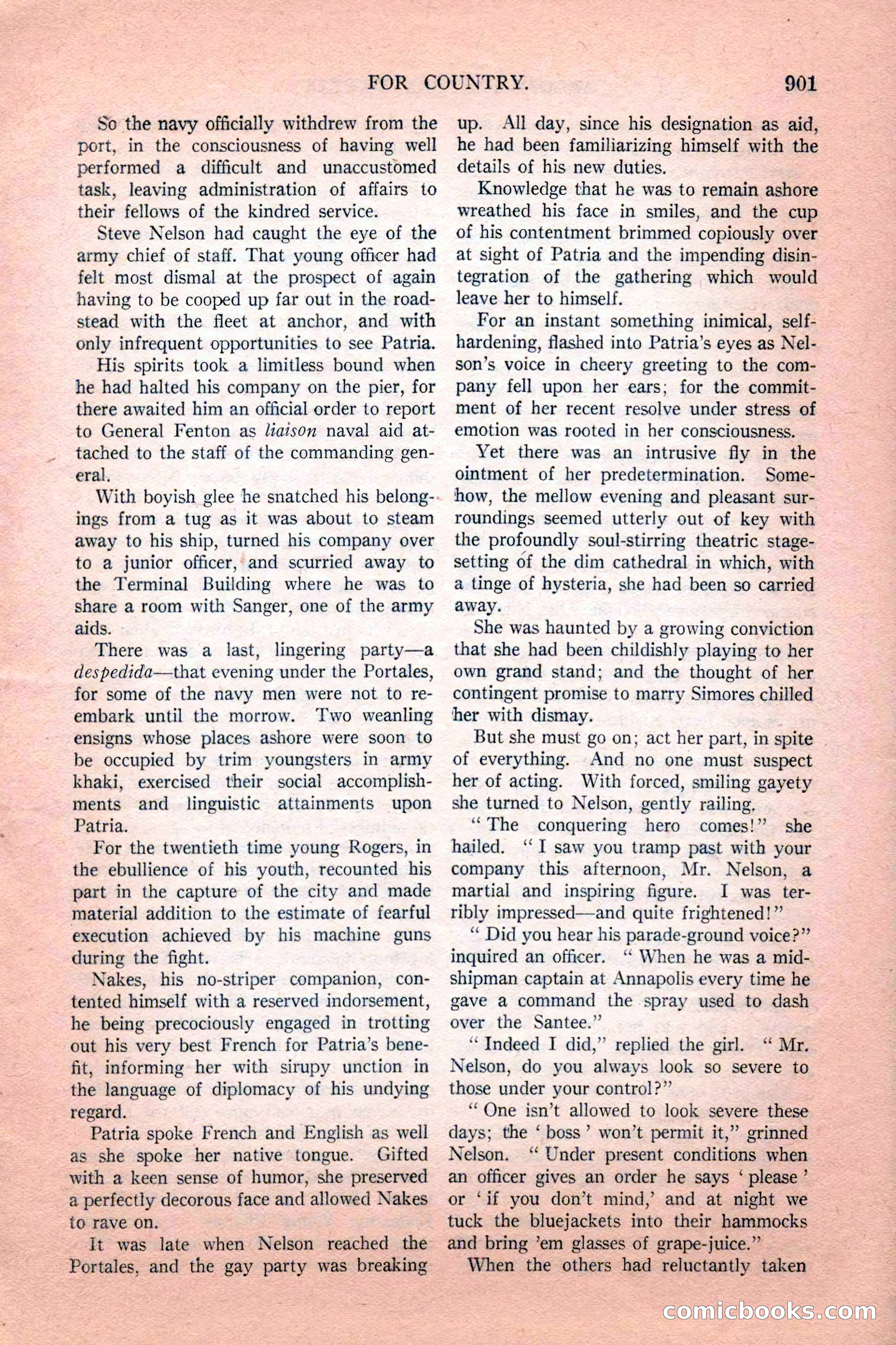
A restored page from Pulp Fiction, 1928. Page through the whole issue in the reader above.
📄 Transcribed text from this page (OCR, searchable)
Machine-transcribed from the original scan — historical spelling and the odd misread are preserved.
FOR COUNTRY. So the navy officially withdrew from the port, in the consciousness of having well performed a difficult and unaccustomed task, leaving administration of affairs to their fellows of the kindred service. Steve Nelson had caught the eye of the army chief of staff. That young officer had felt most dismal at the prospect of again having to be cooped up far out in the road- stead with the fleet at anchor, and with only infrequent opportunities to see Patria. His spirits took a limitless bound when he had halted his company on the pier, for there awaited him an official order to report to General Fenton as liaison naval aid at- tached to the staff of the commanding gen- eral. With boyish glee he snatched his belong- ings from a tug as it was about to steam away to his ship, turned his company over to a junior officer, and scurried away to the Terminal Building where he was to share a room with Sanger, one of the army aids. There was a last, lingering party—a des pedida—that evening under the Portales, for some of the navy men were not to re- embark until the morrow. Two weanling ensigns whose places ashore were soon to be occupied by trim youngsters in army khaki, exercised their social accomplish- ments and linguistic attainments upon Patria. For the twentieth time young Rogers, in the ebullience of his youth, recounted his part in the capture of the city and made material addition to the estimate of fearful execution achieved by his machine guns during the fight. Nakes, his no-striper companion, con- tented himself with a reserved indorsement, he being precociously engaged in trotting out his very best French for Patria’s bene- fit, informing her with sirupy unction in the language of diplomacy of his undying regard. Patria spoke French and English as well as she spoke her native tongue. Gifted with a keen sense of humor, she preserved a perfectly decorous face and allowed Nakes io rave on. It was late when Nelson reached the Portales, and the gay party was breaking 901 up. All day, since his designation as aid, he had been familiarizing himself with the details of his new duties. Knowledge that he was to remain ashore wreathed his face in smiles, and the cup of his contentment brimmed copiously over at sight of Patria and the impending disin- tegration of the gathering which would leave her to himself. For an instant something inimical, self- hardening, flashed into Patria’s eyes as Nel- son’s voice in cheery greeting to the com- pany fell upon her ears; for the commit- ment of her recent resolve under stress of emotion was rooted in her consciousness. Yet there was an intrusive fly in the ointment of her predetermination. Some- how, the mellow evening and pleasant sur- roundings seemed utterly out of key with the profoundly soul-stirring theatric stage- setting of the dim cathedral in which, with a tinge of hysteria, she had been so carried away. She was haunted by a growing conviction that she had been childishly playing to her own grand stand; and the thought of her contingent promise to marry Simores chilled her with dismay. But she must go on; act her part, in spite ~ of everything. And no one must suspect her of acting. With forced, smiling gayety she turned to Nelson, gently railing, | ‘The conquering hero comes!” she hailed. ‘I saw you tramp past with your company this afternoon, Mr. Nelson, a martial and inspiring figure. I was ter- ribly impressed—and quite frightened!” “Did you hear his parade-ground voice?” inquired an officer. ‘“‘ When he was a mid- shipman captain at Annapolis every time he gave a command the spray used to dash over the Santee.” } ‘Indeed I did,” replied the girl. ‘ Mr. Nelson, do you always look so severe to those under your control?” ‘One isn’t allowed to look severe these days; the ‘ boss’ won’t permit it,” grinned Nelson. ‘“ Under present conditions when an officer gives an order he says ‘ please ’ or ‘if you don’t mind,’ and at night we tuck the bluejackets into their hammocks and bring ’em glasses of grape-juice.” When the others had reluctantly taken .OOKS (ECO) AME (EO)