
Pulp Fiction, 1927 · page 76 of 180
Argosy All-Story Weekly, Vol. 189, No. 4 — page 76: what you’re looking at
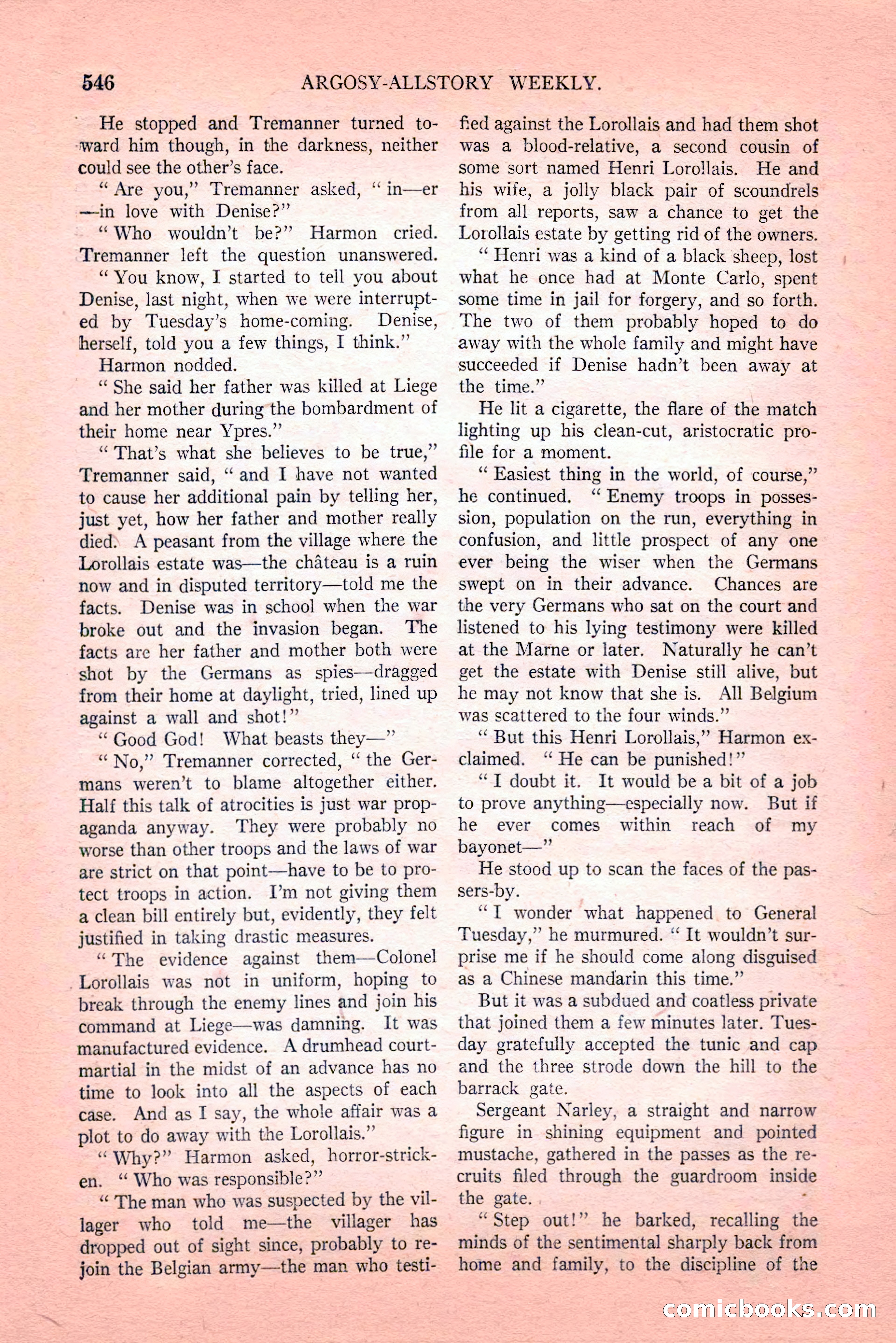
A restored page from Pulp Fiction, 1927. Page through the whole issue in the reader above.
📄 Transcribed text from this page (OCR, searchable)
Machine-transcribed from the original scan — historical spelling and the odd misread are preserved.
546 He stopped and Tremanner turned to- ‘ward him though, in the darkness, neither could see the other’s face. “Are you,” Tremanner asked, ‘“ in—er —in love with Denise?” “Who wouldn’t be?” Harmon cried. Tremanner left the question unanswered. “You know, I started to tell you about Denise, last night, when we were interrupt- ed by Tuesday’s home-coming. Denise, herself, told you a few things, I think.” Harmon nodded. ‘‘ She said her father was killed at Liege and her mother during the bombardment of their home near Ypres.”’ “That’s what she believes to be true,” Tremanner said, “‘ and I have not wanted to cause her additional pain by telling her, just yet, how her father and mother really died) A peasant from the village where the Lorollais estate was—the chateau is a ruin now and in disputed territory—told me the facts. Denise was in school when the war broke out and the invasion began. The facts are her father and mother both were shot by the Germans as spies—dragged from their home at daylight, tried, lined up against a wall and shot!” “Good God! What beasts they—”’ “No,” Tremanner corrected, “ the Ger- mans weren’t to blame altogether either. Half this talk of atrocities is just war prop- aganda anyway. They were probably no worse than other troops and the laws of war are strict on that point—have to be to pro- tect troops in action. I’m not giving them a clean bill entirely but, evidently, they felt justified in taking drastic measures. “The evidence against them—Colonel -Lorollais was not in uniform, hoping to break through the enemy lines and join his command at Liege—was damning. It was manufactured evidence. A drumhead court- martial in the midst of an advance has no time to look into all the aspects of each case. And as I say, the whole affair was a plot to do away with the Lorollais.” “Why?” Harmon asked, horror-strick- en. ‘ Who was responsible?” “‘ The man who was suspected by the vil- lager who told me—the villager has dropped out of sight since, probably to re- join the Belgian army—the man who testi- ARGOSY-ALLSTORY WEEKLY. fled against the Lorollais and had them shot was a blood-relative, a second cousin of some sort named Henri Lorollais. He and his wife, a jolly black pair of scoundrels from all reports, saw a chance to get the Lorollais estate by getting rid of the owners. ‘“ Henri was a kind of a black sheep, lost what he once had at Monte Carlo, spent some time in jail for forgery, and so forth. The two of them probably hoped to do away with the whole family and might have succeeded if Denise hadn’t been away at the time.” He lit a cigarette, the flare of the match lighting up his clean-cut, aristocratic pro- file for a moment. “Easiest thing in the world, of course,” he continued. ‘‘ Enemy troops in posses- sion, population on the run, everything in confusion, and little prospect of any one ever being the wiser when the Germans swept on in their advance. Chances are the very Germans who sat on the court and listened to his lying testimony were killed at the Marne or later. Naturally he can’t get the estate with Denise still alive, but he may not know that she is. All Belgium was scattered to the four winds.” ‘“ But this Henri Lorollais,” Harmon ex- claimed. ‘‘ He can be punished!” ‘““T doubt it. It would be a bit of a job to prove anything—especially now. But if he ever comes within reach of my bayonet—”’ He stood up to scan the faces of the pas- sers-by. “I wonder what happened to General Tuesday,” he murmured. “‘ It wouldn’t sur- prise me if he should come along disguised as a Chinese mandarin this time.” But it was a subdued and coatless private that joined them a few minutes later. Tues- day gratefully accepted the tunic and cap and the three strode down the hill to the barrack gate. Sergeant Narley, a straight and narrow figure in shining equipment and pointed mustache, gathered in the passes as the re- cruits filed through the guardroom inside the gate. ; “Step out!” he barked, recalling the minds of the sentimental sharply back from home and family, to the discipline of the (e(0) .OOKS AAI (E@)