
Pulp Fiction, 1927 · page 131 of 180
Argosy All-Story Weekly, Vol. 189, No. 4 — page 131: what you’re looking at
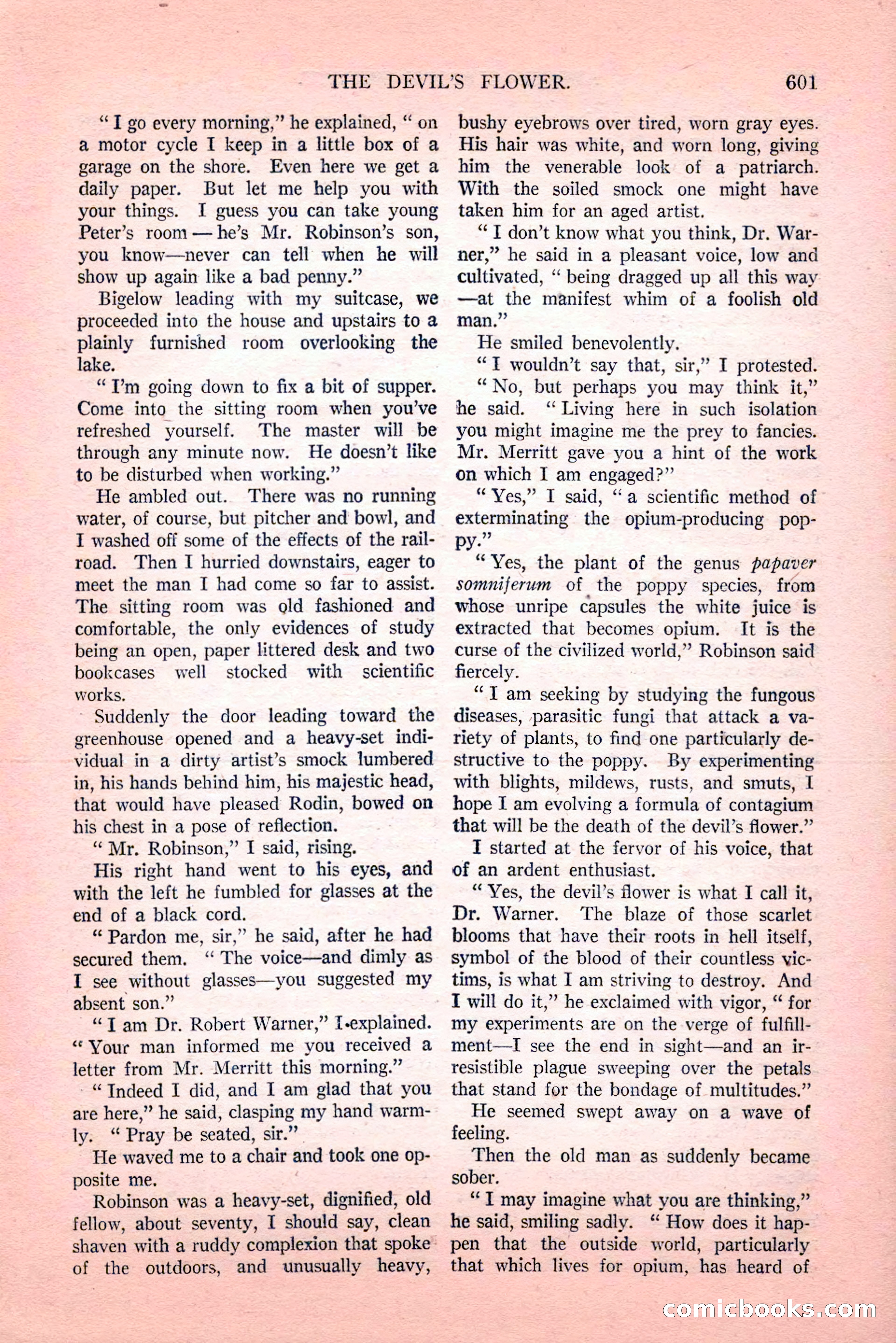
A restored page from Pulp Fiction, 1927. Page through the whole issue in the reader above.
📄 Transcribed text from this page (OCR, searchable)
Machine-transcribed from the original scan — historical spelling and the odd misread are preserved.
THE DEVIL’S “T 90 every morning,” he explained, “ on a motor cycle I keep in a little box of a garage on the shore. Even here we get a daily paper. But let me help you with your things. I guess you can take young Peter’s room — he’s Mr. Robinson’s son, you know—never can tell when he will show up again like a bad penny.” Bigelow leading with my suitcase, we proceeded into the house and upstairs to a plainly furnished room overlooking the lake. “T’m going down to fix a bit of supper. Come into the sitting room when you’ve refreshed yourself. The master will be through any minute now. He doesn’t like to be disturbed when working.” He ambled out. There was no running water, of course, but pitcher and bowl, and I washed off some of the effects of the rail- road. Then I hurried downstairs, eager to meet the man I had come so far to assist. The sitting room was gld fashioned and comfortable, the only evidences of study being an open, paper littered desk and two bookcases well stocked with scientific works. ~ Suddenly the door leading toward the greenhouse opened and a heavy-set indi- vidual in a dirty artist’s smock lumbered in, his hands behind him, his majestic head, that would have pleased Rodin, bowed on his chest in a pose of reflection. “ Mr. Robinson,” I said, rising. His right hand went to his eyes, and with the left he fumbled for glasses at the end of a black cord. “ Pardon me, sir,” he said, after he had secured them. ‘‘ The voice—and dimly as I see without glasses—you suggested my absent son.” “Tam Dr. Robert Warner,” I-explained. “Vour man informed me you received a letter from Mr. Merritt this morning.” -“Tndeed I did, and I am glad that you are here,” he said, clasping my hand warm- ly. ‘“ Pray be seated, sir.” He waved me to a chair and took one op- posite me. 3 Robinson was a heavy-set, dignified, old fellow, about seventy, I should say, clean shaven with a ruddy complexion that spoke of the outdoors, and unusually heavy, FLOWER. 601 bushy eyebrows over tired, worn gray eyes. His hair was white, and worn long, giving him the venerable look of a patriarch. With the soiled smock one might have taken him for an aged artist. “‘T don’t know what you think, Dr. War- ner,” he said in a pleasant voice, low and cultivated, “ being dragged up all this way —at the manifest whim of a foolish old man.” He smiled benevolently. “1 wouldn’t say that, sir,” I protested. “No, but perhaps you may think it,” he said. ‘“ Living here in such isolation you might imagine me the prey to fancies. Mr. Merritt gave you a hint of the work on which I am engaged?” “Yes,” I said, “a scientific method of exterminating the opium-producing pop- 93 “Yes, the plant of the genus papaver somniferum of the poppy species, from whose unripe capsules the white juice is extracted that becomes opium. It is the curse of the civilized world,” Robinson said fiercely. ““T am seeking by studying the fungous diseases, parasitic fungi that attack a va- riety of plants, to find one particularly de- structive to the poppy. By experimenting with blights, mildews, rusts, and smuts, I hope I am evolving a formula of contagium that will be the death of the devil’s flower.” I started at the fervor of his voice, that of an ardent enthusiast. “Yes, the devil’s flower is what I call it, Dr. Warner. The blaze of those scarlet blooms that have their roots in hell itself, symbol of the blood of their countless vic- tims, is what I am striving to destroy. And I will do it,” he exclaimed with vigor, “ for my experiments are on the verge of fulfill- ment—TI see the end in sight—and an ir- resistible plague sweeping over the petals that stand for the bondage of multitudes.” He seemed swept away on a wave of feeling. Then the old man as suddenly became sober. “‘T may imagine what you are thinking,” he said, smiling sadly. ‘“ How does it hap- pen that the outside world, particularly that which lives for opium, has heard of Gomichbooks (E@