
Pulp Fiction, 1927 · page 130 of 180
Argosy All-Story Weekly, Vol. 189, No. 4 — page 130: what you’re looking at
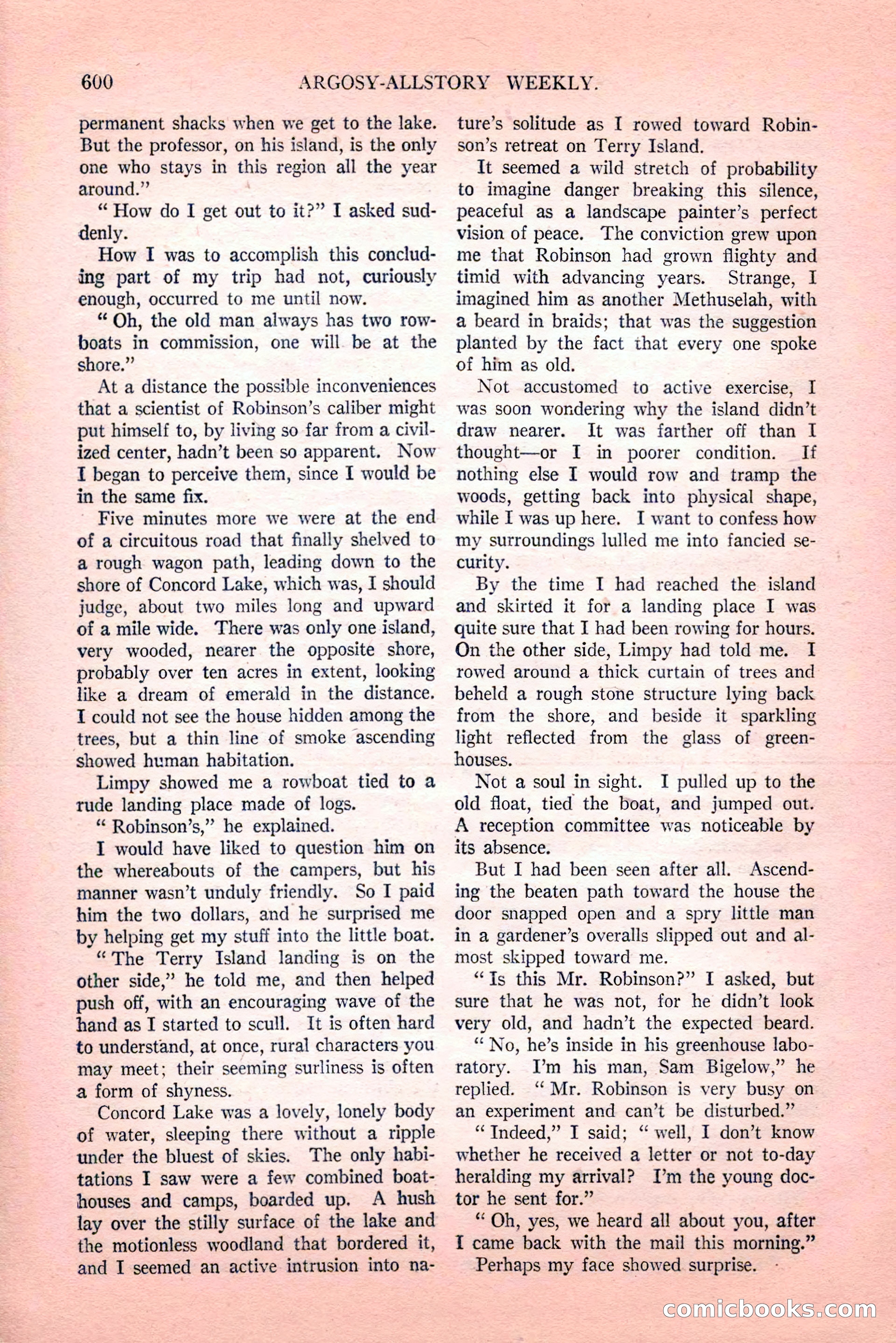
A restored page from Pulp Fiction, 1927. Page through the whole issue in the reader above.
📄 Transcribed text from this page (OCR, searchable)
Machine-transcribed from the original scan — historical spelling and the odd misread are preserved.
600 permanent shacks when we get to the lake. But the professor, on his island, is the only one who stays in this region all the year around.” “ How do I get out to it?” I asked sud- denly. How I was to accomplish this conclud- ing part of my trip had not, curiously enough, occurred to me until now. “Oh, the old man always has two row- boats in commission, one will be at the shore.” At a distance the possible inconveniences that a scientist of Robinson’s caliber might put himself to, by living so far from a civil- ized center, hadn’t been so apparent. Now I began to perceive them, since I would be in the same fix. Five minutes more we were at the end of a circuitous road that finally shelved to a rough wagon path, leading down to the shore of Concord Lake, which was, I should judge, about two miles long and upward of a mile wide. There was only one island, very wooded, nearer the opposite shore, probably over ten acres in extent, looking like a dream of emerald in the distance. T could not see the house hidden among the trees, but a thin line of smoke ascending showed human habitation. Limpy showed me a rowboat tied to a tude landing place made of logs. * Robinson’s,” he explained. I would have liked to question him on the whereabouts of the campers, but his manner wasn’t unduly friendly. So I paid him the two dollars, and he surprised me by helping get my stuff into the little boat. “The Terry Island landing is on the other side,” he told me, and then helped push off, with an encouraging wave of the hand as I started to scull. It is often hard to understand, at once, rural characters you may meet; their seeming surliness is often a form of shyness. Concord Lake was a lovely, lonely body of water, sleeping there without a ripple under the bluest of skies. The only habi- tations I saw were a few combined boat- houses and camps, boarded up. A hush lay over the stilly surface of the lake and the motionless woodland that bordered it, and I seemed an active intrusion into na- ARGOSY-ALLSTORY WEEKLY. ture’s solitude as I rowed toward Robin- son’s retreat on Terry Island. It seemed a wild stretch of probability to imagine danger breaking this silence, peaceful as a landscape painter’s perfect vision of peace. The conviction grew upon me that Robinson had grown flighty and timid with advancing years. Strange, I imagined him as another Methuselah, with a beard in braids; that was the suggestion planted by the fact that every one spoke of him as old. Not accustomed to active exercise, I was soon wondering why the island didn’t draw nearer. It was farther off than I thought—or I in poorer condition. If nothing else I would row and tramp the woods, getting back into physical shape, while I was up here. I want to confess how my surroundings lulled me into fancied se- curity. By the time I had reached the island and skirted it for a landing place I was quite sure that I had been rowing for hours. On the other side, Limpy had told me. I rowed around a thick curtain of trees and beheld a rough stone structure lying back from the shore, and beside it sparkling light reflected from the glass of green- houses. Not a soul in sight. I pulled up to the old float, tied the boat, and jumped out. A reception committee was noticeable by its absence. But I had been seen after all. Ascend- ing the beaten path toward the house the door snapped open and a spry little man in a gardener’s overalls slipped out and al- most skipped toward me. “Ts this Mr. Robinson?” I asked, but sure that he was not, for he didn’t look very old, and hadn’t the expected beard. “No, he’s inside in his greenhouse labo- ratory. I’m his man, Sam Bigelow,” he replied. ‘“‘ Mr. Robinson is very busy on an experiment and can’t be disturbed.” “‘ Indeed,” I said; “ well, I don’t know whether he received a letter or not to-day heralding my arrival? I’m the young doc- tor he sent for.” “Oh, yes, we heard all about you, after I came back with the mail this morning.” Perhaps my face showed surprise. Gomichbooks (E@)