
Pulp Fiction, 1927 · page 55 of 168
Argosy All-Story Weekly, February 12, 1927 — page 55: what you’re looking at
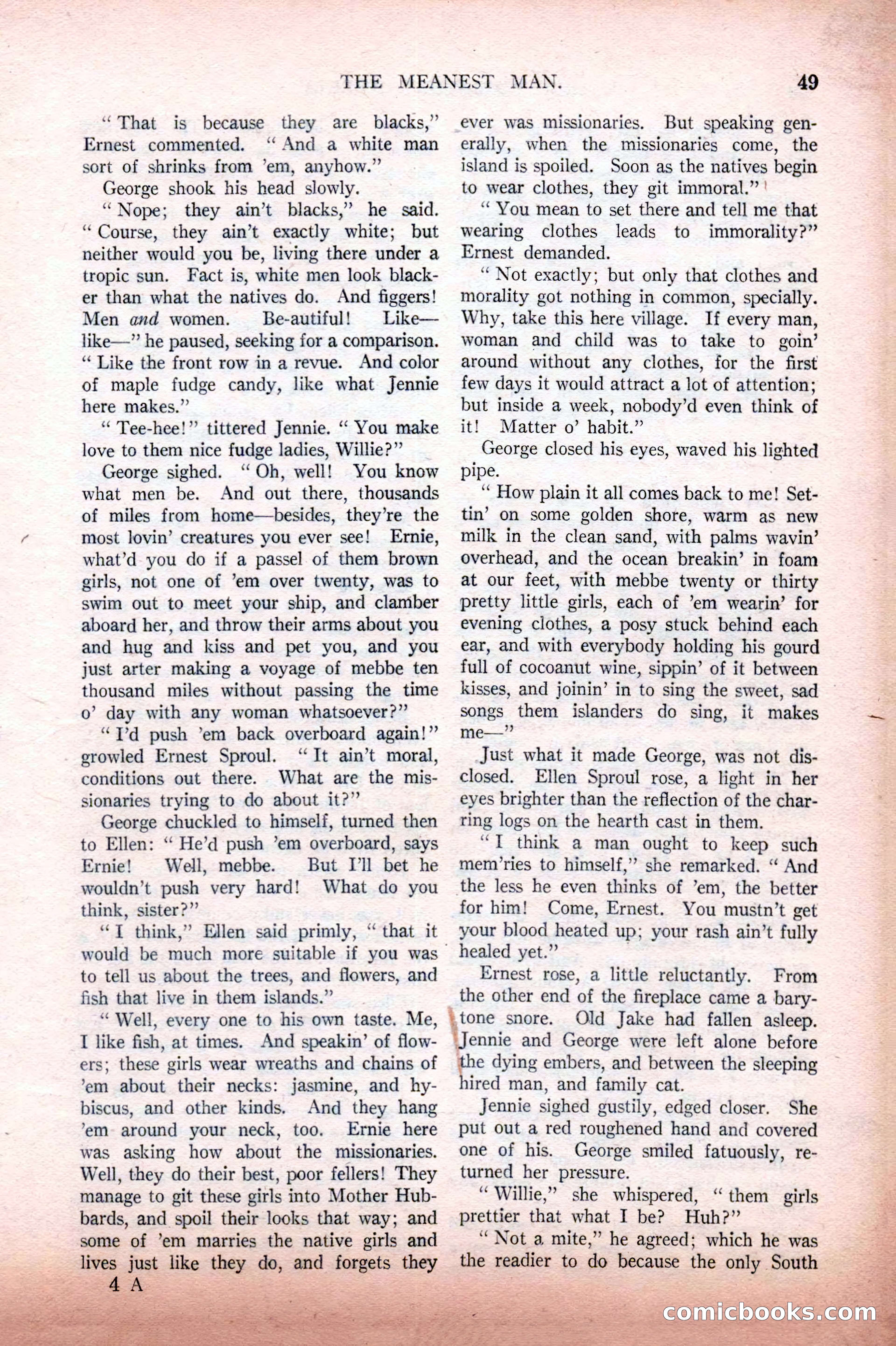
A restored page from Pulp Fiction, 1927. Page through the whole issue in the reader above.
📄 Transcribed text from this page (OCR, searchable)
Machine-transcribed from the original scan — historical spelling and the odd misread are preserved.
THE MEANEST MAN. 49 “That is because they are blacks,” Ernest commented. ‘‘ And a white man sort of shrinks from ’em, anyhow.” George shook his head slowly. “Nope; they ain’t blacks,” he said. “Course, they ain’t exactly white; but neither would you be, living there under a tropic sun. Fact is, white men look black- er than what the natives do. And figgers! Men and women. Be-autiful! Like— like—” he paused, seeking for a comparison. “Like the front row in a revue. And color of maple fudge candy, like what Jennie here makes.” ‘“‘ Tee-hee!”’ tittered Jennie. ‘‘ You make love to them nice fudge ladies, Willie?” George sighed. ‘Oh, well! You know what men be. And out there, thousands of miles from home—besides, they’re the most lovin’ creatures you ever see! Ernie, what’d you do if a passel of them brown girls, not one of ’em over twenty, was to swim out to meet your ship, and clamber aboard her, and throw their arms about you and hug and kiss and pet you, and you just arter making a voyage of mebbe ten thousand miles without passing the time 0’ day with any woman whatsoever?” “T’d push ’em back overboard again!” growled Ernest Sproul. “It ain’t moral, conditions out there. What are the mis- sionaries trying to do about it?” George chuckled to himself, turned then to Ellen: ‘“‘ He’d push ’em overboard, says Ernie! Well, mebbe. But Ill bet he wouldn’t push very hard! What do you think, sister?” “T think,” Ellen said primly, “ that it would be much more suitable if you was to tell us about the trees, and flowers, and fish that live in them islands.” ‘Well, every one to his own taste. Me, I like fish, at times. And speakin’ of flow- ers; these girls wear wreaths and chains of ’em about their necks: jasmine, and hy- biscus, and other kinds. And they hang ‘em around your neck, too. Ernie here was asking how about the missionaries. Well, they “do their best, poor fellers! They manage to git these girls into Mother Hub- bards, and spoil their looks that way; and some of ’em marries the native girls and Bed ela ike Sa do, seer Pa ae ever was missionaries. But speaking gen- erally, when the missionaries come, the island is spoiled. Soon as the natives begin to wear clothes, they git immoral.” ' “You mean to set there and tell me that wearing clothes leads to immorality?” Ernest demanded. ‘Not exactly; but only that clothes and morality got nothing in common, specially. Why, take this here village. If every man, woman and child was to take to goin’ around without any clothes, for the first few days it would attract a lot of attention; but inside a week, nobody’d even think of it! Matter o’ habit.” George closed his eyes, waved his lighted pipe. ‘* How plain it all comes back to me! Set- tin’ on some golden shore, warm as new milk in the clean sand, with palms wavin’ overhead, and the ocean breakin’ in foam at our feet, with mebbe twenty or thirty pretty little girls, each of ’em wearin’ for evening clothes, a posy stuck behind each ear, and with everybody holding his gourd full of cocoanut wine, sippin’ of it between kisses, and joinin’ in to sing the sweet, sad — songs them islanders do sing, it makes me—”’ Just what it made George, was not dis- closed. Ellen Sproul rose, a light in her eyes brighter than the reflection of the char- ring logs on the hearth cast in them. “TI think a man ought to keep such mem/ries to himself,’ she remarked. “ And the less he even thinks of ’em, the better for him! Come, Ernest. You mustn’t get your blood heated up; your rash ain’t fully healed yet.” Ernest rose, a little reluctantly. From the other end of the fireplace came a bary- tone snore. Old Jake had fallen asleep. ennie and George were left alone before he dying embers, and between the sleeping ired man, and family cat. Jennie sighed gustily, edged closer. She put out a red roughened hand and covered one of his. George smiled fatuously, re- turned her pressure. “Willie,” she whispered, “them girls prettier that what I be? Huh?” ‘“ Not a mite,” he agreed; which he was dite readier to do because the eee? South |