
Pulp Fiction, 1927 · page 54 of 168
Argosy All-Story Weekly, February 12, 1927 — page 54: what you’re looking at
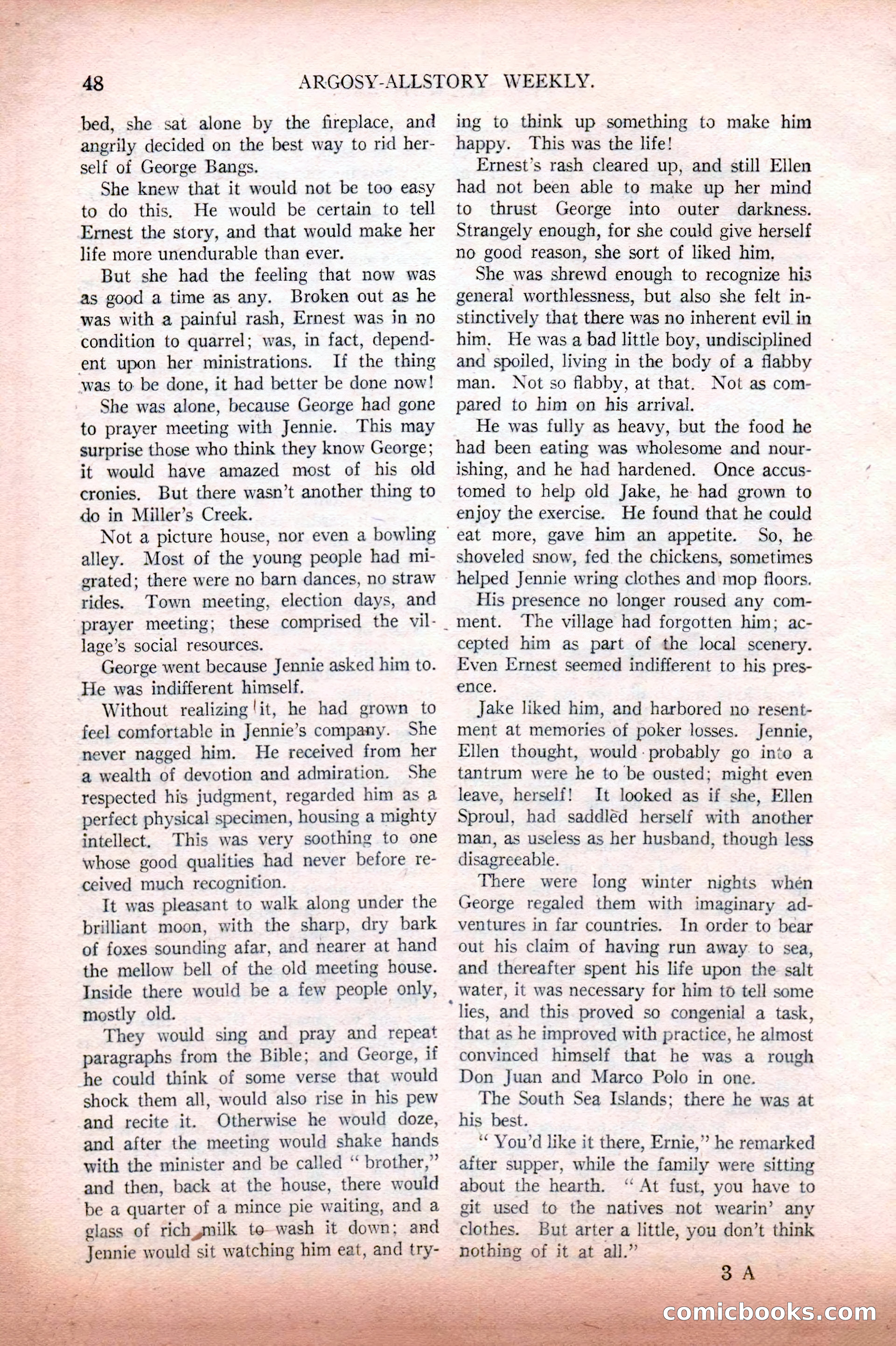
A restored page from Pulp Fiction, 1927. Page through the whole issue in the reader above.
📄 Transcribed text from this page (OCR, searchable)
Machine-transcribed from the original scan — historical spelling and the odd misread are preserved.
ae: — bed, she sat alone by the fireplace, and angrily decided on the best way to rid her- self of George Bangs. She knew that it would not be too easy to do this, He would be certain to tell Ernest the story, and that would make her life more unendurable than ever. But she had the feeling that now was as good a time as any. Broken out as he was with a painful rash, Ernest was in no condition to quarrel; was, in fact, depend- ent upon her ministrations. If the thing was to be done, it had better be done now! She was alone, because George had gone to prayer meeting with Jennie. This may surprise those who think they know George; it would have amazed most of his old cronies. But there wasn’t another thing to do in Miller’s Creek. Not a picture house, nor even a bowling alley. Most of the young people had mi- grated; there were no barn dances, no straw rides. Town meeting, election days, and prayer meeting; lage’s social resources. George went because Jennie asked him to. He was indifferent himself. Without realizing it, he had grown to feel comfortable in Jennie’s company. She never nagged him. He received from her a wealth of devotion and admiration. She respected his judgment, regarded him as a perfect physical specimen, housing a mighty intellect, This was very soothing to one whose good qualities had never before re- ceived much recognition. It was pleasant to walk along under the brilliant moon, with the sharp, dry bark of foxes sounding afar, and nearer at hand the mellow bell of the old meeting house. Inside there would be a few people only, mostly old. They would sing and pray and repeat paragraphs from the Bible; and George, if he could think of some verse that would shock them all, would also rise in his pew and recite it. Otherwise he would doze, and after the meeting would shake hands with the minister and be called “ brother,” and then, back at the house, there would be a quarter of a mince pie waiting, and a glass of rich,milk to wash it down; and _ Jennie would sit watching him eat, and try- " =e . ~— ee - - ~s ee ae, : - ee ge en Oa ee ry, Se ae ee 2 a ee ee ee a ma re . ~ ae vg Se > > Te ee zs, = a = a - - " a ss eat more, gave him an appetite. these comprised the vil- _ ARGOSY-ALLSTORY WEEKLY. ing to think up something to make him happy. This was the life! Ernest’s rash cleared up, and still Ellen had not been able to make up her mind to thrust George into outer darkness. Strangely enough, for she could give herself no good reason, she sort of liked him, She was shrewd enough to recognize his general worthlessness, but also she felt in- stinctively that there was no inherent evil in him. He was a bad little boy, undisciplined and spoiled, living in the body of a flabby man. Not so flabby, at that. Not as com- pared to him on his arrival. He was fully as heavy, but the food he had been eating was wholesome and nour- ishing, and he had hardened. Once accus- tomed to help old Jake, he had grown to enjoy the exercise. He found that he could So, he shoveled snow, fed the chickens, sometimes helped Jennie wring clothes and mop floors. His presence no longer roused any com- ment. The village had forgotten him; ac- cepted him as part of the local scenery. Even Ernest seemed indifferent to his pres- ence. Jake liked him, and harbored no resent- ment at memories of poker losses. Jennie, Ellen thought, would: probably go into a tantrum were he to be ousted; might even leave, herself! It looked as if she, Ellen Sproul, had saddled herself with another man, as useless as her husband, though less disagreeable. There were long winter nights whén George regaled them with imaginary ad- ventures in far countries. In order to bear out his claim of having run away. to sea, and thereafter spent his life upon the salt water, it was necessary for him to tell some ‘lies, and this proved so congenial a task, that as he improved with practice, he almost convinced himself that he was a rough Don Juan and Marco Polo in one. The South Sea Islands; there he was at his best. ‘* You'd like it there, Ernie,” he remarked after supper, while the family were sitting about the hearth. “ At fust, you have to git used to the natives not wearin’ any clothes. But arter a little, you don’t think nothing of it at all.” : oe, ” ee > oe zh Corie a cS ee : 5 ee ee ee oe eet — 2 eee ~ = : eo em Ron FL y Ss = _ —> ee eee a eee ee ¢ ER OR ge Sa a en —. : < = +e ag thy y i A sna eo ‘com