
Pulp Fiction, 1927 · page 31 of 168
Argosy All-Story Weekly, February 12, 1927 — page 31: what you’re looking at
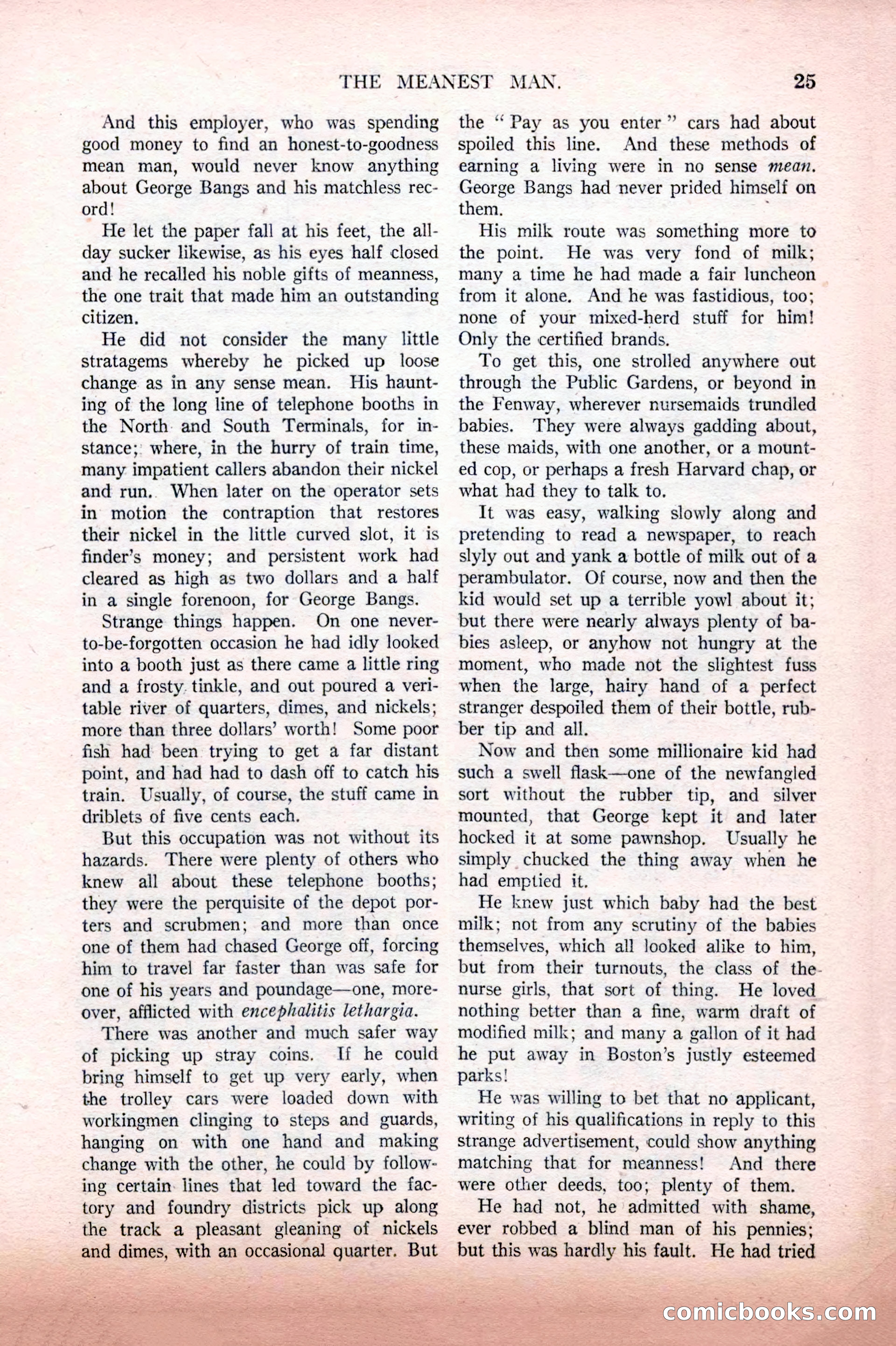
A restored page from Pulp Fiction, 1927. Page through the whole issue in the reader above.
📄 Transcribed text from this page (OCR, searchable)
Machine-transcribed from the original scan — historical spelling and the odd misread are preserved.
THE And this employer, who was spending good money to find an honest-to-goodness mean man, would never know anything about George Bangs and his matchless rec- ord! He let the paper fall at his feet, the all- day sucker likewise, as his eyes half closed and he recalled his noble gifts of meanness, the one trait that made him an outstanding citizen. He did not consider the many little stratagems whereby he picked up loose change as in any sense mean. His haunt- ing of the long line of telephone booths in the North. and South Terminals, for in- stance; where, in the hurry of train time, many impatient callers abandon their nickel and run.. When later on the operator sets in motion the contraption that restores their nickel in the little curved slot, it is finder’s money; and persistent work had cleared as high as two dollars and a half in a single forenoon, for George Bangs. Strange things happen. On one never- to-be-forgotten occasion he had idly looked into a booth just as there came a little ring and a frosty. tinkle, and out poured a veri- table river of quarters, dimes, and nickels; more than three dollars’ worth! Some poor fish had been trying to get a far distant point, and had had to dash off to catch his train. Usually, of course, the stuff came in driblets of five cents each. But this occupation was not without its hazards. There were plenty of others who knew all about these telephone booths; they were the perquisite of the depot por- ters and scrubmen; and more than once one of them had chased George off, forcing him to travel far faster than was safe for one of his years and poundage—one, more- over, afflicted with encephalitis lethargia. There was another and much safer way of picking up stray coins. If he could bring himself to get up very early, when the trolley cars were loaded down with workingmen clinging to steps and guards, hanging on with one hand and making change with the other, he could by follow- ing certain: lines that led toward the fac- tory and foundry districts pick up along the track a pleasant gleaning of nickels MEANEST MAN. 25 the “ Pay as you enter” cars had about spoiled this line. And these methods of earning a living were in no sense mean. George Bangs had never prided himself on them. His milk route was something more to the point. He was very fond of milk; many a time he had made a fair luncheon from it alone. And he was fastidious, too; none of your mixed-herd stuff for him! Only the certified brands. To get this, one strolled anywhere out through the Public Gardens, or beyond in the Fenway, wherever nursemaids trundled babies. They were always gadding about, these maids, with one another, or a mount- ed cop, or perhaps a fresh Harvard chap, or what had they to talk to. It was easy, walking slowly along and pretending to read a newspaper, to reach slyly out and yank a bottle of milk out of a perambulator. Of course, now and then the kid would set up a terrible yowl about it; but there were nearly always plenty of ba- bies asleep, or anyhow not hungry at the moment, who made not the slightest fuss when the large, hairy hand of a perfect stranger despoiled them of their bottle, rub- ber tip and all. Now and then some millionaire kid had such a swell flask—one of the newfangled sort without the rubber tip, and _ silver mounted, that George kept it and later hocked it at some pawnshop. Usually he simply chucked the thing away when he had emptied it. He knew just which baby had the best milk; not from any scrutiny of the babies themselves, which all looked alike to him, but from their turnouts, the class of the- nurse girls, that sort of thing. He loved nothing better than a fine, warm draft of modified milk; and many a gallon of it had he put away in Boston’s justly esteemed parks! He was willing to bet that no applicant, writing of his qualifications in reply to this strange advertisement, could show anything matching that for meanness! were other deeds, too; plenty of them. He had not, he admitted with shame, ever robbed a blind man of his pennies; And there and dimes, with an occasional quarter. But as Ses AS, Ee. * - a S es a Oe a ae a ag en gg a = POD eS Re ga ne ee ge eee Dea a eT pa a = S ge OE ~e oe ~*E, ~~ ao aig - but this was hardly his fault. He had tried = 4 - -* © ——, ms “7? ~ — = FS et ~~ we - - et Se ge Ne “i ae te atte $ ee ae ee a Sy eee a ne + os Ge ee a a =>