
Pulp Fiction, 1927 · page 30 of 168
Argosy All-Story Weekly, February 12, 1927 — page 30: what you’re looking at
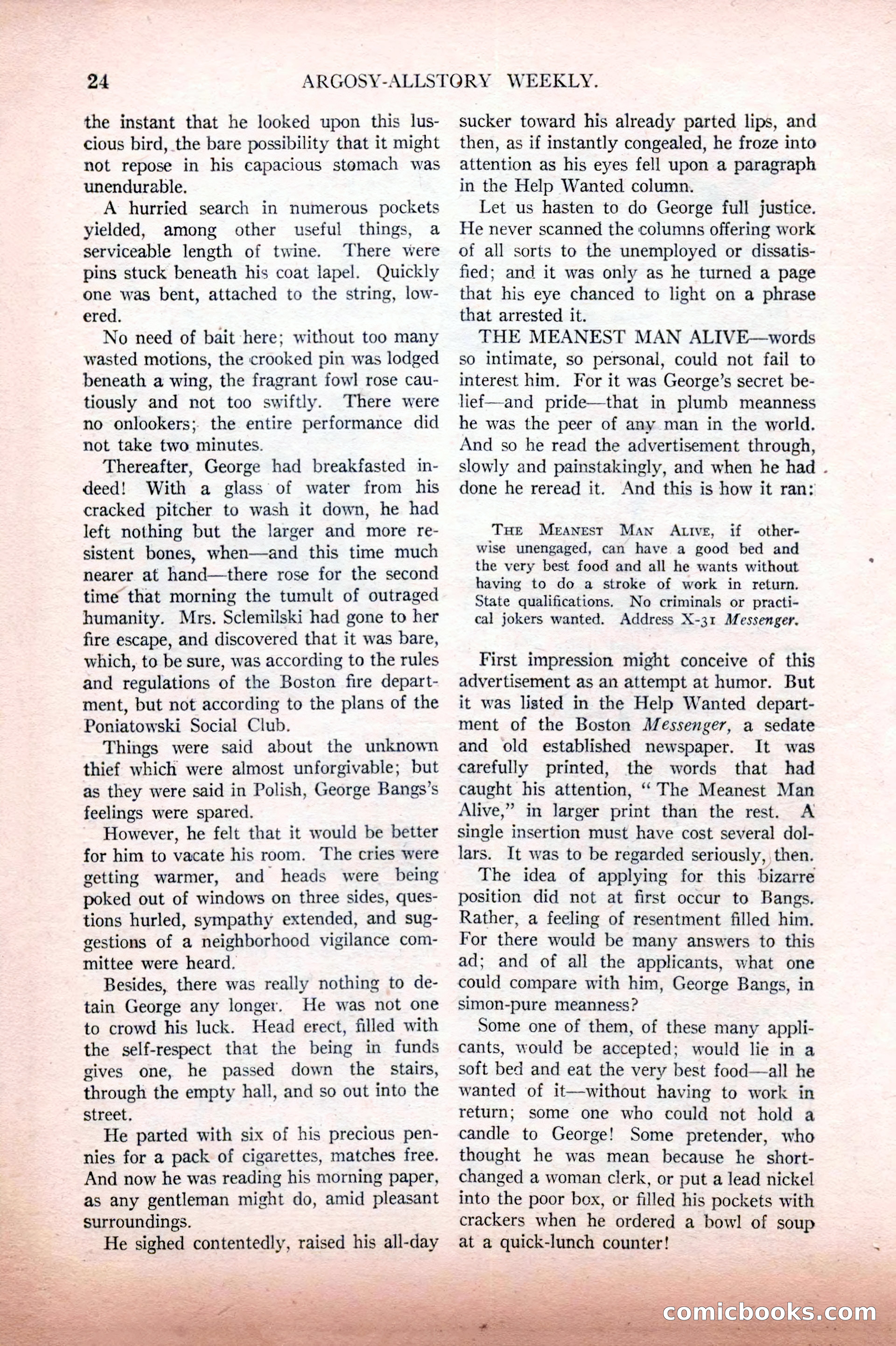
A restored page from Pulp Fiction, 1927. Page through the whole issue in the reader above.
📄 Transcribed text from this page (OCR, searchable)
Machine-transcribed from the original scan — historical spelling and the odd misread are preserved.
24 ARGOSY-ALLSTORY WEEKLY. the instant that he looked upon this lus- cious bird, the bare possibility that it might not repose in his capacious stomach was unendurable. A hurried search in numerous pockets yielded, among other useful things, a serviceable length of twine. There were pins stuck beneath his coat lapel. Quickly one was bent, attached to the string, low- ered. No need of bait here; without too many wasted motions, the crooked pin was lodged beneath a wing, the fragrant fowl rose cau- tiously and not too swiftly. There were no onlookers; the entire performance did not take two minutes. Thereafter, George had breakfasted in- deed! With a glass of water from his cracked pitcher to wash it down, he had left nothing but the larger and more re- sistent bones, when—and this time much nearer at hand—there rose for the second time that morning the tumult of outraged humanity. Mrs. Sclemilski had gone to her fire escape, and discovered that it was bare, which, to be sure, was according to the rules and regulations of the Boston fire depart- ment, but not according to the plans of the Poniatowski Social Club. Things were said about the unknown thief which were almost unforgivable; but as they were said in Polish, George Bangs’s feelings were spared. However, he felt that it would be better for him to vacate his room. The cries were getting warmer, and heads were being poked out of windows on three sides, ques- tions hurled, sympathy extended, and sug- gestions of a neighborhood vigilance com- mittee were heard. Besides, there was really nothing to de- tain George any longer. He was not one to crowd his luck. Head erect, filled with the self-respect that the being in funds gives one, he passed down the stairs, through the empty hall, and so out into the street. He parted with six of his precious pen- nies for a pack of cigarettes, matches free. And now he was reading his morning paper, as any gentleman might do, amid pleasant surroundings. He sighed contentedly, raised his all-day sucker toward his already parted lips, and then, as if instantly congealed, he froze into attention as his eyes fell upon a paragraph in the Help Wanted column. Let us hasten to do George full justice. He never scanned the columns offering work of all sorts to the unemployed or dissatis- fied; and it was only as he turned a page that his eye chanced to light on a phrase that arrested it. THE MEANEST MAN ALIVE—words so intimate, so personal, could not fail to interest him. For it was George’s secret be- lief—and pride—that in plumb meanness he was the peer of any man in the world. And so he read the advertisement through, slowly and painstakingly, and when he had . done he reread it. And this is how it ran: THE Meanest Man Ative, if other- wise unengaged, can have a good bed and the very best food and all he wants without having to do a stroke of work in return. State qualifications. No criminals or practi- cal jokers wanted. Address X-31 Messenger. First impression might conceive of this advertisement as an attempt at humor. But it was listed in the Help Wanted depart- ment of the Boston Messenger, a sedate and old established newspaper. It was carefully printed, the words that had caught his attention, “‘ The Meanest Man Alive,” in larger print than the rest. A single insertion must have cost several dol- lars. It was to be regarded seriously, then. The idea of applying for this bizarre position did not at first occur to Bangs. Rather, a feeling of resentment filled him. For there would be many answers to this ad; and of all the applicants, what one could compare with him, George Bangs, in simon-pure meanness? Some one of them, of these many appli- cants, would be accepted; would lie in a soft bed and eat the very best food—all he wanted of it—without having to work in return; some one who could not hold a candle to George! Some pretender, who thought he was mean because he short- changed a woman clerk, or put a lead nickel into the poor box, or filled his pockets with crackers when he ordered a bowl of soup at a quick-lunch counter! Pon | ~ comicbooks.com - —_ al ._ » . - se ele One ay : fen = re pee Sa ee” Ae —< JF ae SS Sips