
Pulp Fiction, 1925 · page 146 of 182
Argosy All-Story Weekly, April 4, 1925 — page 146: what you’re looking at
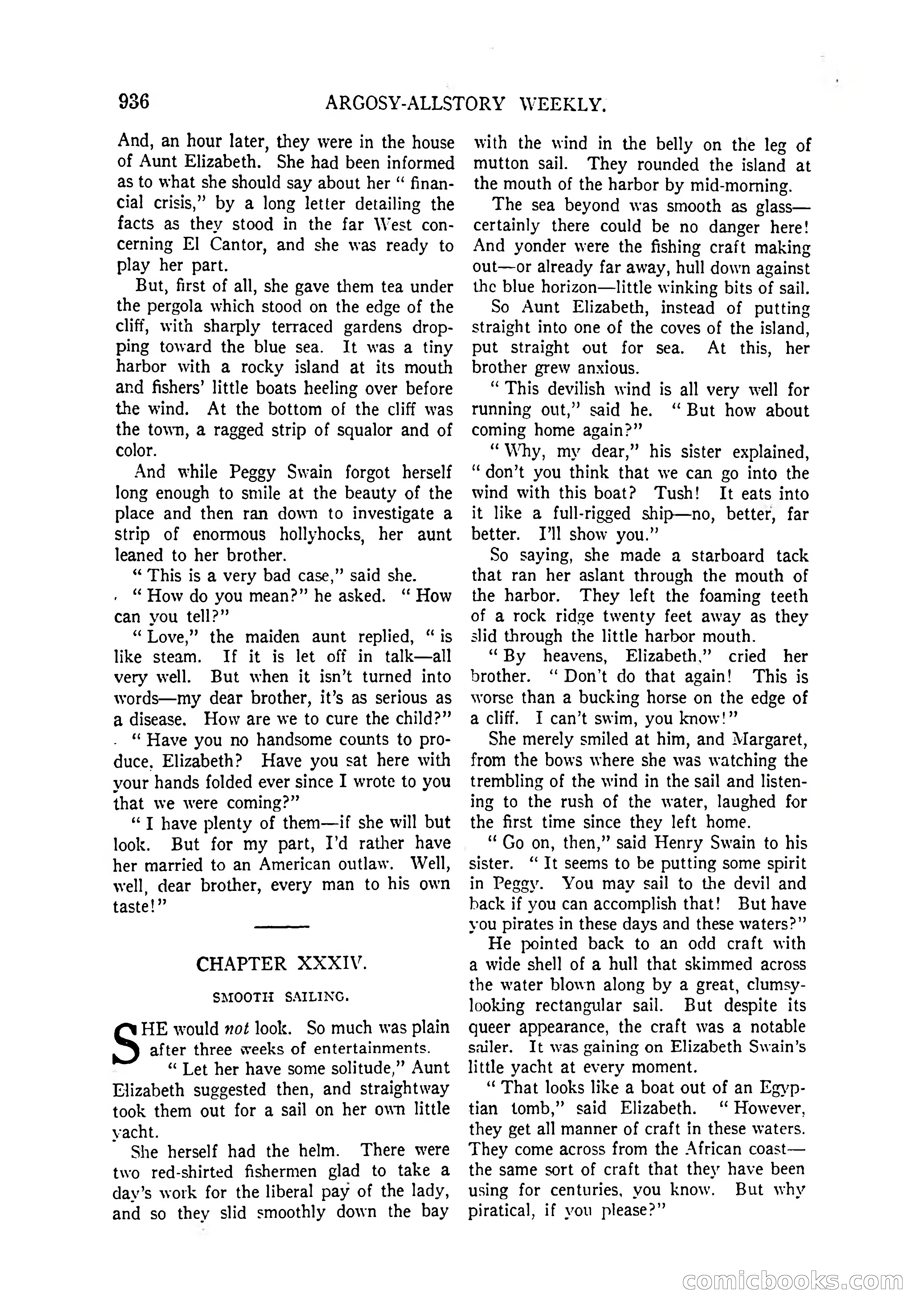
A restored page from Pulp Fiction, 1925. Page through the whole issue in the reader above.
📄 Transcribed text from this page (OCR, searchable)
Machine-transcribed from the original scan — historical spelling and the odd misread are preserved.
936 And, an hour later, they were in the house of Aunt Elizabeth. She had been informed as to what she should say about her “ finan- cial crisis,” by a long letter detailing the facts as they stood in the far West con- cerning El Cantor, and she was ready to play her part. But, first of all, she gave them tea under the pergola which stood on the edge of the cliff, with sharply terraced gardens drop- ping toward the blue sea. It was a tiny harbor with a rocky island at its mouth and fishers’ little boats heeling over before the wind. At the bottom of the cliff was the town, a ragged strip of squalor and of color. And while Peggy Swain forgot herself long enough to smile at the beauty of the place and then ran down to investigate a strip of enormous hollyhocks, her aunt leaned to her brother. “This is a very bad case,” said she. “How do you mean?” he asked. ‘‘ How can you tell?” “Love,” the maiden aunt replied, “is like steam. If it is let off in talk—all very well. But when it isn’t turned into words—my dear brother, it’s as serious as a disease. How are we to cure the child?” ‘*‘ Have you no handsome counts to pro- duce, Elizabeth? Have you sat here with vour hands folded ever since I wrote to you that we were coming?” “T have plenty of them—if she will but look. But for my part, I’d rather have her married to an American outlaw. Well, well, dear brother, every man to his own taste!” CHAPTER XXXIV. SMOOTH SAILING. HE would not look. So much was plain S after three weeks of entertainments. “Let her have some solitude,”’ Aunt Elizabeth suggested then, and straightway took them out for a sail on her own little vacht. She herself had the helm. There were two red-shirted fishermen glad to take a dav’s work for the liberal pay of the lady, and so they slid smoothly down the bay ARGOSY-ALLSTORY WEEKLY. of at with the wind in the belly on the leg mutton sail. They rounded the island the mouth of the harbor by mid-morning. The sea beyond was smooth as glass— certainly there could be no danger here! And yonder were the fishing craft making out—or already far away, hull down against the blue horizon—little winking bits of sail. So Aunt Elizabeth, instead of putting straight into one of the coves of the island, put straight out for sea. At this, her brother grew anxious. “This devilish wind is all very well for running out,” said he. ‘ But how about coming home again?” “Why, my dear,” his sister explained, “don’t you think that we can go into the wind with this boat? Tush! It eats into it like a full-rigged ship—no, better, far better. IJ’ll show you.” So saying, she made a starboard tack that ran her aslant through the mouth of the harbor. They left the foaming teeth of a rock ridge twenty feet away as they slid through the little harbor mouth. ‘““By heavens, Elizabeth,” cried her brother. ‘‘ Don’t do that again! This is worse than a bucking horse on the edge of a cliff. I can’t swim, you know!” She merely smiled at him, and Margaret, from the bows where she was watching the trembling of the wind in the sail and listen- Ing to the rush of the water, laughed for the first time since they left home. “Go on, then,” said Henry Swain to his sister. ‘It seems to be putting some spirit in Pegey. You may sail to the devil and back if you can accomplish that! But have you pirates in these days and these waters?” He pointed back to an odd craft with a wide shell of a hull that skimmed across the water blown along by a great, clumsy- looking rectangular sail. But despite its queer appearance, the craft was a notable sailer. It was gaining on Elizabeth Swain’s little yacht at every moment. “That looks like a boat out of an Egyp- tian tomb,” said Elizabeth. ‘‘ However, they get all manner of craft in these waters. They come across from the African coast— the same sort of craft that they have been using for centuries, you know. But why piratical, if vou please?” GIOok