
Pulp Fiction, 1925 · page 145 of 182
Argosy All-Story Weekly, April 4, 1925 — page 145: what you’re looking at
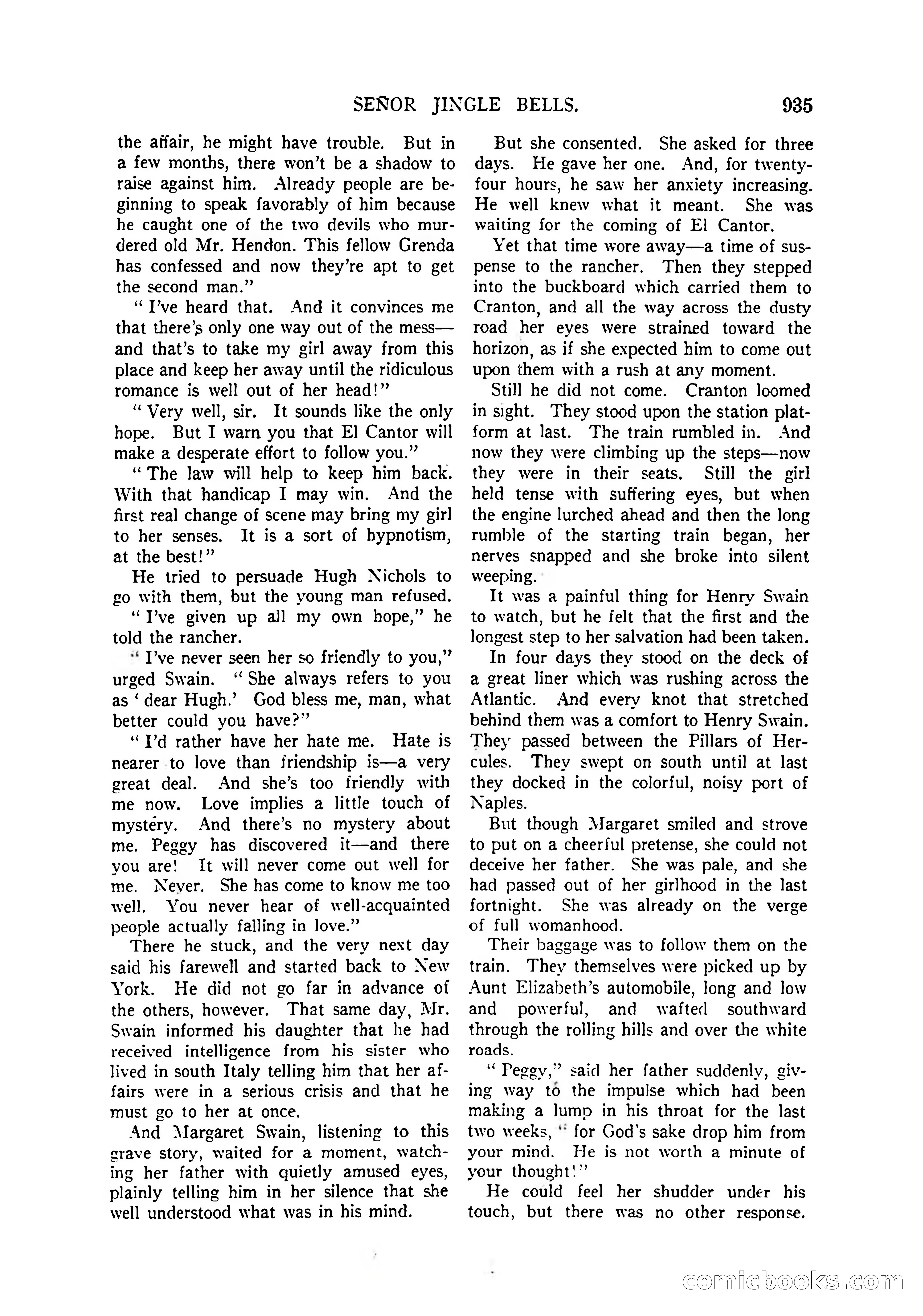
A restored page from Pulp Fiction, 1925. Page through the whole issue in the reader above.
📄 Transcribed text from this page (OCR, searchable)
Machine-transcribed from the original scan — historical spelling and the odd misread are preserved.
SENOR JINGLE BELLS, the affair, he might have trouble. But in a few months, there won’t be a shadow to raise against him. Already people are be- ginning to speak favorably of him because he caught one of the two devils who mur- dered old Mr. Hendon. This fellow Grenda has confessed and now they’re apt to get the second man.” ‘I’ve heard that. And it convinces me that there’s only one way out of the mess— and that’s to take my girl away from this place and keep her away until the ridiculous romance is well out of her head!” ‘Very well, sir. It sounds like the only hope. But I warn you that El Cantor will make a desperate effort to follow you.” “The law will help to keep him back. With that handicap I may win. And the first real change of scene may bring my girl to her senses. It is a sort of hypnotism, at the best!” He tried to persuade Hugh Nichols to go with them, but the young man refused. ‘“T’ve given up all my own hope,” he told the rancher. ‘‘ T’ve never seen her so friendly to you,” urged Swain. ‘‘She always refers to you as ‘dear Hugh.’ God bless me, man, what better could you have?” ‘1d rather have her hate me. Hate is nearer to love than friendship is—a very creat deal. And she’s too friendly with me now. Love implies a little touch of mystery. And there’s no mystery about me. Peggy has discovered it—and there It will never come out well for vou are! me. Never. She has come to know me too well. You never hear of well-acquainted people actually falling in love.” There he stuck, and the very next day said his farewell and started back to New York. He did not go far in advance of the others, however. That same day, Mr. Swain informed his daughter that he had received intelligence from his sister who lived in south Italy telling him that her af- fairs were in a serious crisis and that he must go to her at once. And Margaret Swain, listening to this crave story, waited for a moment, watch- ing her father with quietly amused eyes, plainly telling him in her silence that she well understood what was in his mind. 935 But she consented. She asked for three days. He gave her one. And, for twenty- four hours, he saw her anxiety increasing. He well knew what it meant. She was waiting for the coming of El Cantor. Yet that time wore away—a time of sus- pense to the rancher. Then they stepped into the buckboard which carried them to Cranton, and all the way across the dusty road her eyes were strained toward the horizon, as if she expected him to come out upon them with a rush at any moment. Still he did not come. Cranton loomed in sight. They stood upon the station plat- form at last. The train rumbled in. And now they were climbing up the steps—now they were in their seats. Still the girl held tense with suffering eyes, but when the engine lurched ahead and then the long rumble of the starting train began, her nerves snapped and she broke into silent weeping. It was a painful thing for Henry Swain to watch, but he felt that the first and the longest step to her salvation had been taken. In four days they stood on the deck of a great liner which was rushing across the Atlantic. And every knot that stretched behind them was a comfort to Henry Swain. They passed between the Pillars of Her- cules. They swept on south until at last they docked in the colorful, noisy port of Naples. But though Margaret smiled and strove to put on a cheerful pretense, she could not deceive her father. She was pale, and she had passed out of her girlhood in the last fortnight. She was already on the verge of full womanhood. Their baggage was to follow them on the train. They themselves were picked up by Aunt Elizabeth’s automobile, long and low and powerful, and waftecd southward through the rolling hills and over the white roads. ‘“ Pegev,” said her father suddenly, giv- ing way to the impulse which had been making a lump in his throat for the last two weeks, ‘ for God's sake drop him from your mind. He is not worth a minute of your thought!” He could feel her shudder under his touch, but there was no other response. An GIOok