
Pulp Fiction, 1925 · page 31 of 184
Argosy All-Story Weekly, February 7, 1925 — page 31: what you’re looking at
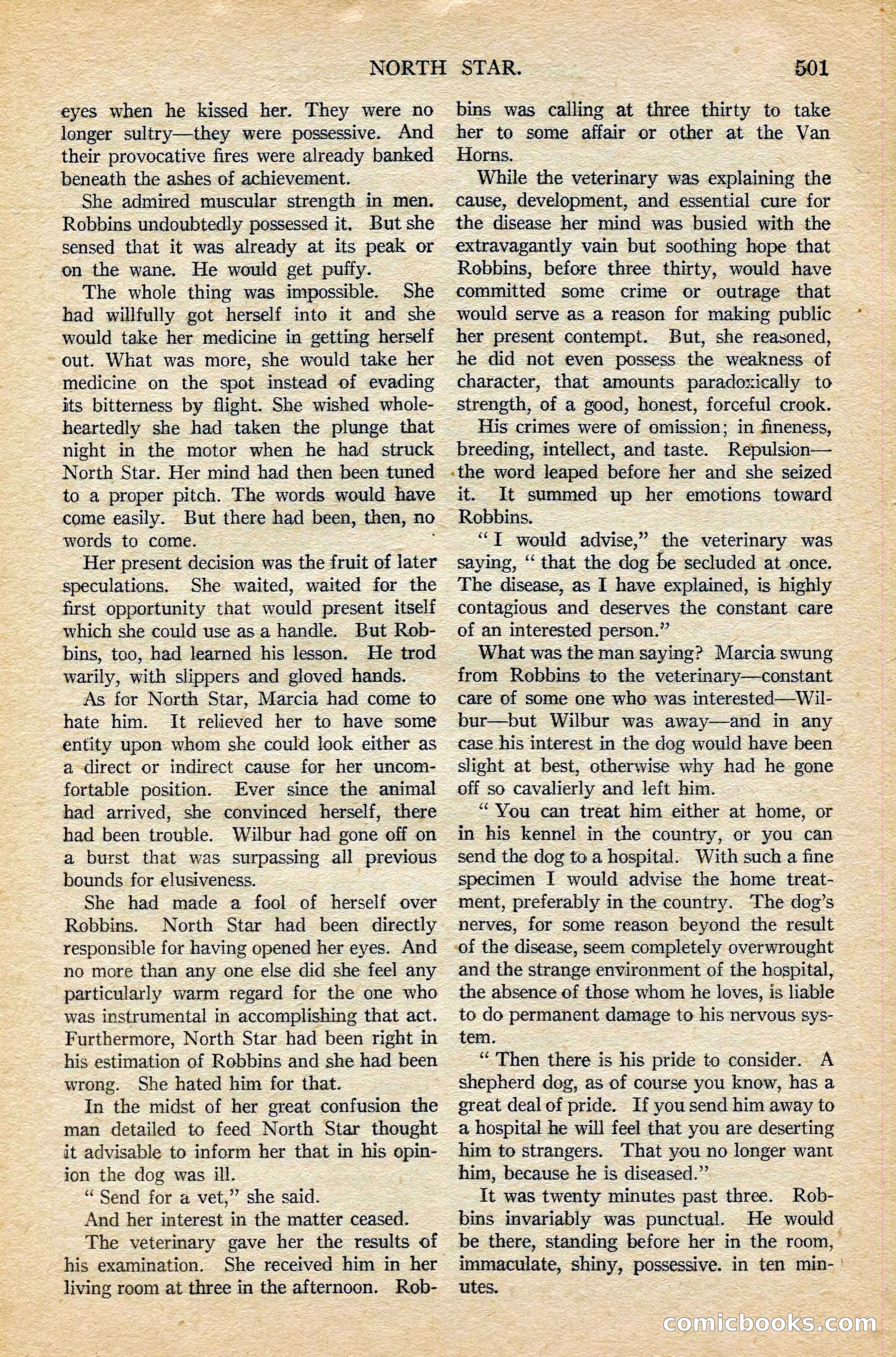
A restored page from Pulp Fiction, 1925. Page through the whole issue in the reader above.
📄 Transcribed text from this page (OCR, searchable)
Machine-transcribed from the original scan — historical spelling and the odd misread are preserved.
NORTH STAR. eyes when he kissed her. They were no longer sultry—they were possessive. And their provocative fires were already banked beneath the ashes of achievement. She admired muscular strength in men. Robbins undoubtedly possessed it. But she sensed that it was already at its peak or on the wane. He would get puffy. The whole thing was impossible. She had willfully got herself into it and she would take her medicine in getting herself ~ out. What was more, she would take her medicine on the spot instead of evading its bitterness by flight. She wished whole- heartedly she had taken the plunge that — night in the motor when he had struck North Star. Her mind had then been tuned to a proper pitch. The words would have come easily. But there had been, then, no words to come. Her present decision was the fruit of later speculations. She waited, waited for the first opportunity that ie present itself — which she could use as a handle. But Rob- bins, too, had learned his lesson. He trod warily, with slippers and gloved hands. As for North Star, Marcia had come to hate him. It relieved her to have some entity upon whom ske could look either as a direct or indirect cause for her uncom- fortable position. Ever since the animal had arrived, she convinced herself, there had been trouble. Wilbur had gone off on a burst that was surpassing all previous bounds for elusiveness. She had made a fool of herself over Robbins. North Star had been directly responsible for having opened her eyes. And no more than any one else did she feel any particularly warm regard for the one who was instrumental in accomplishing that act. Furthermore, North Star had been right in his estimation of Robbins and she had been wrong. She hated him for that. In the midst of her great confusion the man detailed to feed North Star thought it advisable to inform her that in his opin- ion the dog was ill. “Send for a vet,” she said. And her interest in the matter ceased. The veterinary gave her the results of his examination. living room at three in the afternoon. Rob- She received him in her bins was calling at three thirty to take her to some affair or other at the Van Horns. While the veterinary was explaining the cause, development, and essential cure for the disease her mind was busied with the extravagantly vain but soothing hope that Robbins, before three thirty, would have 2 committed some crime or outrage that would serve as a reason for making public her present contempt. But, she reasoned, he did not even possess the weakness of character, that amounts paradoxically to strength, of a good, honest, forceful crook. His crimes were of omission; in fineness, breeding, intellect, and taste. Repulsion— _.the word leaped before her and she seized it. It summed up her emotions toward Robbins. “T would advise,” the veterinary was saying, “that the dog be secluded at once. The disease, as I have explained, is highly contagious ant deserves the constant care of an interested person.” _ What was the man saying? Worcs swung from Robbins to the veterinary—constant care of some one who was interested—Wil- bur—but Wilbur was away—and in any case his interest in the dog would have been slight at best, otherwise why had he gone off so Cavaliers and left him. “You can treat him either at home, or in his kennel in the country, or you can send the dog to a hospital. With such a fine specimen I would advise the home treat- ment, preferably in the country. The dog’s nerves, for some reason beyond the result of the disease, seem completely overwrought and the strange environment of the hospital, the absence of those whom he loves, is liable to do permanent damage to his nervous sys- tem. “Then there is his pride to consider. A shepherd dog, as of course you know, has a great deal of pride. If you send him away to a hospital he will feel that you are deserting him to strangers. That you no longer want him, because he is diseased.” It was twenty minutes past three. Rob- bins invariably was punctual. He would be there, standing before her in the room, immaculate, shiny, possessive. in ten min- | utes. Gomicbooks:-co ea iat.