
Pulp Fiction, 1925 · page 30 of 184
Argosy All-Story Weekly, February 7, 1925 — page 30: what you’re looking at
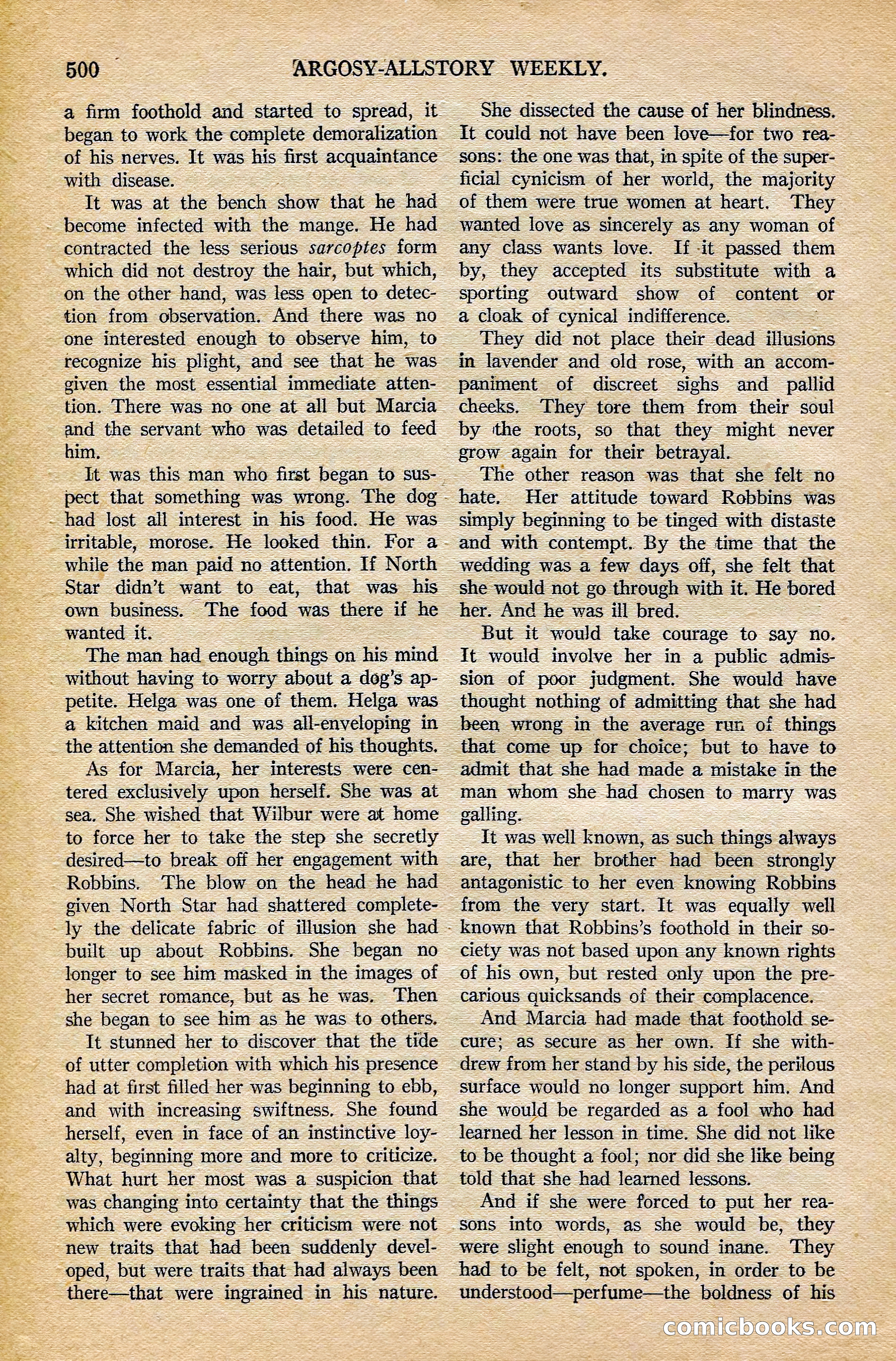
A restored page from Pulp Fiction, 1925. Page through the whole issue in the reader above.
📄 Transcribed text from this page (OCR, searchable)
Machine-transcribed from the original scan — historical spelling and the odd misread are preserved.
~ Robbins. ee foothold and started to sued = to work the complete tencuiastion = It was at the ba — that he had - become infected with the mange. He had contracted the less serious sarcoptes form which did not destroy the hair, but which, on the other hand, was less open to detec- tion from observation. And there was no one interested enough to observe him, to _ BES recognize his plight, and see that he was given the most essential immediate atten- - tion. There was no one- at all but Marcia and the servant “who was detailed to feed him, — Jit was this man = first began to sus-_ pect that something was wrong. The dog had lost all interest in his food. He was __ irritable, morose. He looked thin. For a - — while the. man paid no. attention. Tf North Star didn’t want to eat, that was his — own business. The food. was” there. if he- See panied it. | 3 The man Ae Se mace on fie oe = = without having to worry about a dop’s ap- - petite. Helga was one of them. Helga was a kitchen maid and was all-enveloping in — ___ the attention she demanded of his. thoughts. tha As for Mar cia, sea. She wished that Wilbur were at home to force her to take the step she secretly desired—to break off. her engagement with — The blow on the head he had — ~ given North Star had shattered complete- -ly the delicate fabric of illusion she had - built up about Robbins. She - began no longer to see him masked in the images of her secret romance, but as he was. Then she began to see bine as he was to others. It stunned her to discover that the tide of utter completion with which his presence had at first filled her was beginning to ebb, and with increasing swiftness. She found herself, even in face of an instinctive loy- alty, beginning more and more to criticize. What hurt her most was a suspicion that was changing into certainty that the things : which were evoking her criticism were: not new traits that had been suddenly devel- = Se but were traits that had always been _ there—that were ingrained in his nature. _of them were true women at heart. wanted. love as sincerely as any woman of any class wants love. ~ hate, simply beginning to be tinged with distaste her interests were oe eee exclusiv vely upon herself. She was at ARGOSY-ALLSTORY. WEEKLY. She dissected the cause of her blindness. 7 Tt could not have been love—for two rea-— of his nerves. It was Ais: first acquaintance sons: the one was that, in spite of the super- with disease. ficial cynicism of her world, the majority If -it passed them by, they accepted its substitute with a ‘sporting outward - show of content or a cloak of cynical indifference. They did not place their dead flusions in lavender and old rose, with an accom- paniment of discreet sivhs and pallid cheeks. - They tore them from their soul by ‘the roots, so that they might never : grow -again for their betrayal. ~The other reason was that she felt no Her attitude. toward ‘Robbins was and with contempt. ‘By the time that the wedding was a few days off, she felt that she would not go dutue with 3 it. ‘He bored her. And he was ill bred. But it would take courage to. say no. It would involve her in a public admis- sion of poor judgment. She would have sheet neon of Se that she had galling. — It was well known, as such things always are, that her brother, had been strongly antagonistic to her even knowing Robbins from the very start. It was equally well known that Robbins’s foothold in their so- ciety was not based upon any known rights of his own, but rested only upon the pre- carious miicksands of their complacence. And Marcia had made that foothold se- -cure;- as secure as her own. If she with- = eae from her stand by his side, the perilous surface would no longer support him. And she would be regarded as a fool who had learned her Jesson in time. She did not like to be thought a fool; nor did she like being told that she had fea lessons. And if she were forced to put her rea- sons” into words, as she would: be, they were slight enough to sound inane. had to be felt, not spoken, in order to be They understood—perfume—the boldness of his They at come ‘up for: choice: 1 bie to. have? to admit that she had made a mistake in the man whom she had chosen to marry was comick Deo oks.co