
Pulp Fiction, 1924 · page 36 of 180
Argosy All-Story Weekly — page 36: what you’re looking at
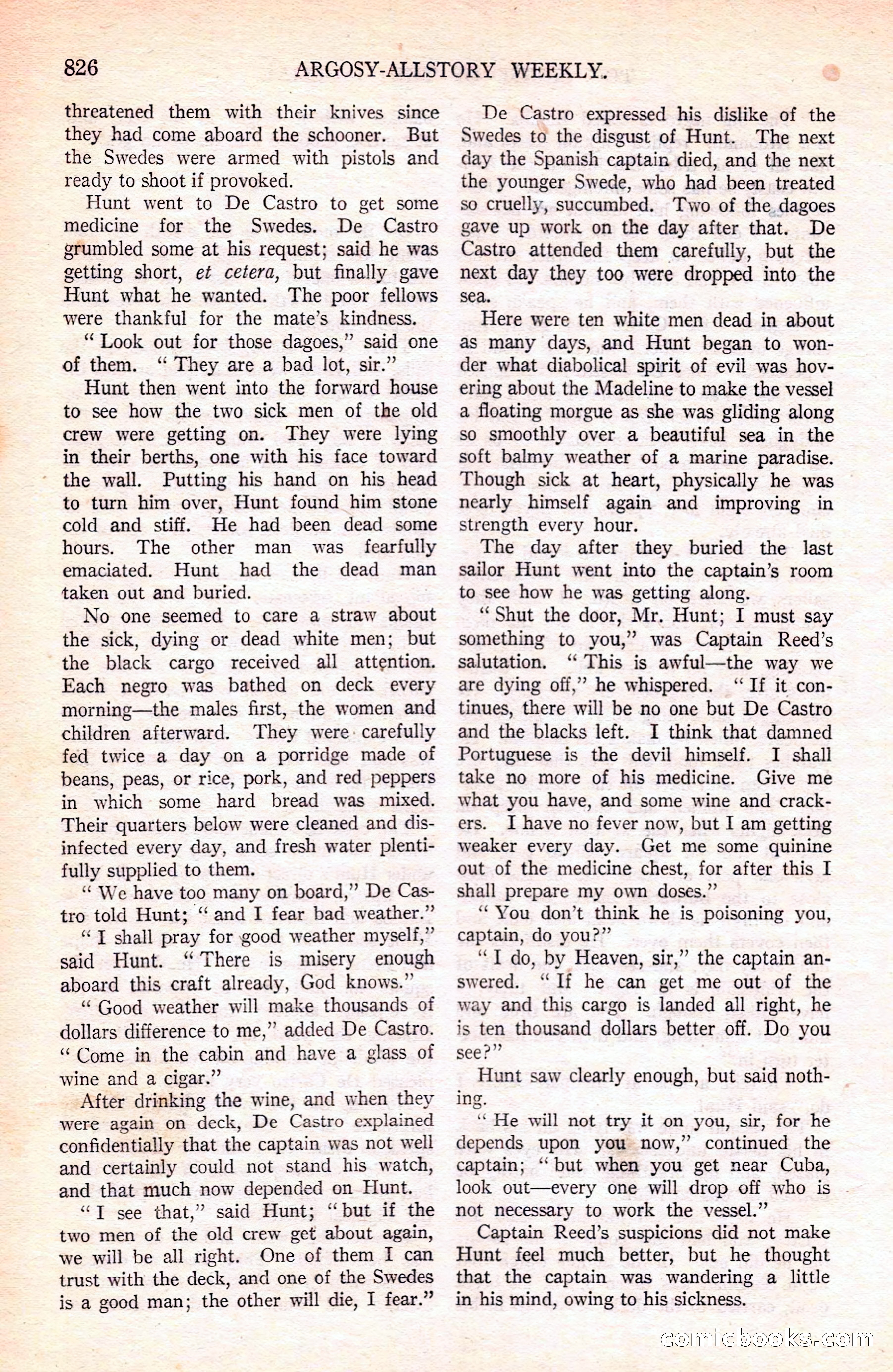
A restored page from Pulp Fiction, 1924. Page through the whole issue in the reader above.
📄 Transcribed text from this page (OCR, searchable)
Machine-transcribed from the original scan — historical spelling and the odd misread are preserved.
826 threatened them with their knives since they had come aboard the schooner. But the Swedes were armed with pistols and ready to shoot if provoked. Hunt went to De Castro to get some medicine for the Swedes. De Castro grumbled some at his request; said he was getting short, et cetera, but finally gave Hunt what he wanted. The poor fellows were thankful for the mate’s kindness. “Look out for those dagoes,” said one of them. ‘“ They are a bad lot, sir.” Hunt then went into the forward house to see how the two sick men of the old crew were getting on. They were lying in their berths, one with his face toward the wall. Putting his hand on his head to turn him over, Hunt found him stone cold and stiff. He had been dead some hours. The other man was fearfully emaciated. Hunt had the dead man taken out and buried. No one seemed to care a straw about the sick, dying or dead white men; but the black cargo received all attention. Each negro was bathed on deck every morning—the males first, the women and children afterward. They were: carefully fed twice a day on a porridge made of beans, peas, or rice, pork, and red peppers in which some hard bread was mixed. Their quarters below were cleaned and dis- infected every day, and fresh water plenti- fully supplied to them, ‘We have too many on board,” De Cas- tro told Hunt; “and I fear bad weather.” “TJ shall pray for good weather myself,” said Hunt. “There is misery enough aboard this craft already, God knows.” “ Good weather will make thousands of dollars difference to me,” added De Castro. “Come in the cabin and have a glass of wine and a cigar.” After drinking the wine, and when they were again on deck, De Castro explained confidentially that the captain was not well and certainly could not stand his watch, and that much now depended on Hunt. “TJ see that,” said Hunt; “but if the two men of the old crew get about again, we will be all right. One of them I can trust with the deck, and one of the Swedes is a good man; the other will die, I fear.” ARGOSY-ALLSTORY WEEKLY. De Castro expressed his dislike of the Swedes to the disgust of Hunt. The next day the Spanish captain died, and the next the younger Swede, who had been treated so cruelly, succumbed. Two of the. dagoes gave up work on the day after that. De Castro attended them carefully, but the next day they too were dropped into the sea. Here were ten white men dead in about as many days, and Hunt began to won- der what diabolical spirit of evil was hov- ering about the Madeline to make the vessel a floating morgue as she was gliding along so smoothly over a beautiful sea in the soft balmy weather of a marine paradise. Though sick at heart, physically he was nearly himself again and improving in strength every hour. The day after they buried the last sailor Hunt went into the captain’s room to see how he was getting along. “Shut the door, Mr. Hunt; I must say something to you,” was Captain Reed’s salutation. “ This is awful—the way we are dying off,” he whispered. “If it con- tinues, there will be no one but De Castro and the blacks left. I think that damned Portuguese is the devil himself. I shall take no more of his medicine. Give me what you have, and some wine and crack- ers. I have no fever now, but I am getting weaker every day. Get me some quinine out of the medicine chest, for after this I shall prepare my own doses.” “You don’t think he is poisoning you, captain, do you?” ‘“T do, by Heaven, sir,” the captain an- swered. “If he can get me out of the way and this cargo is landed all right, he is ten thousand dollars better off. Do you see?” Hunt saw clearly enough, but said noth- ing. ‘“ He will not try it on you, sir, for he depends upon you now,” continued the captain; “‘but when you get near Cuba, look out—every one will drop off who is not necessary to work the vessel.” Captain Reed’s suspicions did not make Hunt feel much better, but he thought that the captain was wandering a little in his mind, owing to his sickness. oO CoOmiclbookSsec©