
Pulp Fiction, 1924 · page 35 of 180
Argosy All-Story Weekly — page 35: what you’re looking at
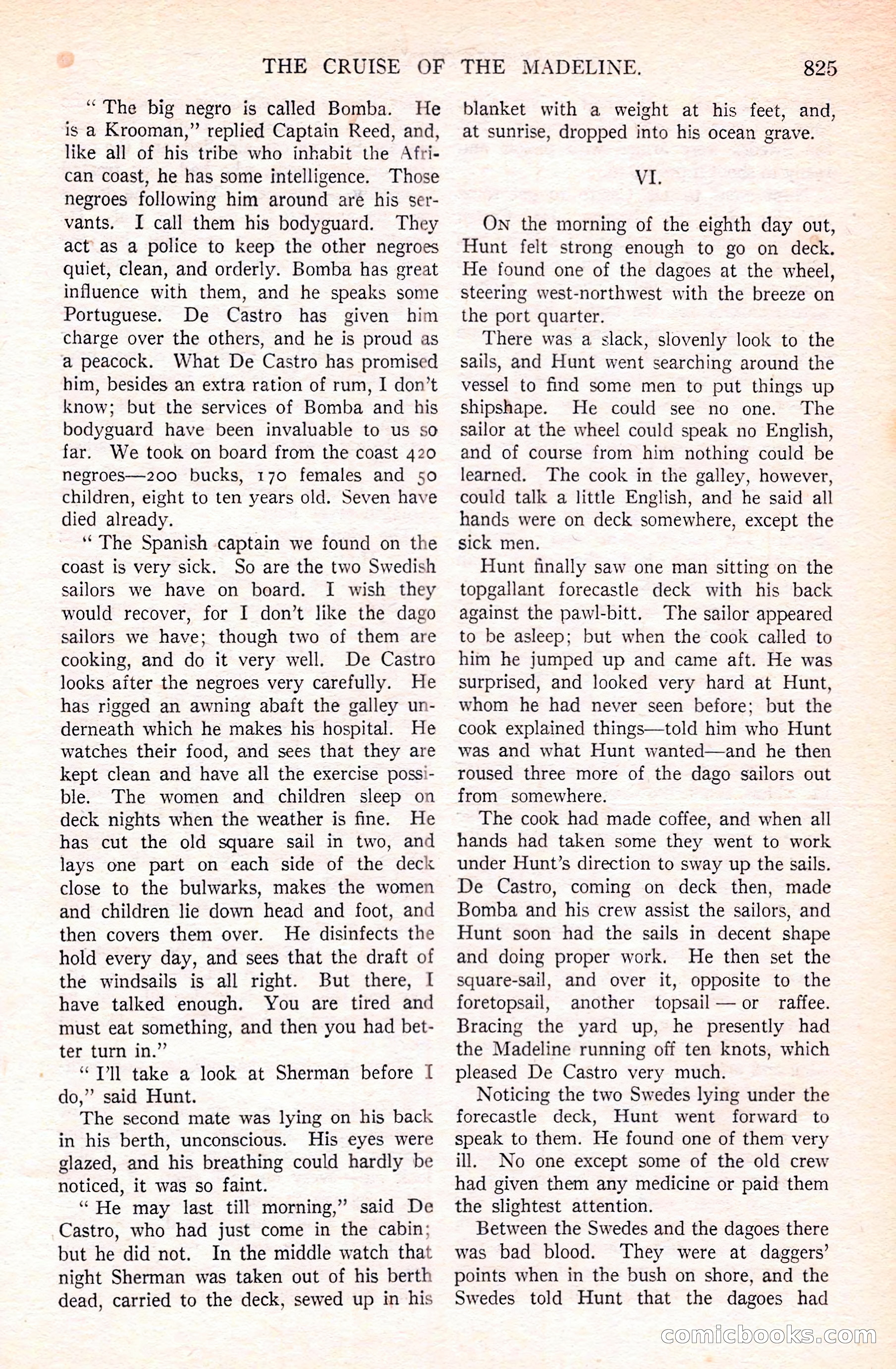
A restored page from Pulp Fiction, 1924. Page through the whole issue in the reader above.
📄 Transcribed text from this page (OCR, searchable)
Machine-transcribed from the original scan — historical spelling and the odd misread are preserved.
THE CRUISE OF ‘The big negro is called Bomba. He is a Krooman,” replied Captain Reed, and, like all of his tribe who inhabit the Afri- can coast, he has some intelligence. Those negroes following him around are his ser- vants. I call them his bodyguard. They act as a police to keep the other negroes quiet, clean, and orderly. Bomba has great influence with them, and he speaks some Portuguese. De Castro has given him charge over the others, and he is proud as a peacock. What De Castro has promised him, besides an extra ration of rum, I don’t know; but the services of Bomba and his bodyguard have been invaluable to us so far. We took on board from the coast 420 negroes—200 bucks, 170 females and 50 children, eight to ten years old. Seven have died already. ‘The Spanish captain we found on the coast is very sick. So are the two Swedish sailors we have on board. I wish they would recover, for I don’t like the dago sailors we have; though two of them are cooking, and do it very well. De Castro looks aiter the negroes very carefully. He has rigged an awning abaft the galley un- derneath which he makes his hospital. He watches their food, and sees that they are kept clean and have all the exercise possi- ble. The women and children sleep on deck nights when the weather is fine. He has cut the old square sail in two, and lays one part on each side of the deck close to the bulwarks, makes the women and children lie down head and foot, and then covers them over. He disinfects the hold every day, and sees that the draft of the windsails is all right. But there, [ have talked enough. You are tired and must eat something, and then you had bet- ter turn in.” “Tl take a look at Sherman before [ do,” said Hunt. The second mate was lying on his back in his berth, unconscious. His eyes were glazed, and his breathing could hardly be noticed, it was so faint. “ He may last till morning,” said De Castro, who had just come in the cabin; but he did not. In the middle watch that night Sherman was taken out of his berth dead, carried to the deck, sewed up in his THE MADELINE. 825 blanket with a weight at his feet, and, at sunrise, dropped into his ocean grave. VI. On the morning of the eighth day out, Hunt felt strong enough to go on deck. He found one of the dagoes at the wheel, steering west-northwest with the breeze on the port quarter. There was a slack, slovenly look to the sails, and Hunt went searching around the vessel to find some men to put things up shipshape. He could see no one. The sailor at the wheel could speak no English, and of course from him nothing could be learned. The cook in the galley, however, could talk a little English, and he said all hands were on deck somewhere, except the sick men. Hunt finally saw one man sitting on the topgallant forecastle deck with his back against the pawl-bitt. The sailor appeared to be asleep; but when the cook called to him he jumped up and came aft. He was surprised, and looked very hard at Hunt, whom he had never seen before; but the cook explained things—told him who Hunt was and what Hunt wanted—and he then roused three more of the dago sailors out from somewhere. The cook had made coffee, and when all hands had taken some they went to work under Hunt’s direction to sway up the sails. De Castro, coming on deck then, made Bomba and his crew assist the sailors, and Hunt soon had the sails in decent shape and doing proper work. He then set the square-sail, and over it, opposite to the foretopsail, another topsail— or raffee. Bracing the yard up, he presently had the Madeline running off ten knots, which pleased De Castro very much. Noticing the two Swedes lying under the forecastle deck, Hunt went forward to speak to them. He found one of them very ill. No one except some of the old crew had given them any medicine or paid them the slightest attention. Between the Swedes and the dagoes there was bad blood. They were at daggers’ points when in the bush on shore, and the Swedes told Hunt that the dagoes had SS oO COMICOO CO