
Pulp Fiction, 1924 · page 127 of 168
Argosy All-Story Weekly — page 127: what you’re looking at
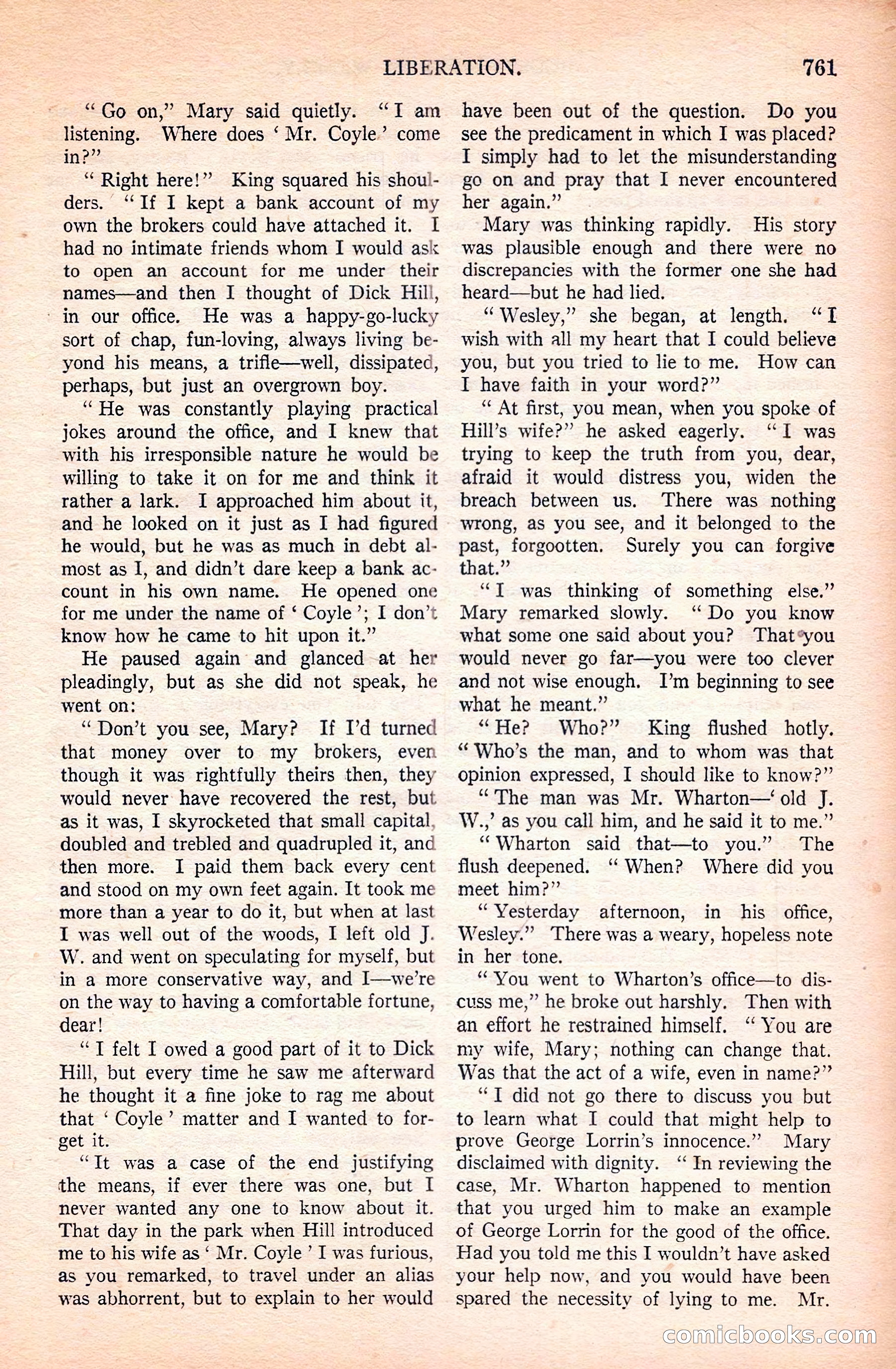
A restored page from Pulp Fiction, 1924. Page through the whole issue in the reader above.
📄 Transcribed text from this page (OCR, searchable)
Machine-transcribed from the original scan — historical spelling and the odd misread are preserved.
LIBERATION. “Go on,” Mary said quietly. “I am listening. Where does ‘ Mr. Coyle’ come ine” “ Right here!” King squared his shoul- ders. ‘If I kept a bank account of my own the brokers could have attached it. I had no intimate friends whom I would ask to open an account for me under their names—and then I thought of Dick Hill, - in our office. He was a happy-go-lucky sort of chap, fun-loving, always living be- yond his means, a trifle—well, dissipated, perhaps, but just an overgrown boy. ‘““He was constantly playing practical jokes around the office, and I knew that with his irresponsible nature he would be willing to take it on for me and think it rather a lark. I approached him about it, and he looked on it just as I had figured he would, but he was as much in debt al- most as I, and didn’t dare keep a bank ac- count in his own name. He opened one for me under the name of ‘ Coyle’; I don’t know how he came to hit upon it.” He paused again and glanced at her pleadingly, but as she did not speak, he went on: “Don’t you see, Mary? If I’d turned that money over to my brokers, even though it was rightfully theirs then, they would never have recovered the rest, but as it was, I skyrocketed that small capital. doubled and trebled and quadrupled it, and then more. I paid them back every cent and stood on my own feet again. It took me more than a year to do it, but when at last I was well out of the woods, I left old J. W. and went on speculating for myself, but in a more conservative way, and I—we’re on the way to having a comfortable fortune, dear! “T felt I owed a good part of it to Dick Hill, but every time he saw me afterward he thought it a fine joke to rag me about that ‘ Coyle’ matter and I wanted to for- get it. “Tt was a case of the end justifying the means, if ever there was one, but I never wanted any one to know about it. That day in the park when Hill introduced me to his wife as ‘ Mr. Coyle ’ I was furious, as you remarked, to travel under an alias was abhorrent, but to explain to her would 761 have been out of the question. Do you see the predicament in which I was placed? I simply had to let the misunderstanding go on and pray that I never encountered her again.” Mary was thinking rapidly. His story was plausible enough and there were no discrepancies with the former one she had heard—but he had lied. “Wesley,” she began, at length. “TI wish with all my heart that I could believe you, but you tried to lie to me. How can I have faith in your word?” ‘* At first, you mean, when you spoke of Hill’s wife?” he asked eagerly. ‘I was trying to keep the truth from you, dear, afraid it would distress you, widen the breach between us. There was nothing wrong, as you see, and it belonged to the past, forgootten. Surely you can forgive that.” ““T was thinking of something else.” Mary remarked slowly. ‘Do you know what some one said about you? That*you would never go far—you were too clever and not wise enough. I’m beginning to see what he meant.” “Hee Whore” King flushed hotly. “Who’s the man, and to whom was that Opinion expressed, I should like to know?” “The man was Mr. Wharton—‘ old J. W.,’ as you call him, and he said it to me.” “Wharton said that—to you.” The flush deepened. ‘‘ When? Where did you meet him?” “Yesterday afternoon, in his office, Wesley.” ‘There was a weary, hopeless note in her tone. ‘You went to Wharton’s office—to dis- cuss me,” he broke out harshly. Then with an effort he restrained himself. “‘ You are my wife, Mary; nothing can change that. Was that the act of a wife, even in name?” ‘I did not go there to discuss you but to learn what I could that might help to prove George Lorrin’s innocence.”’ Mary disclaimed with dignity. ‘“ In reviewing the case, Mr. Wharton happened to mention that you urged him to make an example of George Lorrin for the good of the office. Had you told me this I wouldn’t have asked your help now, and you would have been spared the necessity of lying to me. Mr. ComicoookSse©