
Pulp Fiction, 1924 · page 126 of 168
Argosy All-Story Weekly — page 126: what you’re looking at
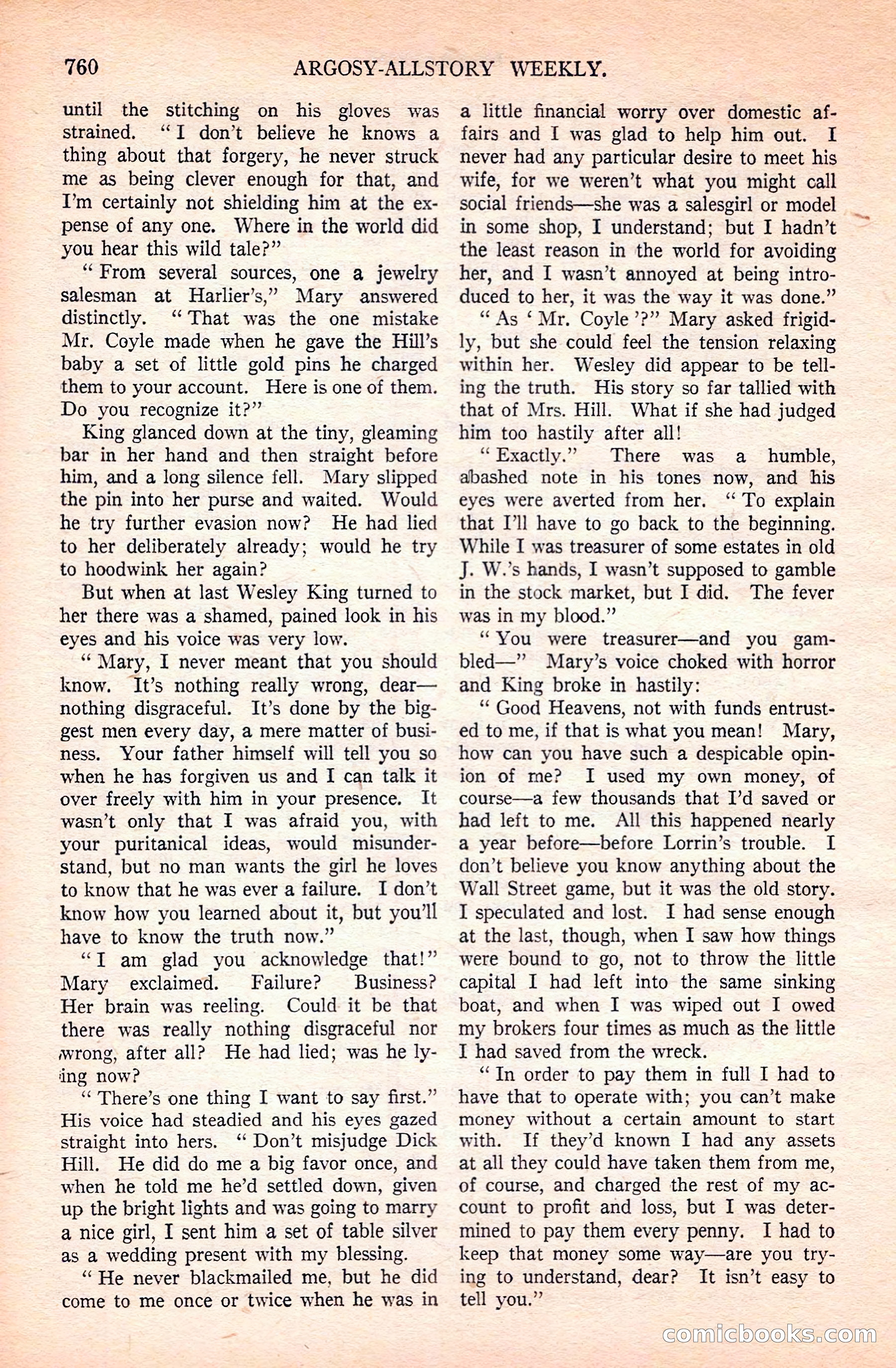
A restored page from Pulp Fiction, 1924. Page through the whole issue in the reader above.
📄 Transcribed text from this page (OCR, searchable)
Machine-transcribed from the original scan — historical spelling and the odd misread are preserved.
760 until the stitching on his gloves was strained. ‘I don’t believe he knows a thing about that forgery, he never struck me as being clever enough for that, and I’m certainly not shielding him at the ex- pense of any one. Where in the world did you hear this wild tale?” “From several sources, one @ jewelry salesman at Harlier’s,’ Mary answered distinctly. ‘“‘ That was the one mistake Mr. Coyle made when he gave the Hill’s baby a set of little gold pins he charged them to your account. Here is one of them. Do you recognize it?” King glanced down at the tiny, gleaming bar in her hand and then straight before him, and a long silence fell. Mary slipped the pin into her purse and waited. Would he try further evasion now? He had lied to her deliberately already; would he try to hoodwink her again? But when at last Wesley King turned to her there was a shamed, pained look in his eyes and his voice was very low. “Mary, I never meant that you should know. It’s nothing really wrong, dear— nothing disgraceful. It’s done by the big- gest men every day, a mere matter of busi- ness. Your father himself will tell you so when he has forgiven us and I can talk it over freely with him in your presence. It wasn’t only that I was afraid you, with your puritanical ideas, would misunder- stand, but no man wants the girl he loves to know that he was ever a failure. I don’t know how you learned about it, but you'll have to know the truth now.” “T am glad you acknowledge that!” Mary exclaimed. Failure? Business? Her brain was reeling. Could it be that there was really nothing disgraceful nor wrong, after all? He had lied; was he ly- ing now? ‘“There’s one thing I want to say first.” His voice had steadied and his eyes gazed straight into hers. ‘‘ Don’t misjudge Dick Hill. He did do me a big favor once, and when he told me he’d settled down, given up the bright lights and was going to marry a nice girl, I sent him a set of table silver as a wedding present with my blessing. “He never blackmailed me, but he did come to me once or twice when he was in ARGOSY-ALLSTORY WEEKLY. a little financial worry over domestic af- fairs and I was glad to help him out. I never had any particular desire to meet his wife, for we weren’t what you might call social friends—she was a salesgirl or model in some shop, I understand; but I hadn’t the least reason in the world for avoiding her, and I wasn’t annoyed at being intro- duced to her, it was the way it was done.” “As ‘ Mr. Coyle ’?” Mary asked frigid- ly, but she could feel the tension relaxing within her. Wesley did appear to be tell- ing the truth. His story so far tallied with that of Mrs. Hill. What if she had judged him too hastily after all! “Exactly.” There was a _ humble, abashed note in his tones now, and his eyes were averted from her. “ To explain that I’ll have to go back to the beginning. While I was treasurer of some estates in old J. W.’s hands, I wasn’t supposed to gamble in the stock market, but I did. The fever was in my blood.” “You were treasurer—and you gam- bled—” Mary’s voice choked with horror and King broke in hastily: ‘Good Heavens, not with funds entrust- ed to me, if that is what you mean! Mary, how can you have such a despicable opin- ion of me? I used my own money, of course—a few thousands that I’d saved or had left to me. All this happened nearly a year before—before Lorrin’s trouble. I don’t believe you know anything about the Wall Street game, but it was the old story. I speculated and lost. I had sense enough at the last, though, when I saw how things were bound to go, not to throw the little capital I had left into the same sinking boat, and when I was wiped out I owed my brokers four times as much as the little I had saved from the wreck. “In order to pay them in full I had to have that to operate with; you can’t make money without a certain amount to start with. If they’d known I had any assets at all they could have taken them from me, of course, and charged the rest of my ac- count to profit and loss, but I was deter- mined to pay them every penny. I had to keep that money some way—are you try- ing to understand, dear? It isn’t easy to tell you.” O Conmmiclooo “eS (S@) ™.