
Pulp Fiction, 1924 · page 165 of 176
Argosy All-Story Weekly — page 165: what you’re looking at
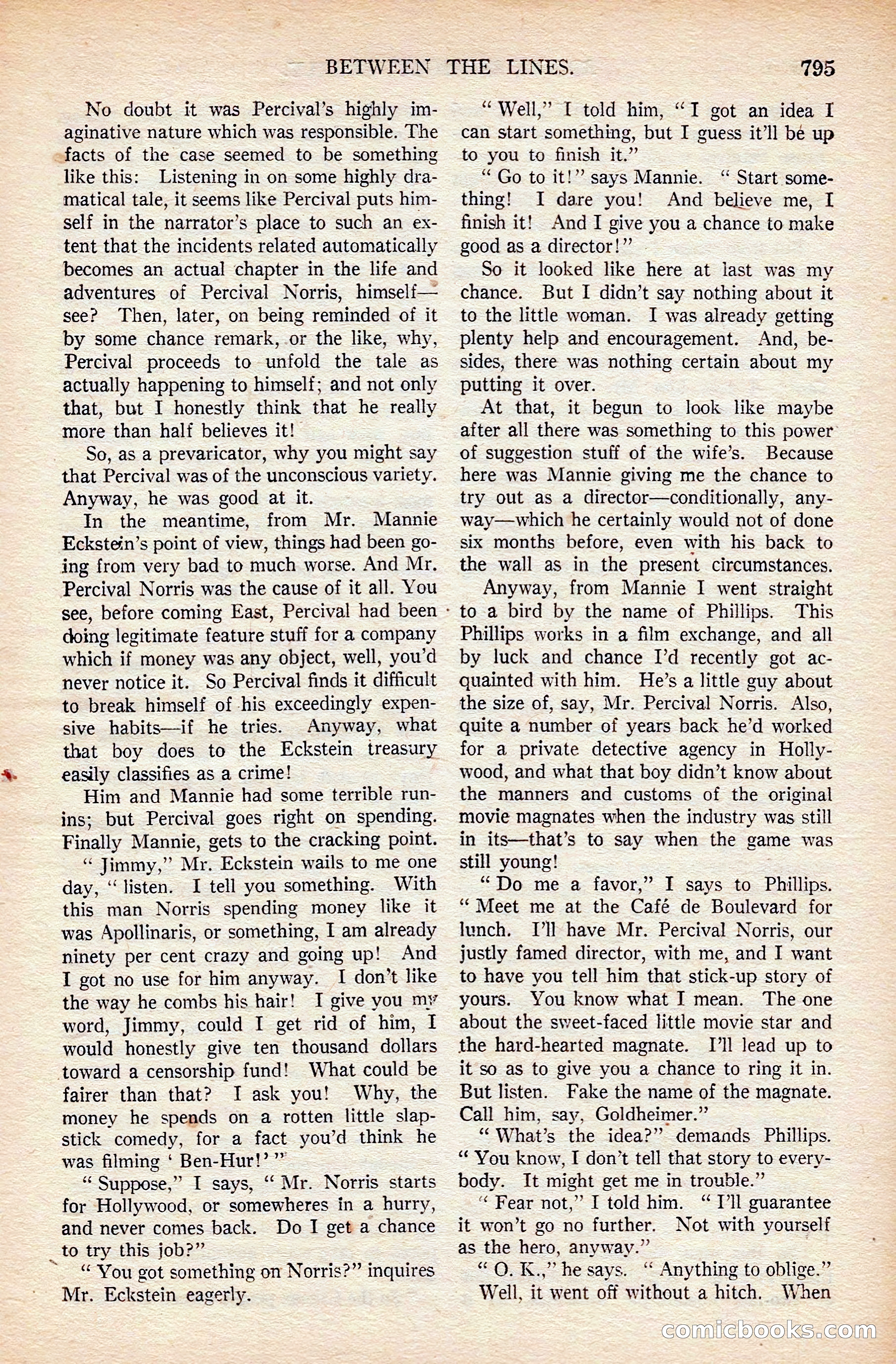
A restored page from Pulp Fiction, 1924. Page through the whole issue in the reader above.
📄 Transcribed text from this page (OCR, searchable)
Machine-transcribed from the original scan — historical spelling and the odd misread are preserved.
toward a censorship fund! BETWEEN THE LINES. No doubt it was Percival’s highly im- aginative nature which was responsible. The -facts of the case seemed to be something like this: Listening in on some highly dra- matical tale, it seems like Percival puts him- self in the narrator’s place to such an ex- tent that the incidents related automatically becomes an actual chapter in the life and adventures of Percival Norris, himself— see? Then, later, on being reminded of it by some chance remark, or the like, why, Percival proceeds to unfold the tale as actually happening to himself; and not only that, but I honestly think that he really more than half believes it! So, as a prevaricator, why you might say that Percival was of the unconscious variety. Anyway, he was good at it. In the meantime, from Mr. Mannie Eckstein’s point of view, things had been go- ing from very bad to much worse. And Mr. Percival Norris was the cause of it all. You see, before coming East, Percival had been - doing legitimate feature stuff for a company which if money was any object, well, you'd never notice it. So Percival finds it difficult to break himself of his exceedingly expen- sive habits—if he tries. Anyway, what that boy does to the Eckstein treasury easily classifies as a crime! Him and Mannie had some terrible run- ins; but Percival goes right on spending. Finally Mannie, gets to the cracking point. “ Jimmy,” Mr. Eckstein wails to me one day, ‘listen. I tell you something. With this man Norris spending money like it was Apollinaris, or something, I am already ninety per cent crazy and going up! And I got no use for him anyway. I don’t like the way he combs his hair! I give you my word, Jimmy, could I get rid of him, I would honestly give ten thousand dollars What could be fairer than that? I ask you! Why, the money he spends on a rotten little slap- stick comedy, for a fact you’d think he was filming ‘ Ben-Hur!’”” “ Suppose,” I says, ‘“‘ Mr. Norris starts for Hollywood, or somewheres in a hurry, and never comes back. Do I get a chance _ to try this job?” “You got something on Norris?” inquires Mr. Eckstein eagerly. 795 “Well,” I told him, “I got an idea I can start something, but I guess it’ll bé up to you to finish it.” “Go to it!” says Mannie. ‘ Start some- thing! I dare you! And believe me, I finish it! And I give you a chance to make good as a director!” - So it looked like here at last was my chance. But I didn’t say nothing about it to the little woman. I was already getting plenty help and encouragement. And, be- sides, there was nothing certain about my putting it over. At that, it begun to look like maybe after all there was something to this power of suggestion stuff of the wife’s. Because here was Mannie giving me the chance to try out as a director—conditionally, any- way—which he certainly would not of done six months before, even with his back to the wall as in the present circumstances. Anyway, from Mannie I went straight to a bird by the name of Phillips. This Phillips works in a film exchange, and all by luck and chance I’d recently got ac- quainted with him. He’s a little guy about the size of, say, Mr. Percival Norris. Also, quite a number of years back he’d worked for a private detective agency in Holly- wood, and what that boy didn’t know about the manners and customs of the original movie magnates when the industry was still in its—that’s to say when the game was still young! “Do me a favor,” I says to Phillips. ‘Meet me at the Café de Boulevard for lunch. Ill have Mr. Percival Norris, our justly famed director, with me, and I want to have you tell him that stick-up story of yours. You know what I mean. The one about the sweet-faced little movie star and the hard-hearted magnate. I'll lead up to it so as to give you a chance to ring it in. But listen. Fake the name of the magnate. Call him, say, Goldheimer.” ““What’s the idea?” demands Phillips. “You know, I don’t tell that story to every- body. It might get me in trouble.” “ Fear not,” I told him. “ I’ll guarantee it won’t go no further. Not with yourself as the hero, anyway.” | “QO. K.,” he says. ‘“ Anything to oblige.” Well, it went off without a hitch. When COMMICOOOKSaEO©