
Pulp Fiction, 1923 · page 113 of 176
Argosy All-Story Weekly — page 113: what you’re looking at
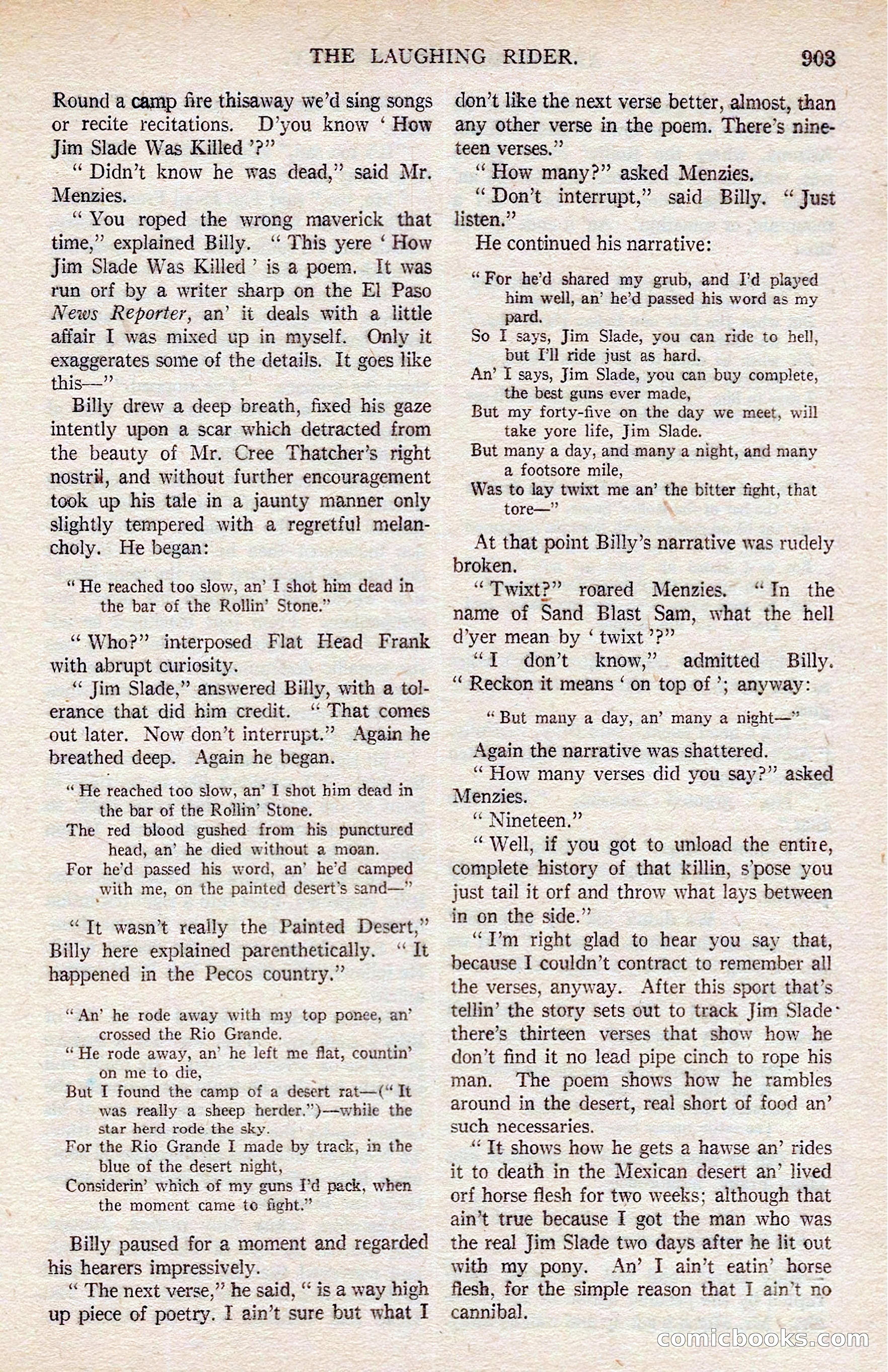
A restored page from Pulp Fiction, 1923. Page through the whole issue in the reader above.
📄 Transcribed text from this page (OCR, searchable)
Machine-transcribed from the original scan — historical spelling and the odd misread are preserved.
THE LAUGHING RIDER. Round a camp fire thisaway we’d sing songs or recite recitations. D’you know ‘ How Jim Slade Was Killed ’?”’ “ Didn’t know he was dead,” said Mr. Menzies. “You roped the wrong maverick that time,” explained Billy. “ This yere ‘ How Jim Slade Was Killed’ is a poem. It was run orf by a writer sharp on the El Paso News Reporter, an’ it deals with a little affair I was mixed up in myself. Only it exaggerates some of the details. It goes like this—”’ Billy drew a deep breath, fixed his gaze intently upen a scar which detracted from the beauty of Mr. Cree Thatcher’s right nostri, and without further encouragement took up his tale in a jaunty manner only slightly tempered with a regretful melan- choly. He began: “ He reached too slow, an’ I shot him dead in the bar of the Rollin’ Stone.” “Who?” interposed Flat Head Frank with abrupt curiosity. “ Jim Slade,” answered Billy, with a tol- erance that did him credit. ‘“ That comes out later. Now don’t interrupt.” Again he breathed deep. Again he began. “ He reached too slow, an’ I shot him dead in the bar of the Rollin’ Stone. The red blood gushed from his punctured head, an’ he died without a moan. For he'd passed his word, an’ he’d camped with me, on the painted desert’s sand—” “Tt wasn’t really the Painted Desert,” Billy here explained parenthetically. ‘ It happened in the Pecos country.” ‘An’ he rode away with my top ponee, an’ crossed the Rio Grande. “He rode away, an’ he left me flat, countin’ on me to die, : But I found the camp of a desert rat—(“ It was really a sheep herder.’’)—-while the star herd rode the sky. For the Rio Grande I made by track, in the blue of the desert night, Considerin’ which of my guns i’d pack, when the moment came to fight.” Billy paused for a moment and regarded his hearers impressively. “ The next verse,”’ he said, “ is a way high up piece of poetry. I ain’t sure but what I 903 don’t like the next verse better, almost, than any other verse in the poem. There’s nine- teen verses,” “How many?” asked Menzies. “Don’t interrupt,” said Billy. “Just listen,” He continued his narrative: “For he’d shared my grub, and I'd played him well, an’ he’d passed his word as my pard, ; So I says, Jim Slade, you can ride to hell, but I'll ride just as hard. An’ I says, Jim Slade, you can buy complete, the best guns ever made, But my forty-five on the day we meet, will take yore life, Jim Slade. But many a day, and many a night, and many a footsore mile, Was to lay twixt me an’ the bitter fight, that tore—” At that point Billy’s narrative was rudely broken. ‘““Twixt?” roared Menzies. “In the name of Sand Blast Sam, what the hell d’yer mean by ‘ twixt ’?” “J don’t know,” admitted Billy. ‘““ Reckon it means ‘ on top of’; anyway: “But many a day, an’ many a night—” Again the narrative was shattered. “How many verses did you say?” asked Menzies. ‘* Nineteen.” “Well, if you got to unload the entire, complete history of that killin, s’pose you just tail it orf and throw what lays between in on the side.”’ “Ym right glad to hear you say that, because I couldn’t contract to remember all the verses, anyway. After this sport that’s tellin’ the story sets out to track Jim Slade- there’s thirteen verses that show how he don’t find it no lead pipe cinch to rope his man. The poem shows how he rambles around in the desert, real short of food an’ such necessaries. “Tt shows how he gets a hawse an’ rides it to death in the Mexican desert an’ lived orf horse flesh for two weeks; although that ain’t true because I got the man who was the real Jim Slade two days after he lit out with my pony. An’ I ain’t eatin’ horse flesh, for the simple reason that I ain’t no cannibal. GOMIGDOOkKS (CO) in