
Pulp Fiction, 1923 · page 112 of 176
Argosy All-Story Weekly — page 112: what you’re looking at
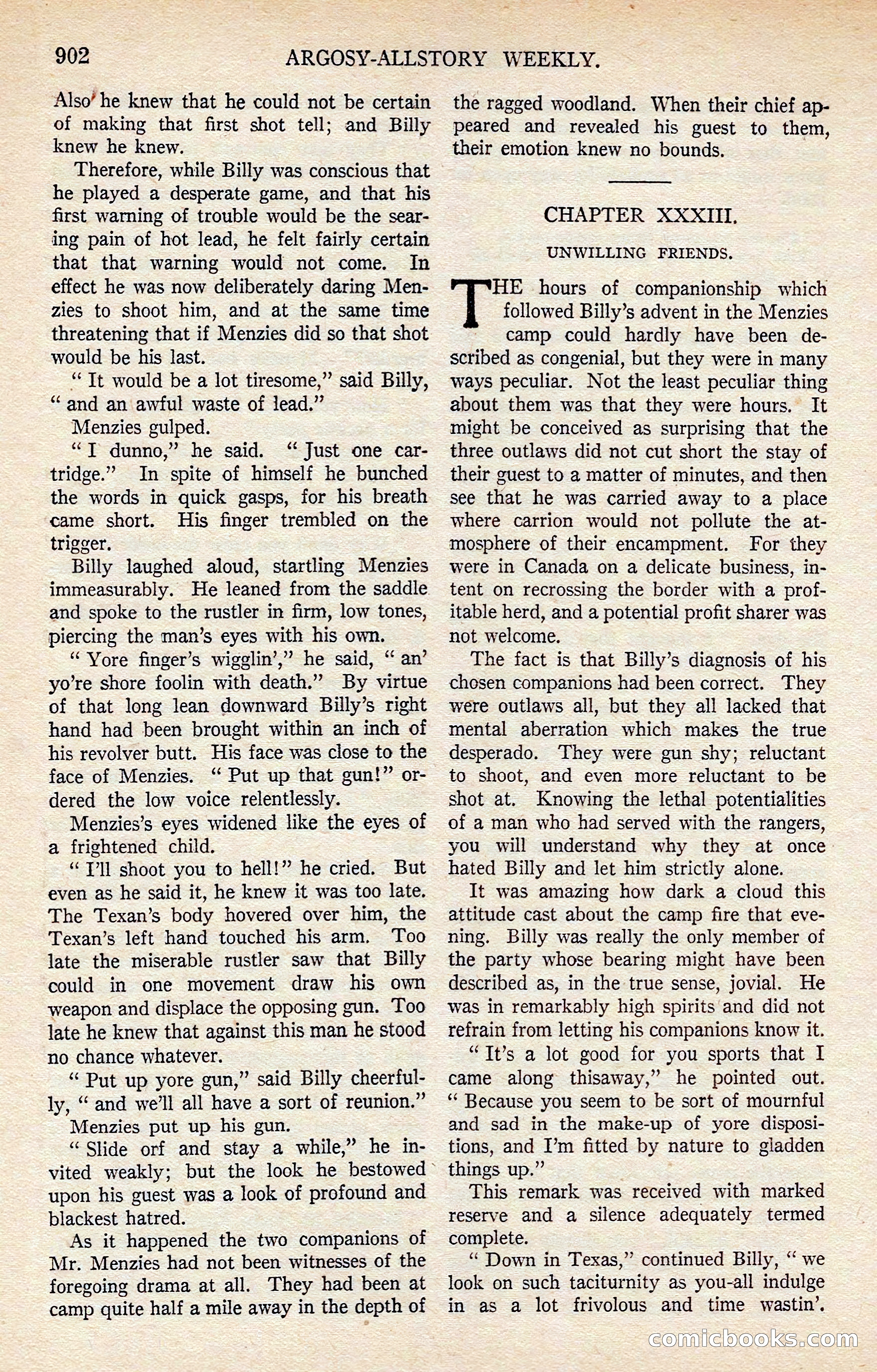
A restored page from Pulp Fiction, 1923. Page through the whole issue in the reader above.
📄 Transcribed text from this page (OCR, searchable)
Machine-transcribed from the original scan — historical spelling and the odd misread are preserved.
902 Also’ he knew that he could not be certain of making that first shot tell; and Billy knew he knew. | Therefore, while Billy was conscious that he played a desperate game, and that his first warning of trouble would be the sear- ing pain of hot lead, he felt fairly certain that that warning would not come. In effect he was now deliberately daring Men- zies to shoot him, and at the same time threatening that if Menzies did so that shot would be his last. “Tt would be a lot tiresome,” said Billy, “ and an awful waste of lead.” Menzies gulped. “T dunno,” he said. “ Just one car- tridge.” In spite of himself he bunched the words in quick gasps, for his breath came short. His finger trembled on the trigger. Billy laughed aloud, startling Menzies immeasurably. He leaned from the saddle. and spoke to the rustler in firm, low tones, piercing the man’s eyes with his own. “Yore finger’s wigglin’,” he said, ‘“ an’ yo’re shore foolin with death.” By virtue of that long lean downward Billy’s right hand had been brought within an inch of his revolver butt. His face was close to the face of Menzies. “ Put up that gun!” or- dered the low voice relentlessly. Menzies’s eyes widened like the eyes of a frightened child. “T’ll shoot you to hell!” he cried. But even as he said it, he knew it was too late. The Texan’s body hovered over him, the Texan’s left hand touched his arm. Too late the miserable rustler saw that Billy could in one movement draw his own weapon and displace the opposing gun. Too late he knew that against this man he stood no chance whatever. “Put up yore gun,” said Billy cheerful- ly, “and we'll all have a sort of reunion.” Menzies put up his gun. “Slide orf and stay a while,” he in- vited weakly; but the look he bestowed” upon his guest was a look of profound and blackest hatred. As it happened the two companions of Mr. Menzies had not been witnesses of the foregoing drama at all. They had been at camp quite half a mile away in the depth of ARGOSY-ALLSTORY WEEKLY. the ragged woodland. When their chief ap- peared and revealed his guest to them, their emotion knew no bounds. CHAPTER XXXIII, UNWILLING FRIENDS. "S ‘HE hours of companionship which followed Billy’s advent in the Menzies camp could hardly have been de- scribed as congenial, but they were in many ways peculiar. Not the least peculiar thing about them was that they were hours. It might be conceived as surprising that the three outlaws did not cut short the stay of their guest to a matter of minutes, and then see that he was carried away to a place where carrion would not pollute the at- mosphere of their encampment. For they were in Canada on a delicate business, in- tent on recrossing the border with a prof- itable herd, and a potential profit sharer was not welcome. The fact is that Billy’s diagnosis of his chosen companions had been correct. They were outlaws all, but they all lacked that mental aberration which makes the true desperado. They were gun shy; reluctant to shoot, and even more reluctant to be shot at. Knowing the lethal potentialities of a man who had served with the rangers, you will understand why they at once hated Billy and let him strictly alone. It was amazing how dark a cloud this attitude cast about the camp fire that eve- ning. Billy was really the only member of the party whose bearing might have been described as, in the true sense, jovial. He was in remarkably high spirits and did not refrain from letting his companions know it. “It’s a lot good for you sports that I came along thisaway,” he pointed out. ‘* Because you seem to be sort of mournful and sad in the make-up of yore disposi- tions, and I’m fitted by nature to gladden things up.” This remark was received with marked reserve and a silence adequately termed complete. ‘“ Down in Texas,”’ continued Billy, “ we look on such taciturnity as you-all indulge in as a lot frivolous and time wastin’. Ccopmmicoooks (CO)