
Pulp Fiction, 1923 · page 88 of 176
Argosy All-Story Weekly — page 88: what you’re looking at
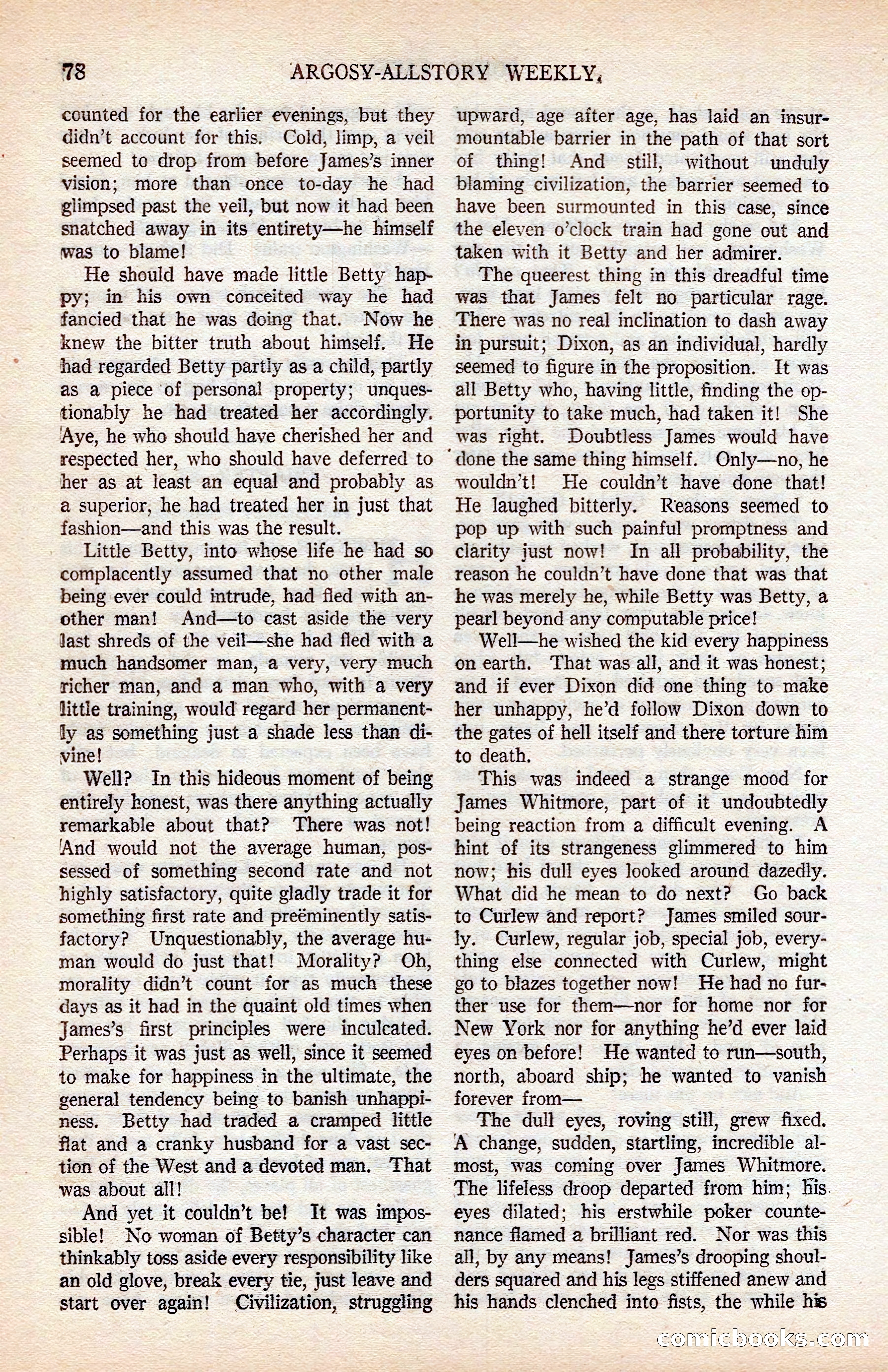
A restored page from Pulp Fiction, 1923. Page through the whole issue in the reader above.
📄 Transcribed text from this page (OCR, searchable)
Machine-transcribed from the original scan — historical spelling and the odd misread are preserved.
18 counted for the earlier evenings, but they didn’t account for this. Cold, limp, a veil seemed to drop from before James’s inner vision; more than once to-day he had glimpsed past the veil, but now it had been snatched away in its entirety—he himself was to blame! He should have made little Betty hap- py; in his own conceited way he had fancied that he was deing that. knew the bitter truth about himself, He had regarded Betty partly as a child, partly as a piece of personal property; unques- tionably he had treated her accordingly. Aye, he who should have cherished her and respected her, who should have deferred to her as at least an equal and probably as a superior, he had treated her in just that fashion—and this was the result. Little Betty, into whose life he had so complacently assumed that no other male being ever could intrude, had fled with an- other man! And—to cast aside the very Jast shreds of the veil—she had fled with a much handsomer man, a very, very much richer man, and a man who, with a very little training, would regard her permanent- ly as something just a shade less than di- vine! Well? In this hideous moment of being entirely honest, was there anything actually remarkable about that? There was not! ‘And would not the average human, pos- sessed of something second rate and not highly satisfactory, quite gladly trade it for something first rate and preéminently satis- factory? Unquestionably, the average hu- man would do just that! Morality? Oh, morality didn’t count for as much these days as it had in the quaint old times when James’s first principles were inculcated. Perhaps it was just as well, since it seemed to make for happiness in the ultimate, the general tendency being to banish unhappi- ness. Betty had traded a cramped little flat and a cranky husband for a vast sec- tion of the West and a devoted man. That was about all! And yet it couldn’t be! It was impos- sible! No woman of Betty’s character can thinkably toss aside every responsibility like an old glove, break every tie, just leave and start over again! Civilization, struggling Now he_ ARGOSY-ALLSTORY WEEKLY, upward, age aiter age, has laid an insur- mountable barrier in the path of that sort of thing! And _ still, without unduly blaming civilization, the barrier seemed to have been surmounted in this case, since the eleven o’clock train had gone out and taken with it Betty and her admirer. The queerest thing in this dreadful time was that James felt no particular rage. There was no real inclination to dash away in pursuit; Dixon, as an individual, hardly seemed to figure in the proposition. It was all Betty who, having little, finding the op- portunity to take much, had taken it! She was right. Doubtless James would have ‘done the same thing himself. Only—no, he wouldn’t! He couldn’t have done that! He laughed bitterly. Reasons seemed to pop up with such painful promptness and clarity just now! In all probability, the reason he couldn’t have done that was that he was merely he, while Betty was Betty, a pearl beyond any computable price! Well—he wished the kid every happiness on earth. That was all, and it was honest; and if ever Dixon did one thing to make her unhappy, he’d follow Dixon down to the gates of hell itself and there torture him to death. This was indeed a strange mood for James Whitmore, part of it undoubtedly being reaction from a difficult evening. A hint of its strangeness glimmered to him now; his dull eyes looked around dazedly. What did he mean to do next? Go back to Curlew and report? James smiled sour- ly. Curlew, regular job, special job, every- thing else connected with Curlew, might go to blazes together now! He had no fur- ther use for them—nor for home nor for New York nor for anything he’d ever laid eyes on before! He wanted to run—south, north, aboard ship; he wanted to vanish forever from— The dull eyes, roving still, grew fixed. A change, sudden, startling, incredible al- most, was coming over James Whitmore. The lifeless droop departed from him; his. eyes dilated; his erstwhile poker counte- nance flamed a brilliant red. Nor was this all, by any means! James’s drooping shoul- ders squared and his legs stiffened anew and his hands clenched into fists, the while his COMME OOOKSs CO