
Pulp Fiction, 1923 · page 87 of 176
Argosy All-Story Weekly — page 87: what you’re looking at
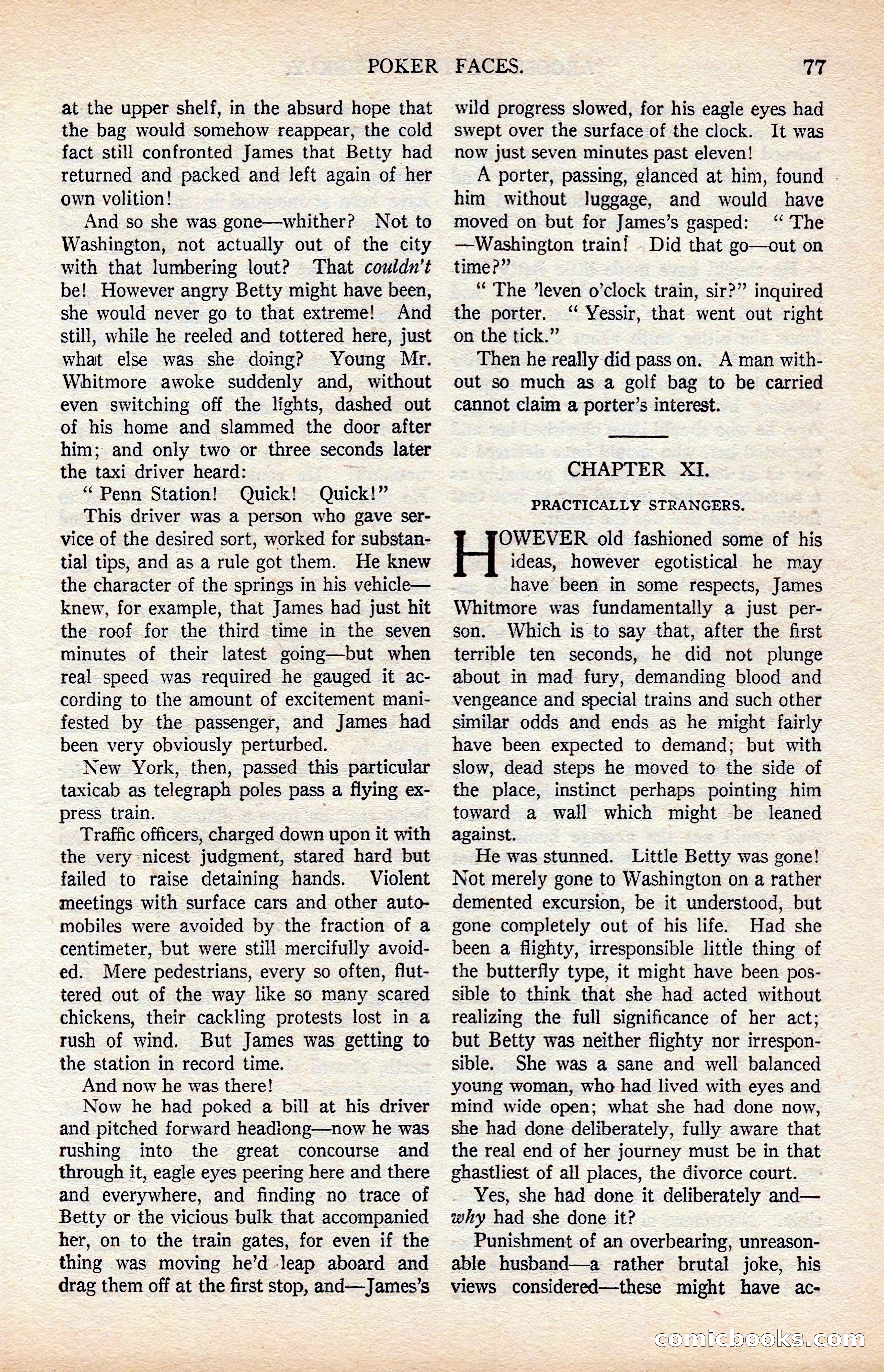
A restored page from Pulp Fiction, 1923. Page through the whole issue in the reader above.
📄 Transcribed text from this page (OCR, searchable)
Machine-transcribed from the original scan — historical spelling and the odd misread are preserved.
POKER at the upper shelf, in the absurd hope that the bag would somehow reappear, the cold fact still confronted James that Betty had returned and packed and left again of her own volition! And so she was gone—whither? Not to Washington, not actually out of the city with that lumbering lout? That couldn’t be! However angry Betty might have been, she would never go to that extreme! And still, while he reeled and tottered here, just what else was she doinge Young Mr. Whitmore awoke suddenly and, without even switching off the lights, dashed out of his home and slammed the door after him; and only two or three seconds later the taxi driver heard: : “Penn Station! Quick! Quick!” This driver was a person who gave ser- vice of the desired sort, worked for substan- tial tips, and as a rule got them. He knew the character of the springs in his vehicle— knew, for example, that James had just hit the roof for the third time in the seven minutes of their latest going—but when real speed was required he gauged it ac- cording to the amount of excitement mani- fested by the passenger, and James had been very obviously perturbed. New York, then, passed this particular taxicab as telegraph poles pass a flying ex- press train. Traffic officers, charged down upon it with the very nicest judgment, stared hard but failed to raise detaining hands. Violent meetings with surface cars and other auto- mobiles were avoided by the fraction of a centimeter, but were still mercifully avoid- ed. Mere pedestrians, every so often, flut- tered out of the way like so many scared chickens, their cackling protests lost in a rush of wind. But James was getting to the station in record time. And now he was there! Now he had poked a bill at his driver and pitched forward headiong—now he was rushing into the great concourse and through it, eagle eyes peering here and there and everywhere, and finding no trace of Betty or the vicious bulk that accompanied her, on to the train gates, for even if the thing was moving he’d leap aboard and drag them off at the first stop, and—James’s FACES. 17 wild progress slowed, for his eagle eyes had swept over the surface of the clock. It was now just seven minutes past eleven! A porter, passing, glanced at him, found . him without luggage, and would have moved on but for James’s gasped: ‘‘ The —Washington train! _ Did that go—out on time?” ‘The ‘leven o’clock train, sir?” inquired the porter. ‘‘ Yessir, that went out right on the tick.” Then he really did pass on. A man with- out so much as a golf bag to be carried cannot claim a porter’s interest. CHAPTER XI. PRACTICALLY STRANGERS. OWEVER old fashioned some of his ideas, however egotistical he may have been in some respects, James Whitmore was fundamentally a just per- son. Which is to say that, after the first terrible ten seconds, he did not plunge about in mad fury, demanding blood and vengeance and special trains and such other similar odds and ends as he might fairly have been expected to demand; but with slow, dead steps he moved to the side of the place, instinct perhaps pointing him toward a wall which might be leaned against. He was stunned. Little Betty was gone! Not merely gone to Washington on a rather demented excursion, be it understood, but gone completely out of his life. Had she been a flighty, irresponsible little thing of the butterfly type, it might have been pos- sible to think that she had acted without realizing the full significance of her act; but Betty was neither flighty nor irrespon- sible. She was a sane and well balanced young woman, who had lived with eyes and mind wide open; what she had done now, she had done deliberately, fully aware that the real end of her journey must be in that ghastliest of all places, the divorce court. Yes, she had done it deliberately and— why had she done it? Punishment of an overbearing, unreason- able husband—a rather brutal joke, his views considered—these might have ac- Eomichbooks (S@)