
Pulp Fiction, 1923 · page 169 of 172
Argosy All-Story Weekly — page 169: what you’re looking at
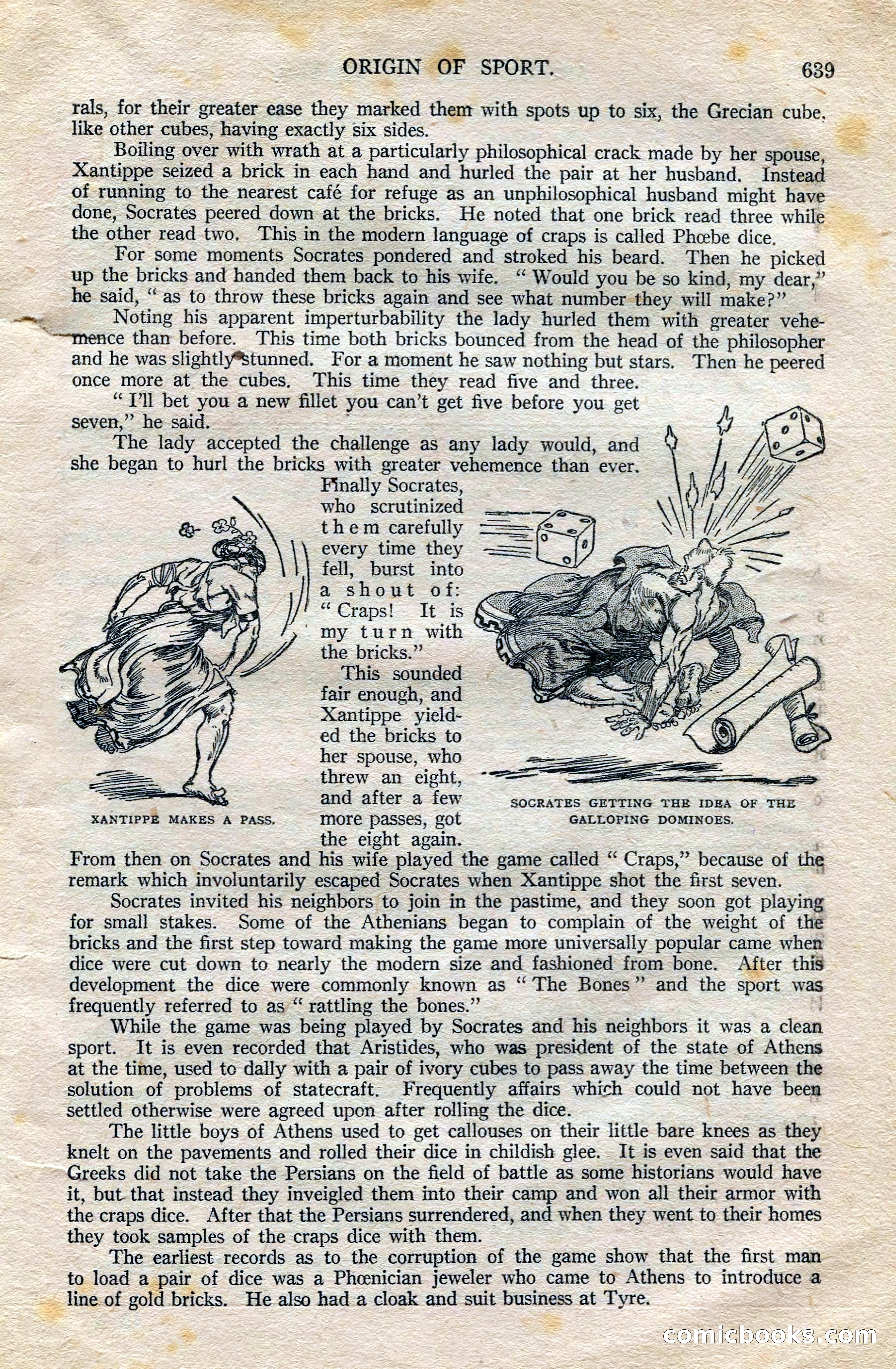
A restored page from Pulp Fiction, 1923. Page through the whole issue in the reader above.
📄 Transcribed text from this page (OCR, searchable)
Machine-transcribed from the original scan — historical spelling and the odd misread are preserved.
ee rals, for their greater ease they marked them with spots up to six, the Grecian cube. like other cubes, having exactly six sides. _ 7 : _ Boiling over with wrath at a particularly philosophical crack made by her spouse, Xantippe seized a brick in each hand and hurled the pair at her husband, Instead of running to the nearest café for refuge as an unphilosophical husband might have the other read two, This in the modern language of craps is called Phcebe dice. For some moments Socrates pondered and stroked his beard. Then he picked up the bricks and handed them back to his wife. ‘ Would you be so kind, my dear,” he said, “as to throw these bricks again and see what number they will make?” Noting his apparent imperturbability the lady hurled them with greater vehe- “«mence than before. This time both bricks bounced from the head of the philosopher _ line of gold bricks. He also had a cloak and suit business at Tyre. Ss and he was slightly*stunned. For a moment he saw nothing but stars. Then he peered once more at the cubes. This time they read five and three. ~ Tl bet you a new fillet you can’t get five before you get seven,” he said. } dh | " The lady accepted the challenge as any lady would, and / Yy A she began to hurl the bricks with greater vehemence than ever. My} Finally Socrates, ra Yl, who scrutinized yy 5 them carefully —==—+/ \\ | y LEZ every time they SE fell, burst into 2 Sh 010 “Craps! It is K&& ‘my turn with the bricks.” | _ This sounded fair enough, and Xantippe yield- ed the bricks to her spouse, who threw an eight, 3 a and after a few SOCRATES GETTING THE IDEA OF THE XANTIPPE MAKES A PASS, more passes, got GALLOPING DOMINOES. the eight again. From then on Socrates and his wife played the game called “ Craps,” because of the remark which involuntarily escaped Socrates when Xantippe shot the first seven. _ Socrates invited his neighbors to join in the pastime, and they soon got playing for small stakes. Some of the Athenians began to complain of the weight of the bricks and the first step toward making the game more universally popular came when dice were cut down to nearly the modern size and fashioned from bone. After this development the dice were commonly known as “ The Bones” and the sport was frequently referred to as “‘ rattling the bones.” ; While the game was being played by Secrates and his neighbors it was a clean sport. It is even recorded that Aristides, who was president of the state of Athens at the time, used te dally with a pair of ivory cubes to pass away the time between the solution of problems of statecraft. Frequently affairs which could not have been settled otherwise were agreed upon after rolling the dice. 2 The little boys of Athens used to get callouses on their little bare knees as they knelt on the pavements and rolled their dice in childish glee. It is even said that the Greeks did not take the Persians on the field of battle as some historians would have it, but-that instead they inveigled them into their camp and won all their armor with the craps dice. After that the Persians surrendered, and when they went to their homes they took samples of the craps dice with them. : * SPORT. ~~ 689 a rer, — Oe. = Sang done, Socrates peered down at the bricks. He noted that one brick read three while — The earliest records as to the corruption of the game show that the first man to load a pair of dice was a Phoenician jeweler who came to Athens to introduce a at Ss EOMMIE NOOKS (COA AES