
Pulp Fiction, 1923 · page 168 of 172
Argosy All-Story Weekly — page 168: what you’re looking at
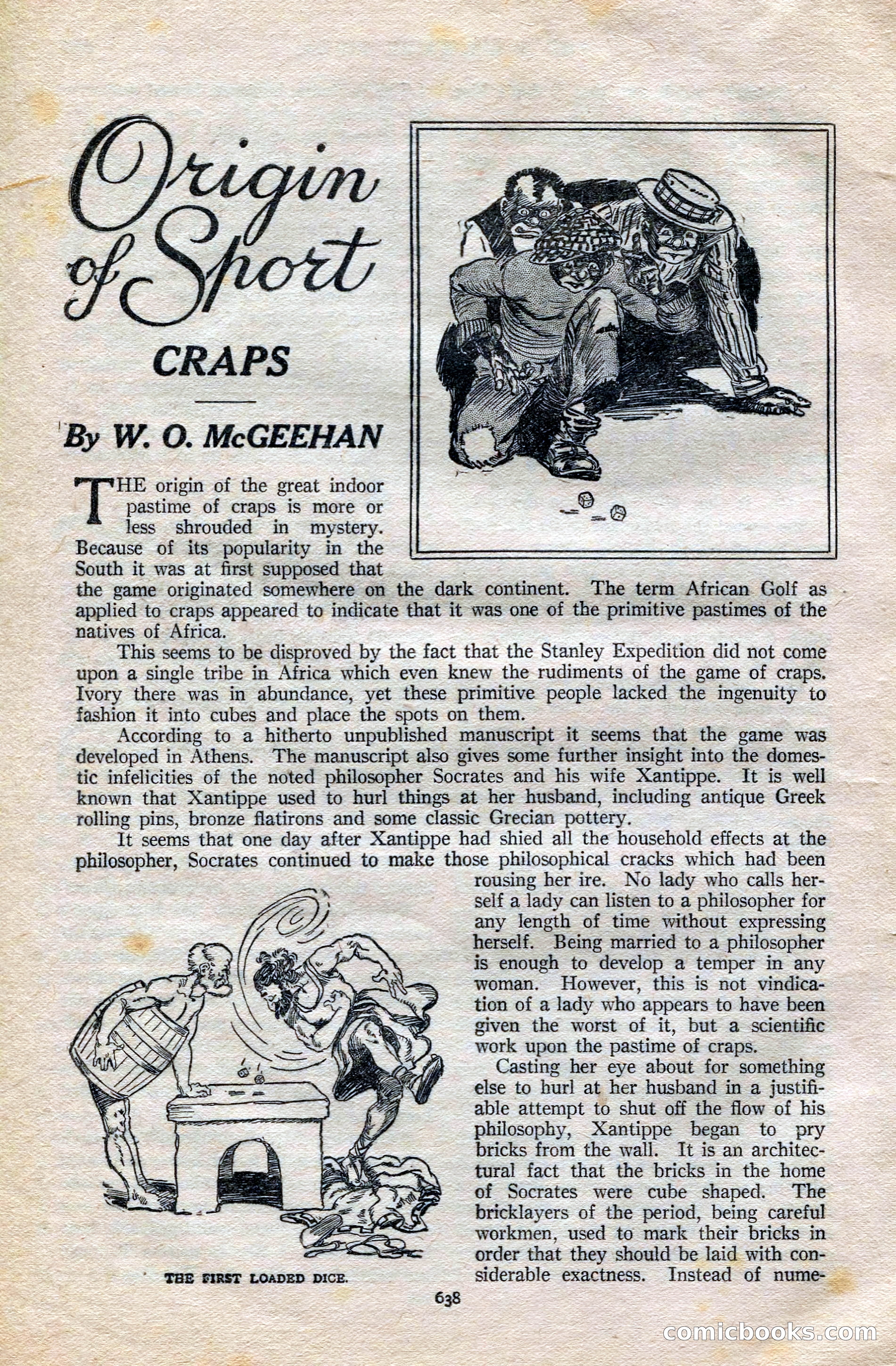
A restored page from Pulp Fiction, 1923. Page through the whole issue in the reader above.
📄 Transcribed text from this page (OCR, searchable)
Machine-transcribed from the original scan — historical spelling and the odd misread are preserved.
CRAPS By W. O. McGEEHAN HE origin of the great indoor pastime of craps is more or less shrouded in mystery. Because of its popularity in the South it was at first supposed that i the game originated somewhere on the dark continent. The term African Golf as . applied to craps appeared to indicate that it was one of the primitive pastimes of the — natives of Africa. This seems to be disproved by the fact that the Stanley Expedition did not come upon a single tribe in Africa which even knew the rudiments of the game of craps. Ivory there was in abundance, yet these primitive people lacked the ingenuity to fashion it into cubes and place the spots on them. 3 According to a hitherto unpublished manuscript it seems that the game was developed in Athens. The manuscript also gives some further insight into the domes- tic infelicities of the noted philosopher Socrates and his wife Xantippe. It is well known that Xantippe used to hurl things at her husband, including antique Greek rolling pins, bronze flatirons and some classic Grecian pottery. It seems that one day after Xantippe had shied all the household effects at the philosopher, Socrates continued to make those philosophical cracks which had been . rousing her ire. No lady who calls her- self a lady can listen to a philosopher for any length of time without expressing herself. Being married to a philosopher ‘is enough to develop a temper in any woman. However, this is not vindica- tion of a lady who appears to have been given the worst of it, but a scientific work upon the pastime of craps. Casting her eye about for something else to hurl at her husband in a justifi- able attempt to shut off the flow of his philosophy, Xantippe began to pry bricks from the wall. It is an architec- tural fact that the bricks in the home of Socrates were cube shaped. The bricklayers of the period, being careful workmen, used to mark their bricks in order that they should be laid with con- siderable exactness. Instead of nume- Jt GomichooksEeo