
Pulp Fiction, 1923 · page 161 of 180
Argosy All-Story Weekly — page 161: what you’re looking at
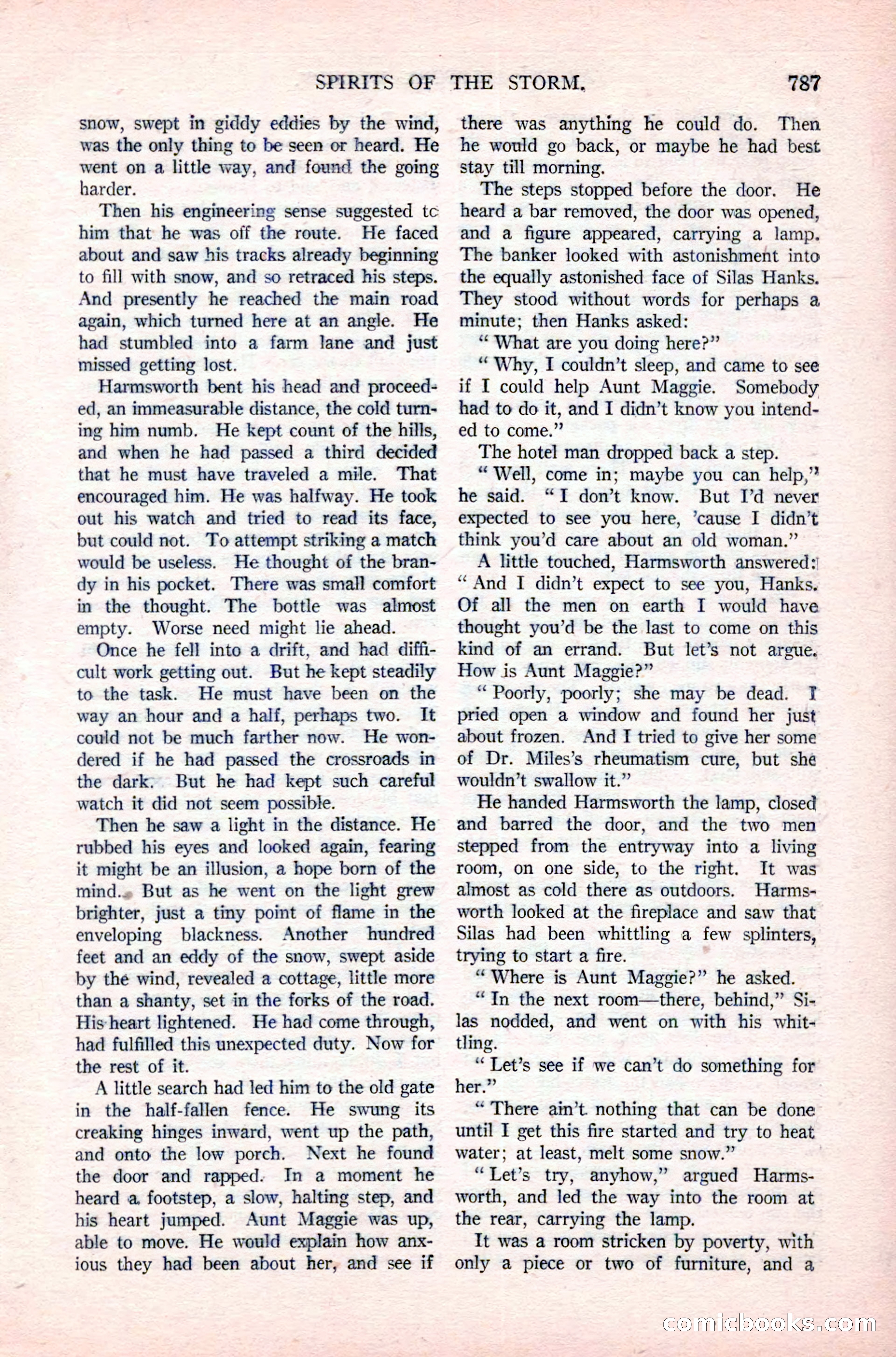
A restored page from Pulp Fiction, 1923. Page through the whole issue in the reader above.
📄 Transcribed text from this page (OCR, searchable)
Machine-transcribed from the original scan — historical spelling and the odd misread are preserved.
SPIRITS OF THE STORM, snow, swept in giddy eddies by the wind, was the only thing to be seen or heard. He went on a little way, and found the going harder. Then his engineering sense suggested tc him that he was off the route. He faced about and saw his tracks already beginning to fill with snow, and so retraced his steps. And presently he reached the main road again, which turned here at an angle. He had stumbled into a farm lane and just missed getting lost. Harmsworth bent his head and proceed- ed, an immeasurable distance, the cold turn- ing him numb. He kept count of the hills, and when he had passed a third decided that he must have traveled a mile. That encouraged him. He was halfway. He took out his watch and tried to read its face, but could not. To attempt striking a match would be useless. He thought of the bran- dy in his pocket. There was small comfort in the thought. The bottle was almost empty. Worse need might lie ahead. Once he fell into a drift, and had diffi- cult work getting out. But he kept steadily to the task. He must have been on the way an hour and a half, perhaps two. It could not be much farther now. He won- dered if he had passed the crossroads in the dark: But he had kept such careful watch it did not seem possible. Then he saw a light in the distance. He rubbed his eyes and looked again, fearing it might be an illusion, a hope born of the mind.» But as he went on the light grew brighter, just a tiny point of flame in the enveloping blackness. Another hundred feet and an eddy of the snow, swept aside by the wind, revealed a cottage, little more than a shanty, set in the forks of the road. His: heart lightened. He had come through, had fulfilled this unexpected duty. Now for the rest of it. A little search had led him to the old gate in the half-fallen fence. He swung its creaking hinges inward, went up the path, and onto the low porch. Next he found the door and rapped. In a moment he heard a. footstep, a slow, halting step, and his heart jumped. Aunt Maggie was up, able to move. He would explain how anx- ious they had been about her, and see if 787 there was anything he could do. Then he would go back, or maybe he had best stay till morning. The steps stopped before the door. He heard a bar removed, the door was opened, and a figure appeared, carrying a lamp. The banker looked with astonishment into the equally astonished face of Silas Hanks. They stood without words for perhaps a minute; then Hanks asked: “What are you doing here?” “Why, I couldn’t sleep, and came to see if I could help Aunt Maggie. Somebody had to do it, and I didn’t know you intend- ed to come.” The hotel man dropped back a step. “Well, come in; maybe you can help,” he said. “I don’t know. But I’d never expected to see you here, ‘cause I didn’t think you’d care about an old woman.” A little touched, Harmsworth answered:) “And I didn’t expect to see you, Hanks. Of all the men on earth I would have thought you’d be the last to come on this kind of an errand. But let’s not argue. How is Aunt Maggie?” “Poorly, poorly; she may be dead. T pried open a window and found her just about frozen. And I tried to give her some of Dr. Miles’s rheumatism cure, but she wouldn’t swallow it.” He handed Harmsworth the lamp, closed and barred the door, and the two men stepped from the entryway into a living room, on one side, to the right. It was almost as cold there as outdoors. Harms- worth looked at the fireplace and saw that Silas had been whittling a few splinters, trying to start a fire. | “Where is Aunt Maggie?” he asked. “In the next room—there, behind,” Si- las nodded, and went on with his whit- tling. “ Let’s see if we can’t do something for her.” “There ain’t. nothing that can be done until I get this fire started and try to heat water; at least, melt some snow.” “'Let’s try, anyhow,” argued Harms- worth, and led the way into the room at the rear, carrying the lamp. It was a room stricken by poverty, with only a piece or two of furniture, and a CoOnmmicloooks (C@