
Pulp Fiction, 1923 · page 160 of 180
Argosy All-Story Weekly — page 160: what you’re looking at
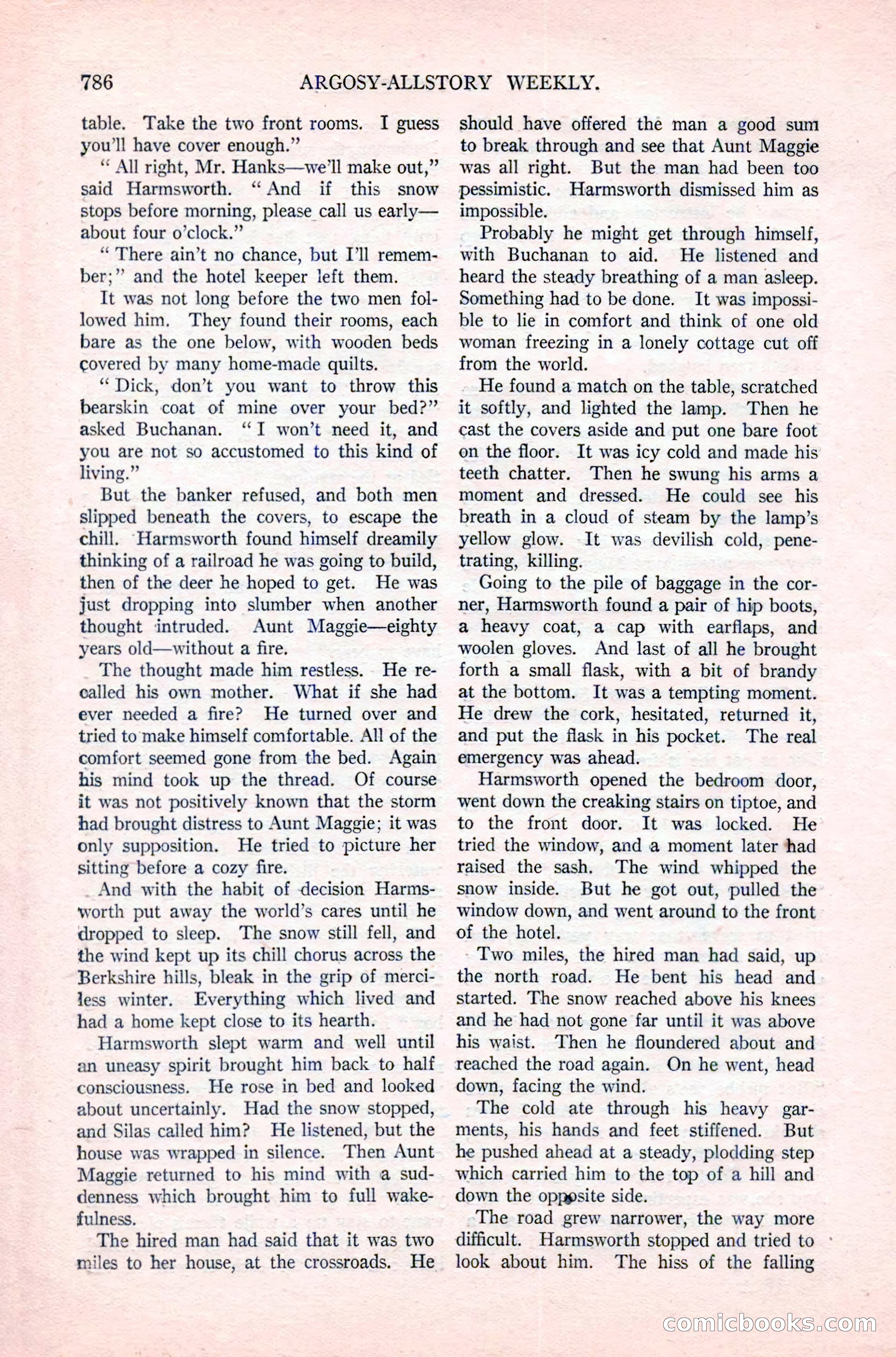
A restored page from Pulp Fiction, 1923. Page through the whole issue in the reader above.
📄 Transcribed text from this page (OCR, searchable)
Machine-transcribed from the original scan — historical spelling and the odd misread are preserved.
786 table. Take the two front rooms. I guess you'll have cover enough.” * All right, Mr. Hanks—we'll make out,” said Harmsworth. “And if this snow stops before morning, please call us early— about four o’clock.” “There ain’t no chance, but I’ll remem- ber;”’ and the hotel keeper left them. It was not long before the two men fol- lowed him. They found their rooms, each bare as the one below, with wooden beds covered by many home-made quilts. “ Dick, don’t you want to throw this bearskin coat of mine over your bed?” asked Buchanan. “I won’t need it, and you are not so accustomed to this kind of living.” But the banker refused, and both men slipped beneath the covers, to escape the chill. “Harmsworth found himself dreamily thinking of a railroad he was going to build, then of the deer he hoped to get. He was just dropping into slumber when another thought intruded. Aunt Maggie—eighty years old—without a fire. The thought made him restless. He re- called his own mother. What if she had ever needed a fire? He turned over and tried to make himself comfortable. All of the comfort seemed gone from the bed. Again his mind took up the thread. Of course it was not positively known that the storm had brought distress to Aunt Maggie; it was only supposition. He tried to picture her sitting before a cozy fire. And with the habit of decision Harms- worth put away the world’s cares until he dropped to sleep. The snow still fell, and the wind kept up its chill chorus across the Berkshire hills, bleak in the grip of merci- less winter. Everything which lived and had a home kept close to its hearth. Harmsworth slept warm and well until an uneasy spirit brought him back to half consciousness. He rose in bed and looked about uncertainly. Had the snow stopped, and Silas called him? He listened, but the house was wrapped in silence. Then Aunt Maggie returned to his mind with a sud- denness which brought him to full wake- fulness. The hired man had said that it was two miles to her house, at the crossroads. He ARGOSY-ALLSTORY WEEKLY. should have offered the man a good sum to break through and see that Aunt Maggie was all right. But the man had been too pessimistic. Harmsworth dismissed him as impossible. Probably he might get through himself, with Buchanan to aid. He listened and heard the steady breathing of a man asleep. Something had to be done. It was impossi- ble to lie in comfort and think of one old woman freezing in a lonely cottage cut off from the world. He found a match on the table, scratched it softly, and lighted the lamp. Then he cast the covers aside and put one bare foot on the floor. It was icy cold and made his teeth chatter. Then he swung his arms a moment and dressed. He could see his breath in a cloud of steam by the lamp’s yellow glow. It was devilish cold, pene- trating, killing. Going to the pile of baggage in the cor- ner, Harmsworth found a pair of hip boots, a heavy coat, a cap with earflaps, and woolen gloves. And last of all he brought forth a small flask, with a bit of brandy at the bottom. It was a tempting moment. He drew the cork, hesitated, returned it, and put the flask in his pocket. The real emergency was ahead. Harmsworth opened the bedroom door, went down the creaking stairs on tiptoe, and to the front door. It was locked. He tried the window, and a moment later thad raised the sash. The wind whipped the snow inside. But he got out, pulled the window down, and went around to the front of the hotel. Two miles, the hired man had said, up the north road. He bent his head and started. The snow reached above his knees and he had not gone far until it was above his waist. Then he floundered about and reached the road again. On he went, head down, facing the wind. The cold ate through his heavy gar- ments, his hands and feet stiffened. But he pushed ahead at a steady, plodding step which carried him to the top of a hill and down the oppgsite side. The road grew narrower, the way more difficult. Harmsworth stopped and tried to look about him. The hiss of the falling COmMiCLoooks (C@