
Pulp Fiction, 1923 · page 128 of 180
Argosy All-Story Weekly — page 128: what you’re looking at
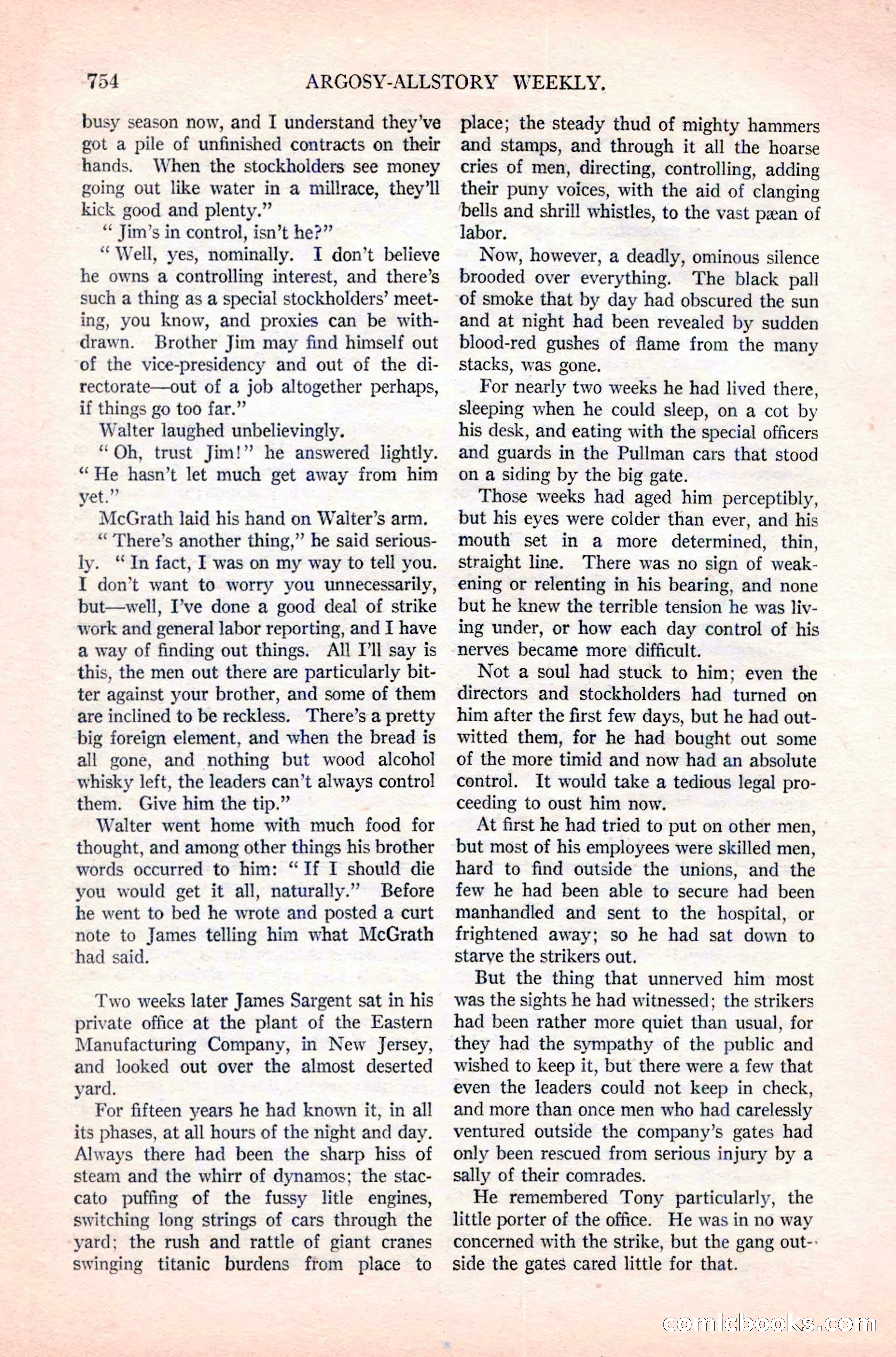
A restored page from Pulp Fiction, 1923. Page through the whole issue in the reader above.
📄 Transcribed text from this page (OCR, searchable)
Machine-transcribed from the original scan — historical spelling and the odd misread are preserved.
754 busy season now, and I understand they’ve got a pile of unfinished contracts on their hands. When the stockholders see money going out like water in a millrace, they’ll kick good and plenty.” “* Jim’s in control, isn’t he?” “Well, yes, nominally. I don’t believe he owns a controlling interest, and there’s such a thing as a special stockholders’ meet- ing, you know, and proxies can be with- drawn. Brother Jim may find himself out of the vice-presidency and out of the di- rectorate—out of a job altogether perhaps, if things go too far.” Walter laughed unbelievingly. “Oh, trust Jim!” he answered lightly. “He hasn’t let much get away from him yet.” McGrath laid his hand on Walter’s arm. “ There’s another thing,” he said serious- ly. “In fact, I was on my way to tell you. I don’t want to worry you unnecessarily, but—well, I’ve done a good deal of strike work and general labor reporting, and I have a way of finding out things. All I'll say is this, the men out there are particularly bit- ter against your brother, and some of them are inclined to be reckless. There’s a pretty big foreign element, and when the bread is all gone, and nothing but wood alcohol whisky left, the leaders can’t always control them. Give him the tip.” Walter went home with much food for thought, and among other things his brother words occurred to him: “If I should die you would get it all, naturally.” Before he went to bed he wrote and posted a curt note to James telling him what McGrath had said. Two weeks later James Sargent sat in his private office at the plant of the Eastern Manufacturing Company, in New Jersey, and looked out over the almost deserted yard. For fifteen years he had known it, in all its phases, at all hours of the night and day. Always there had been the sharp hiss of steam and the whirr of dynamos; the stac- cato puffing of the fussy litle engines, switching long strings of cars through the yard; the rush and rattle of giant cranes swinging titanic burdens ftom place to ARGOSY-ALLSTORY WEEKLY, place; the steady thud of mighty hammers and stamps, and through it all the hoarse cries of men, directing, controlling, adding their puny voices, with the aid of clanging bells and shrill whistles, to the vast pean of labor. Now, however, a deadly, ominous silence brooded over everything. The black pall of smoke that by day had obscured the sun and at night had been revealed by sudden blood-red gushes of flame from the many stacks, was gone. For nearly two weeks he had lived there, sleeping when he could sleep, on a cot by his desk, and eating with the special officers and guards in the Pullman cars that stood on a siding by the big gate. Those weeks had aged him perceptibly, but his eyes were colder than ever, and his mouth set in a more determined, thin, straight line. There was no sign of weak- ening or relenting in his bearing, and none but he knew the terrible tension he was liv- ing under, or how each day control of his nerves became more difficult. Not a soul had stuck to him; even the directors and stockholders had turned on him after the first few days, but he had out- witted them, for he had bought out some of the more timid and now had an absolute control. It would take a tedious legal pro- ceeding to oust him now. At first he had tried to put on other men, but most of his employees were skilled men, hard to find outside the unions, and the few he had been able to secure had been manhandled and sent to the hospital, or frightened away; so he had sat down to starve the strikers out. But the thing that unnerved him most was the sights he had witnessed; the strikers had been rather more quiet than usual, for they had the sympathy of the public and wished to keep it, but there were a few that even the leaders could not keep in check, and more than once men who had carelessly ventured outside the company’s gates had only been rescued from serious injury by a sally of their comrades. He remembered Tony particularly, the little porter of the office. He was in no way concerned with the strike, but the gang out-: side the gates cared little for that. COmicloooks (C@