
Pulp Fiction, 1923 · page 127 of 180
Argosy All-Story Weekly — page 127: what you’re looking at
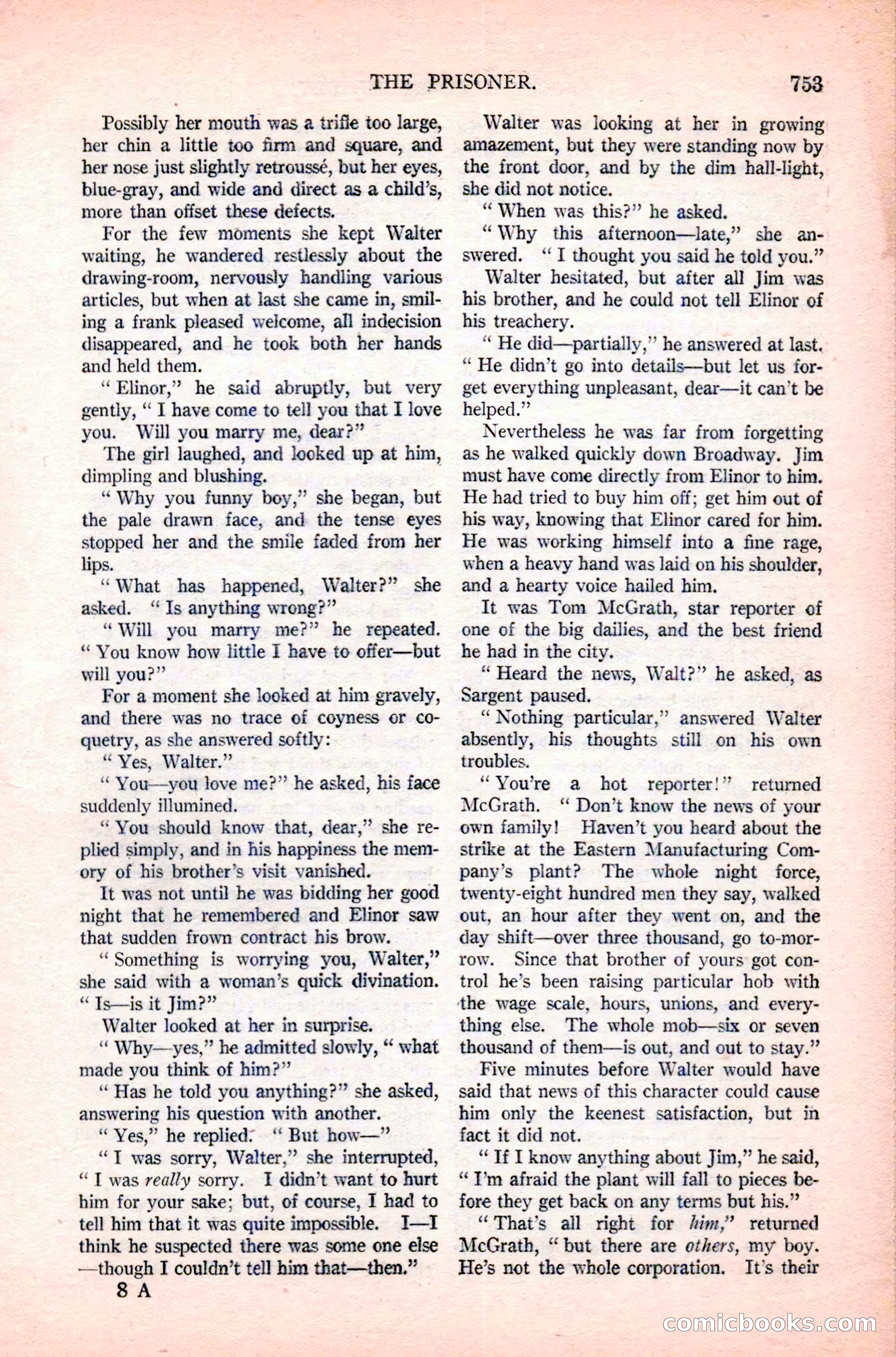
A restored page from Pulp Fiction, 1923. Page through the whole issue in the reader above.
📄 Transcribed text from this page (OCR, searchable)
Machine-transcribed from the original scan — historical spelling and the odd misread are preserved.
THE PRISONER. Possibly her mouth was a trifle too large, her chin a little too firm and square, and her nose just slightly retroussé, but her eyes, blue-gray, and wide and direct as a child’s, more than offset these defects. For the few moments she kept Walter waiting, he wandered restlessly about the drawing-room, nervously handling various articles, but when at last she came in, smil- ing a frank pleased welcome, all indecision disappeared, and he took both her hands and held them. “Elinor,” he said abruptly, but very gently, “ I have come to tell you that I love you. Will you marry me, dear?” The girl laughed, and looked up at him, dimpling and blushing. “Why you funny boy,” she began, but the pale drawn face, and the tense eyes stopped her and the smile faded from her lips. “What has happened, Walter?” she asked. “Is anything wrong?” “Will you marry me?” he repeated. “ You know how little I have to offer—but will you?” For a moment she looked at him gravely, and there was no trace of coyness or co- quetry, as she answered softly: “Yes, Walter.” ‘““ You—you love me?” he asked, his face suddenly illumined. “You should know that, dear,” she re- plied simply, and in his happiness the mem- ory of his brother’s visit vanished. It was not until he was bidding her good night that he remembered and Elinor saw that sudden frown contract his brow. “ Something is worrying you, Walter,” she said with a woman’s quick divination. “ Ts—is it Jim?” Walter looked at her in surprise. ‘“ Why—yes,” he admitted slowly, “ what made you think of him?” ‘Has he told you anything?” she asked, answering his question with another. “Ves,” he replied: ‘“ But how—” “T was sorry, Walter,” she interrupted, “T was really sorry. I didn’t want to hurt him for your sake; but, of course, I had to tell him that it was quite impossible. I—I think he suspected there was some one else —though I couldn’t tell him that—then.” 8 A Walter was looking at her in growing amazement, but they were standing now by the front door, and by the dim hall-light, she did not notice. “When was this?” he asked. “Why this afternoon—late,” she an- swered. ‘I thought you said he told you.” Walter hesitated, but after all Jim was his brother, and he could not tell Elinor of his treachery. “ He did—partially,” he answered at last. “He didn’t go into details—but let us for- get everything unpleasant, dear—it can’t be helped.” Nevertheless he was far from forgetting as he walked quickly down Broadway. Jim must have come directly from Elinor to him. He had tried to buy him off; get him out of his way, knowing that Elinor cared for him. He was working himself into a fine rage, when a heavy hand was laid on his shoulder, and a hearty voice hailed him. It was Tom McGrath, star reporter of one of the big dailies, and the best friend he had in the city. ‘Heard the news, Walt?” he asked, as Sargent paused. “ Nothing particular,’ answered Walter absently, his thoughts still on his own troubles. “You're a_ hot reporter!’”’ returned McGrath. “ Don’t know the news of your own family! Haven’t you heard about the strike at the Eastern Manufacturing Com- pany’s plant? The whole night force, twenty-eight hundred men they say, walked out, an hour after they went on, and the day shift—over three thousand, go to-mor- row. Since that brother of yours got con- trol he’s been raising particular hob with the wage scale, hours, unions, and every- thing else. The whole mob—six or seven thousand of them—is out, and out to stay.” Five minutes before Walter would have said that news of this character could cause him only the keenest satisfaction, but in fact it did not. “ Tf I know anything about Jim,” he said, “ T’m afraid the plant will fall to pieces be- fore they get back on any terms but his.” “That’s all right for fim,’ returned McGrath, “ but there are others, my boy. He’s not the whole corporation. It’s their Gomichbooks 753 (C@