
Pulp Fiction, 1919 · page 77 of 196
Argosy and Railroad Man's Magazine — page 77: what you’re looking at
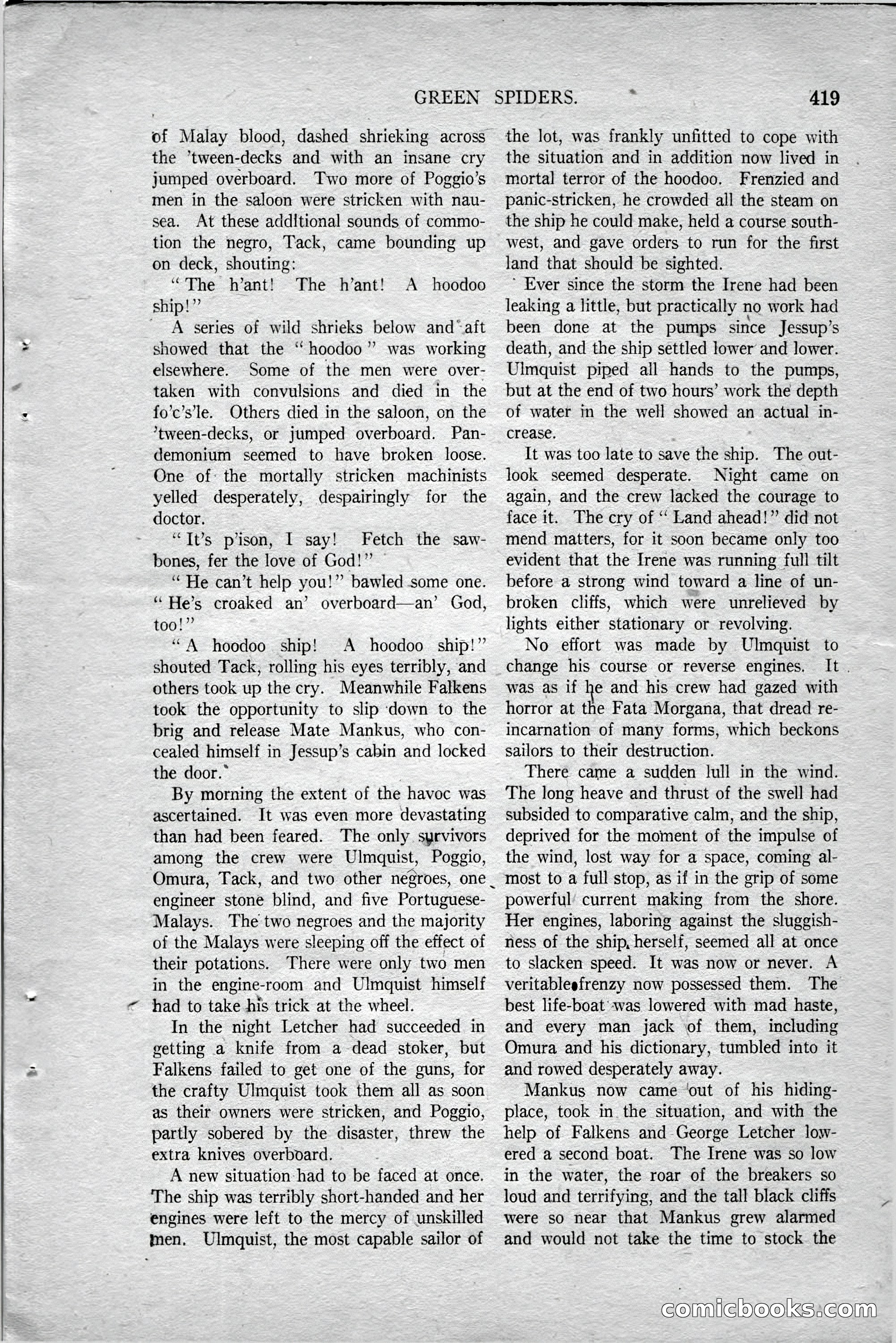
A restored page from Pulp Fiction, 1919. Page through the whole issue in the reader above.
📄 Transcribed text from this page (OCR, searchable)
Machine-transcribed from the original scan — historical spelling and the odd misread are preserved.
vv 4 GREEN of Malay blood, dashed shrieking across the ’tween-decks and with an insane cry jumped overboard. Two more of Poggio’s men in the saloon were stricken with nau- sea. At these additional sounds of commo- tion the negro, Tack, came bounding up on deck, shouting: “The h’ant! The h’ant! A hoodoo ship!” A series of wild shrieks below and “aft showed that the “hoodoo” was working elsewhere. Some of the men were over- taken with convulsions and died in the fo’c’s'le. Others died in the saloon, on the *tween-decks, or jumped overboard. Pan- demonium seemed to have broken loose. One of: the mortally stricken machinists yelled desperately, despairingly for the doctor. “Tt’s pison, I say! Fetch the saw- bones, fer the love of God!” “He can’t help you!” bawled some one. “ He’s croaked an’ overboard—an’ God, too!” “§ hoodoo ship! A hoodoo ship shouted Tack, rolling his eyes terribly, and others took up the cry. Meanwhile Falkens took the opportunity to slip ‘down to the brig and release Mate Mankus, who con- cealed himself in Jessup’s cabin and locked the door.” By morning the extent of the havoc was ascertained. It was even more devastating than had been feared. The only syrvivors among the crew were Ulmquist, Poggio, 4? Omura, Tack, and two other negroes, one _ engineer stone blind, and five Portuguese- Malays. The two negroes and the majority of the Malays were sleeping off the effect of their potations. There were only two men in the engine-room and Ulmquist himself had to take his trick at the wheel. In the night Letcher had succeeded in getting a knife from a dead stoker, but Falkens failed to get one of the guns, for the crafty Ulmquist took them all as soon as their owners were stricken, and Poggio, partly sobered by the disaster, threw the extra knives overboard. A new situation had to be faced at once. The ship was terribly short-handed and her engines were left to the mercy of unskilled men. Ulmquist, the most capable sailor of SPIDERS. - 419 the lot, was frankly unfitted to cope with the situation and in addition now lived in mortal terror of the hoodoo. Frenzied and panic-stricken, he crowded all the steam on the ship he could make, held a course south- west, and gave orders to run for the first land that should be sighted. ~ Ever since the storm the Irene had been leaking a little, but practically no work had been done at the pumps since Jessup’s death, and the ship settled lower and lower. Ulmquist piped all hands to the pumps, but at the end of two hours’ work the depth of water in the well showed an actual in- crease. It was too late to save the ship. The out- look seemed desperate. Night came on again, and the crew lacked the courage to face it. The cry of ‘‘ Land ahead!” did not mend matters, for it soon became only too evident that the Irene was running full tilt before a strong wind toward a line of un- broken cliffs, which were unrelieved by lights either stationary or revolving. No effort was made by Ulmquist to change his course or reverse engines, It . was as if he and his crew had gazed with horror at the Fata Morgana, that dread re- incarnation of many forms, which beckons sailors to their destruction. There came a sudden lull in the wind. The long heave and thrust of the swell had subsided to comparative calm, and the ship, deprived for the moment of the impulse of the wind, lost way for a space, coming al- most to a full stop, as if in the grip of some powerful’ current making from the shore. Her engines, laboring against the sluggish- ness of the ship, herself, seemed all at once to slacken speed. It was now or never. A veritableefrenzy now possessed them. The best life-boat was lowered with mad haste, and every man jack of them, including Omura and his dictionary, tumbled into it and rowed desperately away. Mankus now came ‘out of his hiding- place, took in. the situation, and with the help of Falkens and George Letcher low- ered a second boat. The Irene was so low in the water, the roar of the breakers so loud and terrifying, and the tall black cliffs were so near that Mankus grew alarmed and would not take the time to stock the comnmiclooolkssaconn