
Pulp Fiction, 1919 · page 76 of 196
Argosy and Railroad Man's Magazine — page 76: what you’re looking at
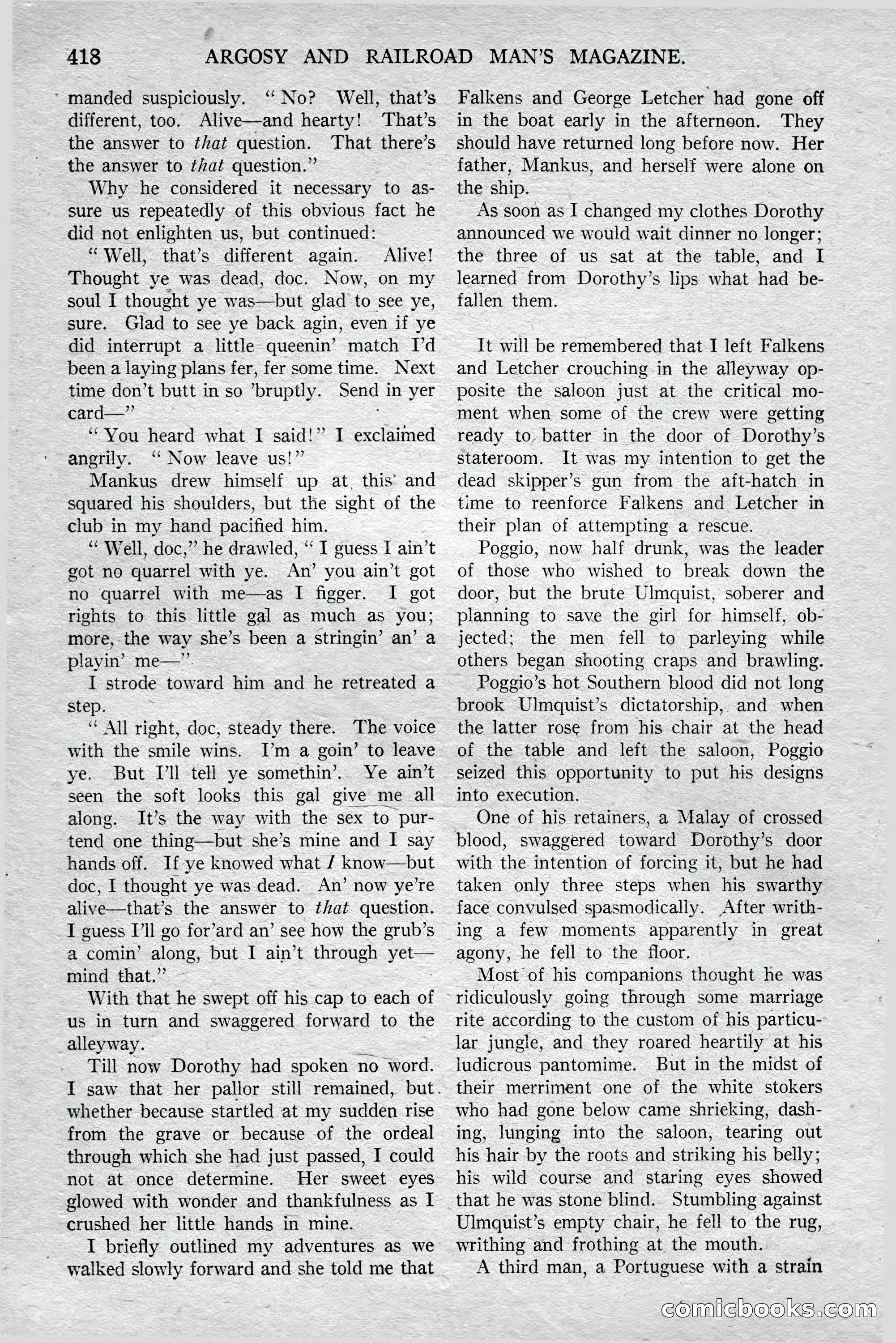
A restored page from Pulp Fiction, 1919. Page through the whole issue in the reader above.
📄 Transcribed text from this page (OCR, searchable)
Machine-transcribed from the original scan — historical spelling and the odd misread are preserved.
418 * manded suspiciously. ‘‘ No? Well, that’s different, too. Alive—and hearty! That’s the answer to that question. That there’s the answer to ¢/hat question.” Why he considered it necessary to as- sure us repeatedly of this obvious fact he did not enlighten us, but continued: “Well, that’s different again. Alive! Thought ye was dead, doc. Now, on my soul I thought ye was—but glad to see ye, sure. Glad to see ye back agin, even if ye did interrupt a little queenin’ match I'd been a laying plans fer, fer some time. Next time Eon t butt in so *bruptly. ond in yer card— “You Beard what I said!” angrily. ‘ Now leave us!”’ Mankus drew himself up at, this’ and squared his shoulders, but the sight of the club in my hand pacified him. “Well, doc,” he drawled, ‘“ I guess I ain’t got no quarrel with ye. An’ you ain’t got no quarrel with me—as I figger. I got rights to this little gal as much as you; more, the way she’s been a stringin’ an’ a playin’ me—” I strode toward him and he retreated a step. I exclaimed ‘* All right, doc, steady there. The voice with the smile wins. I’m a goin’ to leave ye. But I'll tell ye somethin’. Ye ain’t seen the soft looks this gal give me all along. It’s the way with the sex to pur- tend one thing—but she’s mine and I say hands off. If ye knowed what / know—but doc, I thought ye was dead. An’ now ye’re alive—that’s the answer to that question. IT guess I’ll go for’ard an’ see how the grub’s a comin’ along, but I ain’t through yet— mind that.” With that he swept off his cap to each of us in turn and swaggered forward to the alleyway. Till now Dorothy had spoken no word. I saw that her pallor still remained, but. whether because startled at my sudden rise from the grave or because of the ordeal through which she had just passed, I could not at once determine. Her sweet eyes glowed with wonder and thankfulness as I crushed her little hands in mine. I briefly outlined my adventures as we walked slowly forward and she told me that ARGOSY AND RAILROAD MAN’S MAGAZINE. Falkens and George Letcher had gone off in the boat early in the afternoon. They should have returned long before now. Her father, Mankus, and herself were alone on the ship. As soon as I changed my clothes Dorothy announced we would wait dinner no longer; the three of us sat at the table, and I learned from Dorothy’s lips what had be- fallen them. It will be remembered that I left Falkens and Letcher crouching in the alleyway op- posite the saloon just at the critical mo- ment when some of the crew were getting ready to, batter in the door of Dorothy’s stateroom. It was my intention to get the dead skipper’s gun from the aft-hatch in time to reenforce Falkens and Letcher in their plan of attempting a rescue. Poggio, now half drunk, was the leader of those who wished to break down the door, but the brute Ulmquist, soberer and planning to save the girl for himself, ob- jected; the men fell to parleying while others began shooting craps and brawling. Poggio’s hot Southern blood did not long brook Ulmquist’s dictatorship, and when the latter rose from his chair at the head of the table and left the saloon, Poggio seized this opportunity to put his designs into execution. One of his retainers, a Malay of crossed blood, swaggered toward Dorothy’s door with the intention of forcing it, but he had taken only three steps when his swarthy face convulsed spasmodically. After writh- ing a few moments apparently in great agony, he fell to the floor. Most of his companions thought he was ridiculously going through some marriage rite according to the custom of his particu- lar jungle, and they roared heartily at his ludicrous pantomime. But in the midst of their merriment one of the white stokers who had gone below came shrieking, dash- ing, lunging into the saloon, tearing out his hair by the roots and striking his belly; his wild course and staring eyes showed that he was stone blind. Stumbling against Ulmquist’s empty chair, he fell to the rug, writhing and frothing at the mouth. A third man, a Portuguese with a strain commiclooolkks.conn