
Pulp Fiction, 1919 · page 17 of 196
Argosy and Railroad Man's Magazine — page 17: what you’re looking at
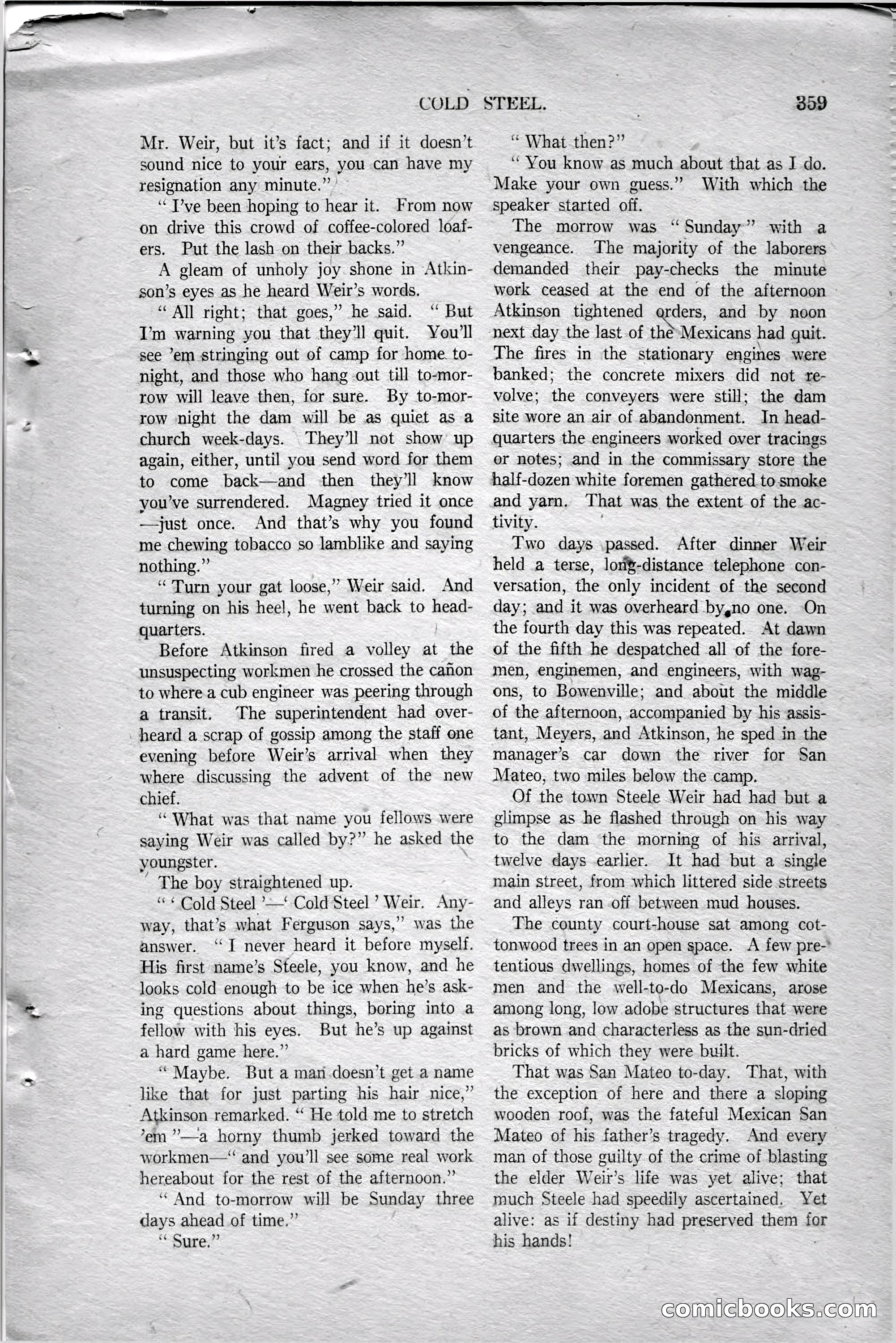
A restored page from Pulp Fiction, 1919. Page through the whole issue in the reader above.
📄 Transcribed text from this page (OCR, searchable)
Machine-transcribed from the original scan — historical spelling and the odd misread are preserved.
i "hd COLD STEEL. 359 Mr. Weir, but it’s fact; and if it doesn’t sound nice to your ears, you can have my resignation any minute.” ’ “ Pve been hoping to hear it. From now on drive this crowd of coffee-colored loaf- ers. Put the lash on their backs.” A gleam of unholy joy shone in Atkin- son’s eyes as he heard Weir’s words. “All right; that goes,” he said. “ But I’m warning you that theyll quit. You'll see ’em stringing out of camp for home. to- night, and those who hang out till to-mor- row will leave then, for sure. By to-mor- row night the dam will be as quiet as a church week-days. They'll not show’ up again, either, until you send word for them to come back—and then they’ll know you’ve surrendered. Magney tried it once —just once. And that’s why you found me chewing tobacco so lamblike and saying nothing.” “Turn your gat loose,” Weir said. And turning on his heel, he went back to head- quarters. Before Atkinson fired a volley at the unsuspecting workmen he crossed the canon to where.a cub engineer was peering through a transit. The superintendent had over- heard a scrap of gossip among the staff one evening before Weir’s arrival when they where discussing the advent of the new chief. “What was that name you fellows were saying Weir was called by?” he asked the youngster. : ‘ The boy straightened up. “* Cold Steel "—‘ Cold Steel ’ Weir. Any- way, that’s what Ferguson says,” was the answer. ‘I never heard it before myself. His first name’s Sfeele, you know, and he looks cold enough to be ice when he’s ask- ing questions about things, boring into a fellow with his eyes. But he’s up against a hard game here.” “Maybe. But a man.doesn’t get a name like that for just parting his hair nice,” Atkinson remarked. “‘ He told me to stretch em ”’—a horny thumb jerked toward the workmen—“ and you'll see some real work hereabout for the rest of the afternoon.” ‘And to-morrow will be Sunday three days ahead of time.” i4 Sure.” “ What then?” ‘‘ You know as much about that as I do. Make your own guess.” With which the speaker started off. The morrow was “Sunday” with a vengeance. The majority of the laborers demanded their pay-checks the minute work ceased at the end of the afternoon Atkinson tightened arders, and by noon next day the last of the-Mexicans had guit. The fires in the stationary engines were banked; the concrete mixers did not te- volve; the conveyers were still; the dam site wore an air of abandonment. In head- quarters the engineers worked over tracings er notes; and in the commissary store the half-dozen white foremen gathered to smoke and yarn. That was the extent of the ac- tivity. Two days passed. After dinner Weir held a terse, lom&-distance telephone con- versation, the only incident of the second day; and it was overheard by,no one. On the fourth day this was repeated. At dawn of the fifth he despatched all of the fore- men, enginemen, and engineers, with wag- ons, to Bowenville; and about the middle of the afternoon, accompanied by his assis- tant, Meyers, and Atkinson, he sped in the manager’s car down the river for San Mateo, two miles below the camp. Of the town Steele Weir had had but a glimpse as he flashed through on his way to the dam the morning of his arrival, twelve days earlier. It had but a single main street, from which littered side streets and alleys ran off between mud houses. The county court-house sat among cot- tonwood trees in an open space. A few pre- tentious dwellings, homes of the few white men and the well-to-do Mexicans, arose among long, low adobe structures that were as brown and characterless as the sun-dried bricks of which they were built. That was San Mateo to-day. That, with the exception of here and there a sloping wooden roof, was the fateful Mexican San Mateo of his father’s tragedy. And every man of those guilty of the crime of blasting the elder Weir’s life was yet alive; that much Steele had speedily ascertained. Yet alive: as if destiny had preserved them for his hands! ConmiclooolksS.conn