
Pulp Fiction, 1919 · page 16 of 196
Argosy and Railroad Man's Magazine — page 16: what you’re looking at
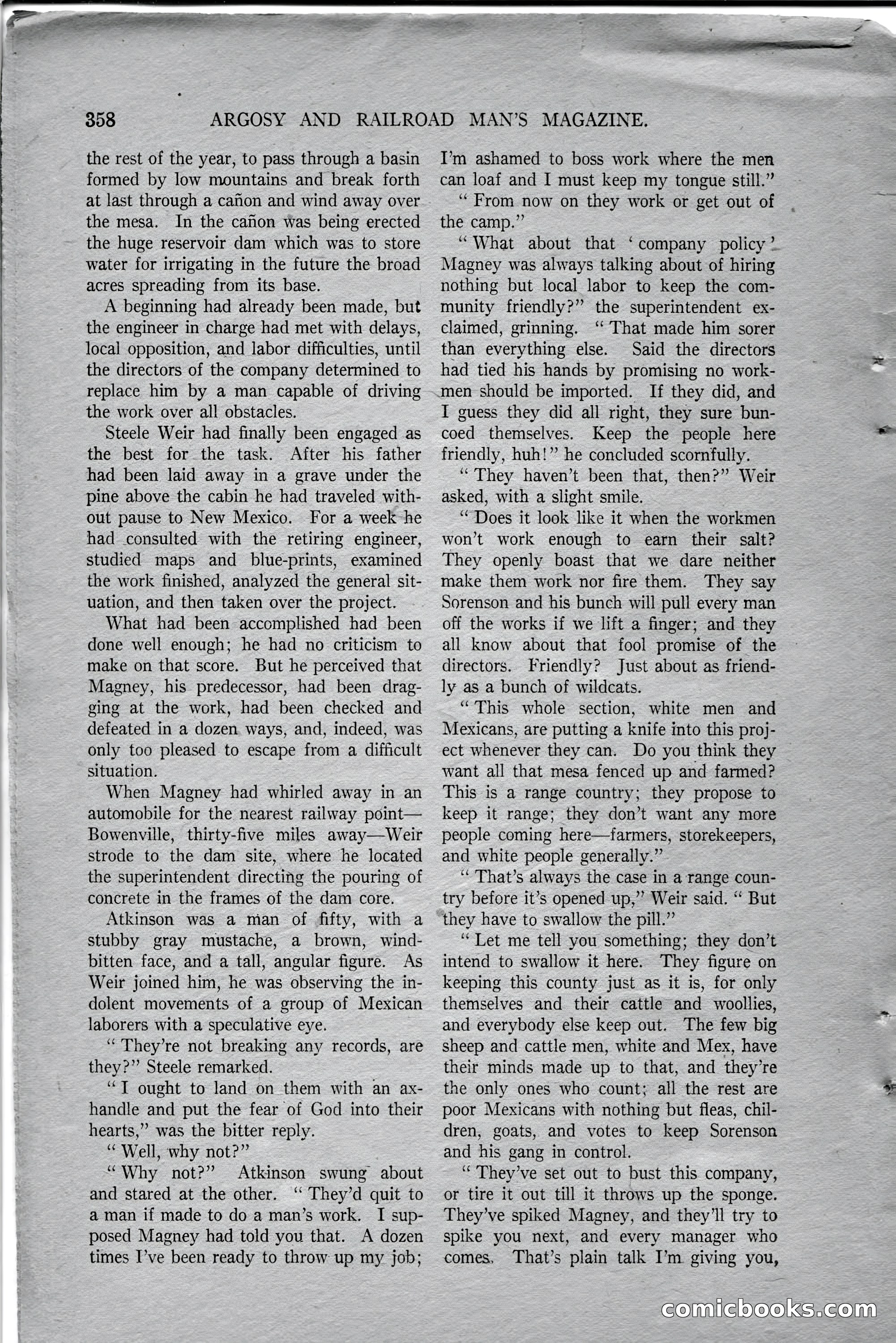
A restored page from Pulp Fiction, 1919. Page through the whole issue in the reader above.
📄 Transcribed text from this page (OCR, searchable)
Machine-transcribed from the original scan — historical spelling and the odd misread are preserved.
358 ARGOSY AND RAILROAD MAN’S MAGAZINE. the rest of the year, to pass through a basin formed by low mountains and break forth at last through a cafon and wind away over the mesa. In the cafion was being erected the huge reservoir dam which was to store water for irrigating in the future the broad acres spreading from its base. A beginning had already been made, but the engineer in charge had met with delays, local opposition, and labor difficulties, until the directors of the company determined to replace him by a man capable of driving the work over all obstacles. Steele Weir had finally been engaged as the best for the task. After his father had been laid away in a grave under the pine above the cabin he had traveled with- out pause to New Mexico. For a week he had consulted with the retiring engineer, studied maps and blue-prints, examined the work finished, analyzed the general sit- uation, and then taken over the project. What had been accomplished had been done well enough; he had no criticism to make on that score. But he perceived that Magney, his predecessor, had been drag- ging at the work, had been checked and defeated in a dozen ways, and, indeed, was only too pleased to escape from a difficult situation. When Magney had whirled away in an automobile for the nearest railway point— Bowenville, thirty-five miles away—Weir strode to the dam site, where he located the superintendent directing the pouring of concrete in the frames of the dam core. Atkinson was a man of fifty, with a stubby gray mustache, a brown, wind- bitten face, and a tall, angular figure. As Weir joined him, he was observing the in- dolent movements of a group of Mexican laborers with a speculative eye. ““They’re not breaking any records, are they?” Steele remarked. ‘“T ought to land on them with an ax- handle and put the fear of God into their hearts,” was the bitter reply. “Well, why not?” “Why not?” Atkinson swung about and stared at the other. ‘“ They’d quit to aman if made to do a man’s work. I sup- posed Magney had told you that. A dozen times I’ve been ready to throw up my job; I’m ashamed to boss work where the men can loaf and I must keep my tongue still.” ‘From now on they work or get out of the camp.” “What about that ‘company policy” Magney was always talking about of hiring nothing but local labor to keep the com- munity friendly?” the superintendent ex- claimed, grinning. ‘“‘ That made him sorer than everything else. Said the directors had tied his hands by promising no work- smen should be imported. If they did, and I guess they did all right, they sure bun- coed themselves. Keep the people here friendly, huh!” he concluded scornfully. “They haven’t been that, then?” Weir asked, with a slight smile. “Does it look like it when the workmen won’t work enough to earn their salt? They openly boast that we dare neither make them work nor fire them. They say Sorenson and his bunch will pull every man off the works if we lift a finger; and they all know about that fool promise of the directors. Friendly? Just about as friend- ly as a bunch of wildcats. “This whole section, white men and Mexicans, are putting a knife into this proj- ect whenever they can. Do you think they want all that mesa fenced up and farmed? This is a range country; they propose to keep it range; they don’t want any more people coming here—farmers, storekeepers, and white people generally.” ““That’s always the case in a range coun- try before it’s opened up,” Weir said. “ But they have to swallow the pill.” “Let me tell you something; they don’t intend to swallow it here. They figure on keeping this county just as it is, for only themselves and their cattle and woollies, and everybody else keep out. The few big sheep and cattle men, white and Mex, have their minds made up to that, and they’re the only ones who count; all the rest are poor Mexicans with nothing but fleas, chil- dren, goats, and votes to keep Sorenson and his gang in control. ““They’ve set out to bust this company, or tire it out till it throws up the sponge. They’ve spiked Magney, and they'll try to spike you next, and every manager who comes, That’s plain talk I’m giving you, comicbooks-com