
Pulp Fiction, 1919 · page 155 of 196
Argosy and Railroad Man's Magazine — page 155: what you’re looking at
A restored page from Pulp Fiction, 1919. Page through the whole issue in the reader above.
📄 Transcribed text from this page (OCR, searchable)
Machine-transcribed from the original scan — historical spelling and the odd misread are preserved.
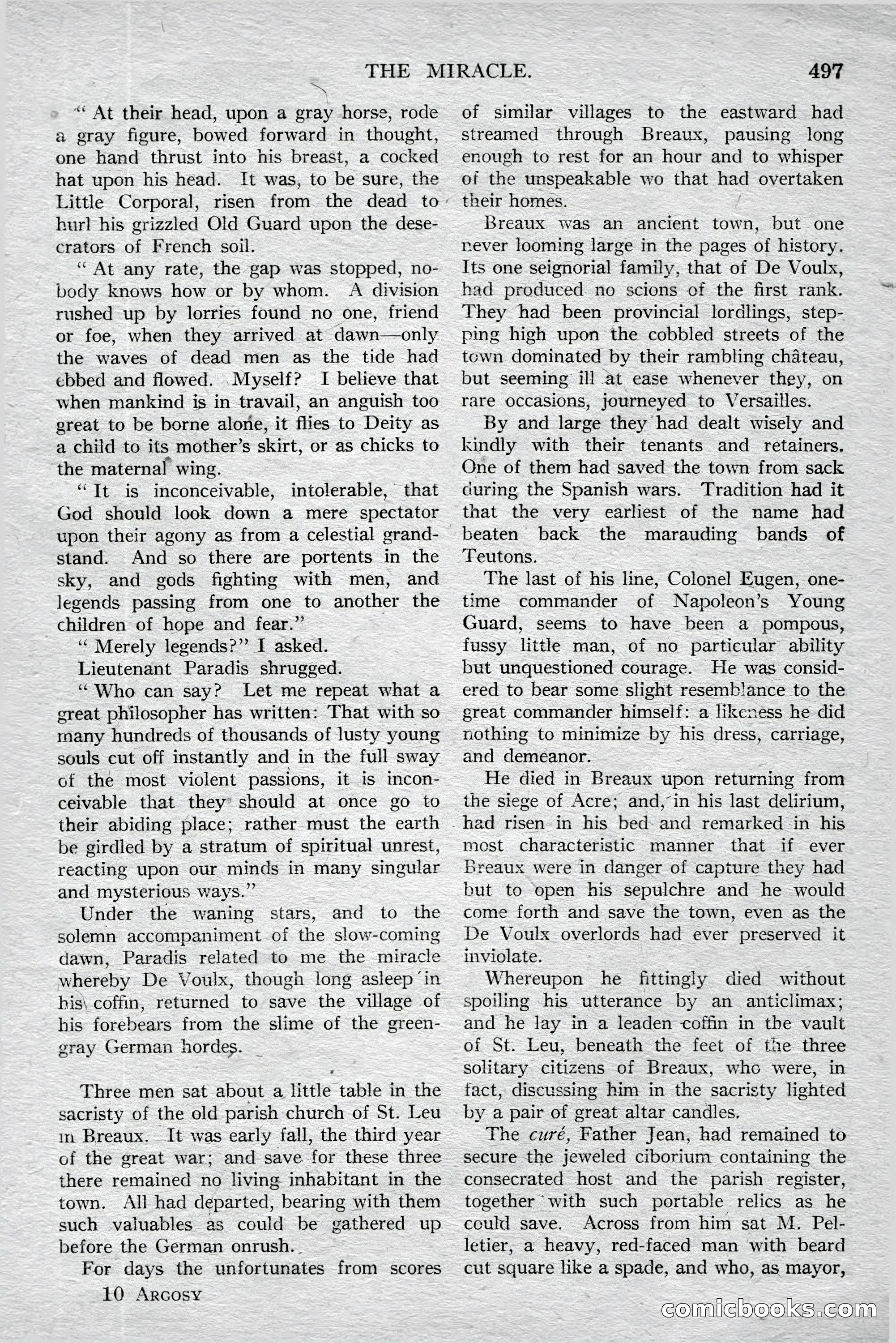
THE “« At their head, upon a gray horse, rode a gray figure, bowed forward in thought, one hand thrust into his breast, a cocked hat upon his head. It was, to be sure, the Little Corporal, risen from the dead to’ hurl his grizzled Old Guard upon the dese- crators of French soil. “At any rate, the gap was stopped, no- body knows how or by whom. A division rushed up by lorries found no one, friend or foe, when they arrived at dawn—only the waves of dead men as the tide had ebbed and flowed. .Myself? I believe that when mankind is in travail, an anguish too great to be borne alone, it flies to Deity as a child to its mother’s skirt, or as chicks to the maternal wing. “Tt is inconceivable, intolerable, that God should look down a mere spectator upon their agony as from a celestial grand- stand. And so there are portents in the sky, and gods fighting with men, and legends passing from one to another the children of hope and fear.” “Merely legends?” I asked. Lieutenant Paradis shrugged. “Who can say? Let me repeat what a great philosopher has written: That with so many hundreds of thousands of lusty young souls cut off instantly and in the full sway of the most violent passions, it is incon- ceivable that they’ should at once go to their abiding place; rather must the earth be girdled by a stratum of spiritual unrest, reacting upon our minds in many singular and mysterious ways.” Under the waning stars, and to the solemn accompaniment of the slow-coming dawn, Paradis related to me the miracle whereby De Voulx, though long asleep ‘in his\ coffin, returned to save the village of his forebears from the slime of the green- gray German hordes. Three men sat about a little table in the sacristy of the old parish church of St. Leu m Breaux. It was early fall, the third year of the great war; and save for these three there remained no living inhabitant in the town. All had departed, bearing with them such valuables as could be gathered up before the German onrush. _ For days the unfortunates from scores 10 Arcosy MIRACLE. 497 of similar villages to the eastward had streamed through Breaux, pausing long enough to rest for an hour and to whisper of the unspeakable wo that had overtaken their homes. Breaux was an ancient town, but one never looming large in the pages of history. Its one seignorial family, that of De Voulx, had produced no scions of the first rank. They had been provincial lordlings, step- ping high upon the cobbled streets of the town dominated by their rambling chateau, but seeming ill at ease whenever they, on rare occasions, journeyed to Versailles. By and large they had dealt wisely and kindly with their tenants and retainers. One of them had saved the town from sack during the Spanish wars. ‘Tradition had it that the very earliest of the name had beaten back the marauding bands of ‘Teutons. The last of his line, Colonel Eugen, one- time commander of Napoleon’s Young Guard, seems to have been a pompous, fussy little man, of no particular ability but unquestioned courage. He was consid- ered to bear some slight resemb!ance to the great commander himself: a likeness he did nothing to minimize by his dress, carriage, and demeanor. He died in Breaux upon returning from the siege of Acre; and, in his last delirium, _had risen in his bed: and remarked in his most characteristic manner that if ever Breaux were in danger of capture they had but to open his sepulchre and he would come forth and save the town, even as the De Voulx overlords had ever preserved it inviolate. Whereupon he fittingly died without spoiling his utterance by an anticlimax; and he lay in a leaden coffin in the vault of St. Leu, beneath the feet of the three solitary citizens of Breaux, who were, in fact, discussing him in the sacristy lighted by a pair of great altar candles, The curé, Father Jean, had remained to secure the jeweled ciborium containing the consecrated host and the parish register, together with such portable relics as he could save. Across from him sat M. Pel- letier, a heavy, red-faced man with beard cut square like a spade, and who, as mayor, comiclooolkks.comnn