
Pulp Fiction, 1919 · page 154 of 196
Argosy and Railroad Man's Magazine — page 154: what you’re looking at
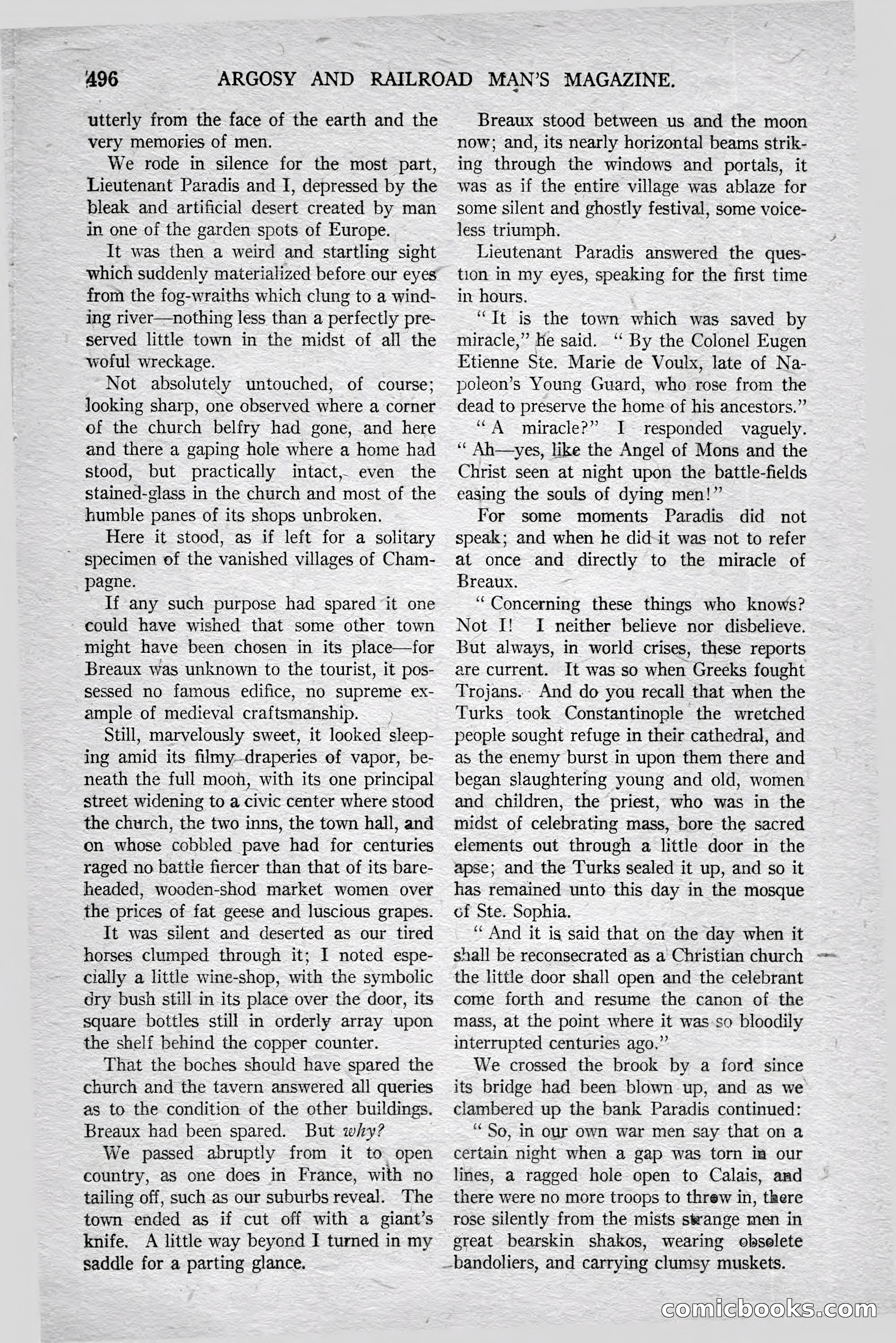
A restored page from Pulp Fiction, 1919. Page through the whole issue in the reader above.
📄 Transcribed text from this page (OCR, searchable)
Machine-transcribed from the original scan — historical spelling and the odd misread are preserved.
496 utterly from the face of the earth and the very memories of men. We rode in silence for the most part, Lieutenant Paradis and I, depressed by the bleak and artificial desert created by man in one of the garden spots of Europe. It was then a weird and startling sight which suddenly materialized before our eyes from the fog-wraiths which clung to a wind- ing river—nothing less than a perfectly pre- served little town in the midst of all the woful wreckage. Not absolutely untouched, of course; looking sharp, one observed where a corner of the church belfry had gone, and here and there a gaping hole where a home had stood, but practically intact, even the stained-glass in the church and most of the humble panes of its shops unbroken. Here it stood, as if left for a solitary ~ specimen of the vanished villages of Cham- pagne. If any such purpose had spared “it one could have wished that some other town might have been chosen in its place—for Breaux was unknown to the tourist, it pos- sessed no famous edifice, no supreme ex- ample of medieval craftsmanship. Still, marvelously sweet, it looked sleep- ing amid its filmy—draperies of vapor, be- neath the full mooh, with its one principal street widening to a civic center where stood the church, the two inns, the town hall, and on whose cobbled pave had for centuries raged no battle fiercer than that of its bare- headed, wooden-shod market women over the prices of fat geese and luscious grapes. It was silent and deserted as our tired horses clumped through it; I noted espe- cially a little wine-shop, with the symbolic cry bush still in its place over the door, its square bottles still in orderly array upon the shelf behind the copper counter. That the boches should have spared the church and the tavern answered all queries as to the condition of the other buildings. Breaux had been spared. But why? We passed abruptly from it to open country, as one does in France, with no tailing off, such as our suburbs reveal. The town ended as if cut off with a giant’s knife. A little way beyond I turned in my saddle for a parting glance. ARGOSY AND RAILROAD MAN’S MAGAZINE. Breaux stood between us and the moon now; and, its nearly horizontal beams strik- ing through the windows and portals, it was as if the entire village was ablaze for some silent and ghostly festival, some voice- less triumph. Lieutenant Paradis answered the ques- tion in my eyes, speaking for the first time in hours. “Tt is the town which was saved by miracle,” He said. ‘“ By the Colonel Eugen Etienne Ste. Marie de Voulx, late of Na- poleon’s Young Guard, who rose from the dead to preserve the home of his ancestors.” “A miracle?” I responded vaguely. “ Ah—yes, like the Angel of Mons and the Christ seen at night upon the battle-fields easing the souls of dying men!”’ For some moments Paradis did not speak; and when he did-it was not to refer at once and directly to the miracle of Breaux. “Concerning these things who knows? Not I! I neither believe nor disbelieve. But always, in world crises, these reports are current. It was so when Greeks fought Trojans. And do you recall that when the Turks took Constantinople the wretched people sought refuge in their cathedral, and as the enemy burst in upon them there and began slaughtering young and old, women and children, the priest, who was in the midst of celebrating mass, bore the sacred elements out through a little door in the apse; and the Turks sealed it up, and so it has remained unto this day in the mosque of Ste. Sophia. ““ And it is said that on the day when it shall be reconsecrated as a Christian church == the little door shall open and the celebrant come forth and resume the canon of the mass, at the point where it was so bloodily interrupted centuries ago.” We crossed the brook by a ford since its bridge had been blown up, and as we clambered up the bank Paradis continued: “So, in our own war men say that on a certain night when a gap was torn im our lines, a ragged hole open to Calais, and there were no more troops to threw in, there rose silently from the mists strange men in great bearskin shakos, wearing olselete —bandoliers, and carrying clumsy muskets. conniclooolkks.conn