
Pulp Fiction, 1919 · page 129 of 196
Argosy and Railroad Man's Magazine — page 129: what you’re looking at
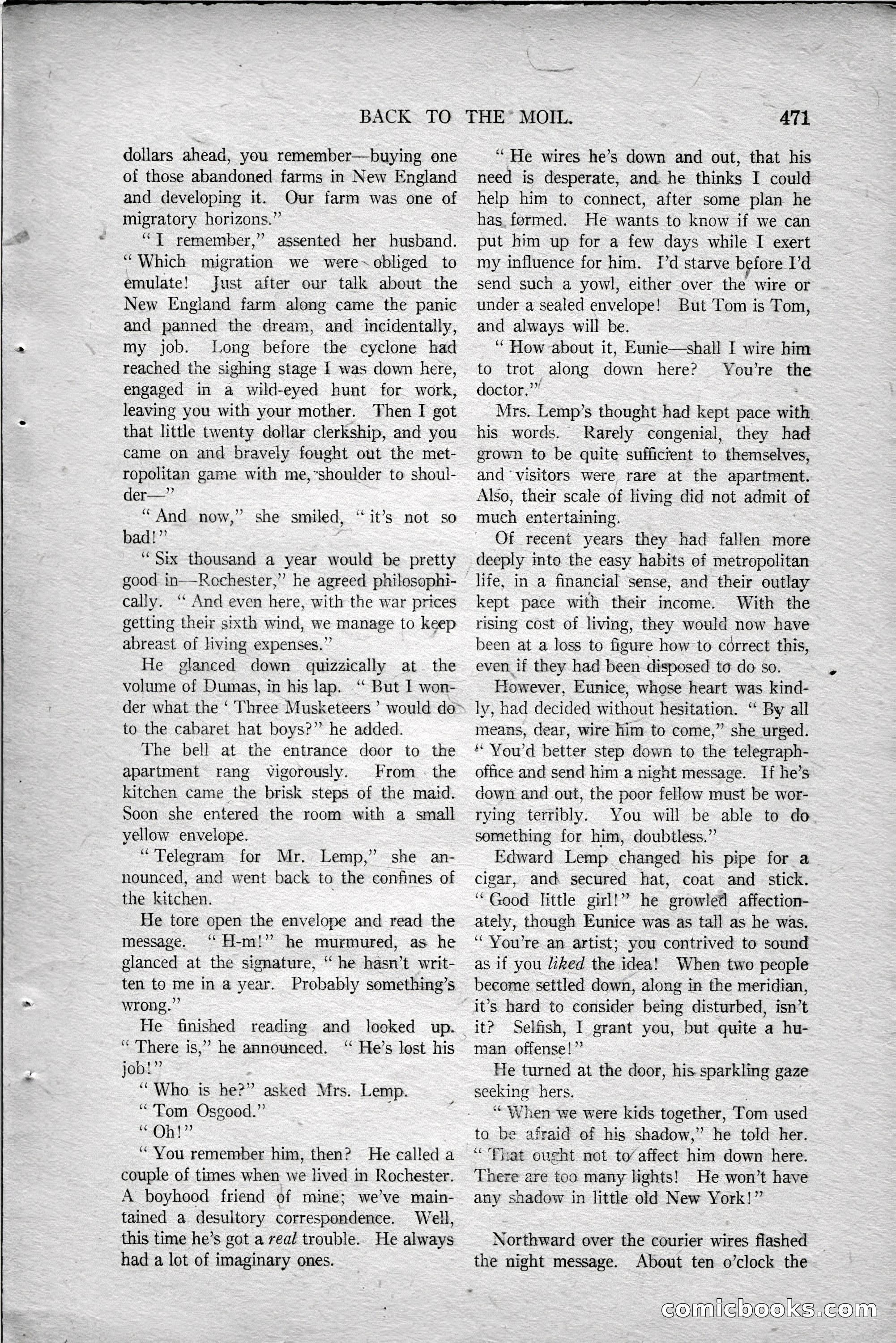
A restored page from Pulp Fiction, 1919. Page through the whole issue in the reader above.
📄 Transcribed text from this page (OCR, searchable)
Machine-transcribed from the original scan — historical spelling and the odd misread are preserved.
BACK TO THE MOIL, dollars ahead, you remember—buying one of those abandoned farms in New England and developing it. Our farm was one of migratory horizons.” “T remember,” assented her husband. “Which migration we were~obliged to emulate! Just after our talk about the New England farm along came the panic and panned the dream, and incidentally, my job. Long before the cyclone had reached the sighing stage 1 was down here, engaged in a wild-eyed hunt for work, leaving you with your mother. Then I got that little twenty dollar clerkship, and you came on and bravely fought out the met- ropolitan game with me,-shoulder to shoul- der—” “And now,” she smiled, “it’s not so bad!” “Six thousand a year would be pretty good in——Rochester,” he agreed philosophi- cally. “ And even here, with the war prices getting their sixth wind, we manage to keep abreast of living expenses.” He glanced down quizzically at. the volume of Dumas, in his lap. “ But I won- der what the ‘ Three Musketeers ’ would do to the cabaret hat boys?” he added. The bell at the entrance door to the apartment rang vigorously. From - the kitchen came the brisk steps of the maid. Soon she entered the room with a small yellow envelope. “Telegram for Mr. Lemp,” she an- nounced, and went back to the confines of the kitchen. : He tore open the envelope and read the message. ‘ H-m!” he murmured, as he glanced at the signature, “ he hasn’t writ- ten to me in a year. Probably something’s wrong.” He finished reading and looked up. | “There is,” he announced. ‘ He’s lost his job!” “Who is he?” asked Mrs. Lemp. “Tom Osgood.” : “< Oh ! ”» “You remember him, then? He called a couple of times when we lived in Rochester. A boyhood friend of mine; we’ve main- tained a desultory correspondence. Well, this time he’s got a real trouble. He always had a lot of imaginary ones. 471 “He wires he’s down and out, that his need is desperate, and. he thinks I could help him to connect, after some plan he has formed. He wants to know if we can put him up for a few days while I exert my influence for him. I’d starve before I’d send such a yowl, either over the wire or under a sealed envelope! But Tom is Tom, and always will be. “How about it, Eunie—shall I wire him to trot along down here? You're the doctor.” : Mrs. Lemp’s thought had kept pace with his words. Rarely congenial, they had grown to be quite suffictent to themselves, and ‘visitors were rare at the apartment. Also, their scale of living did not admit of much entertaining. Of recent years they had fallen more deeply into the easy habits of metropolitan life, in a financial sense, and their outlay kept pace with their income. With the rising cost of living, they would now have been at a loss to figure how to correct this, even if they had been disposed to do so. However, Eunice, whose heart was kind- ly, had decided without hesitation. “ By all means, dear, wire him to come,” she urged. * You'd better step down to the telegraph- office and send him a night message. If he’s down and out, the poor fellow must be wor- rying terribly. You will be able to do something for him, doubtless.” Edward Lemp changed his pipe for a cigar, and secured hat, coat and_ stick. “Good little girl!” he growled affection- ately, though Eunice was as tall as he was. “You're an artist; you contrived to sound as if you liked the idea! When two people beeome settled down, along in the meridian, it’s hard to consider being disturbed, isn’t it? Selfish, I grant you, but quite a hu- man offense!” He turned at the door, his sparkling gaze seeking hers. “When we were kids together, Tom used to be afraid of his shadow,” he told her. “Phat ought not to’affeet him down here. There are too many lights! He won’t have any shadow in little old New York!” Northward over the courier wires flashed the night message. About ten o’clock the conmiclooolks.conn