
Pulp Fiction, 1919 · page 128 of 196
Argosy and Railroad Man's Magazine — page 128: what you’re looking at
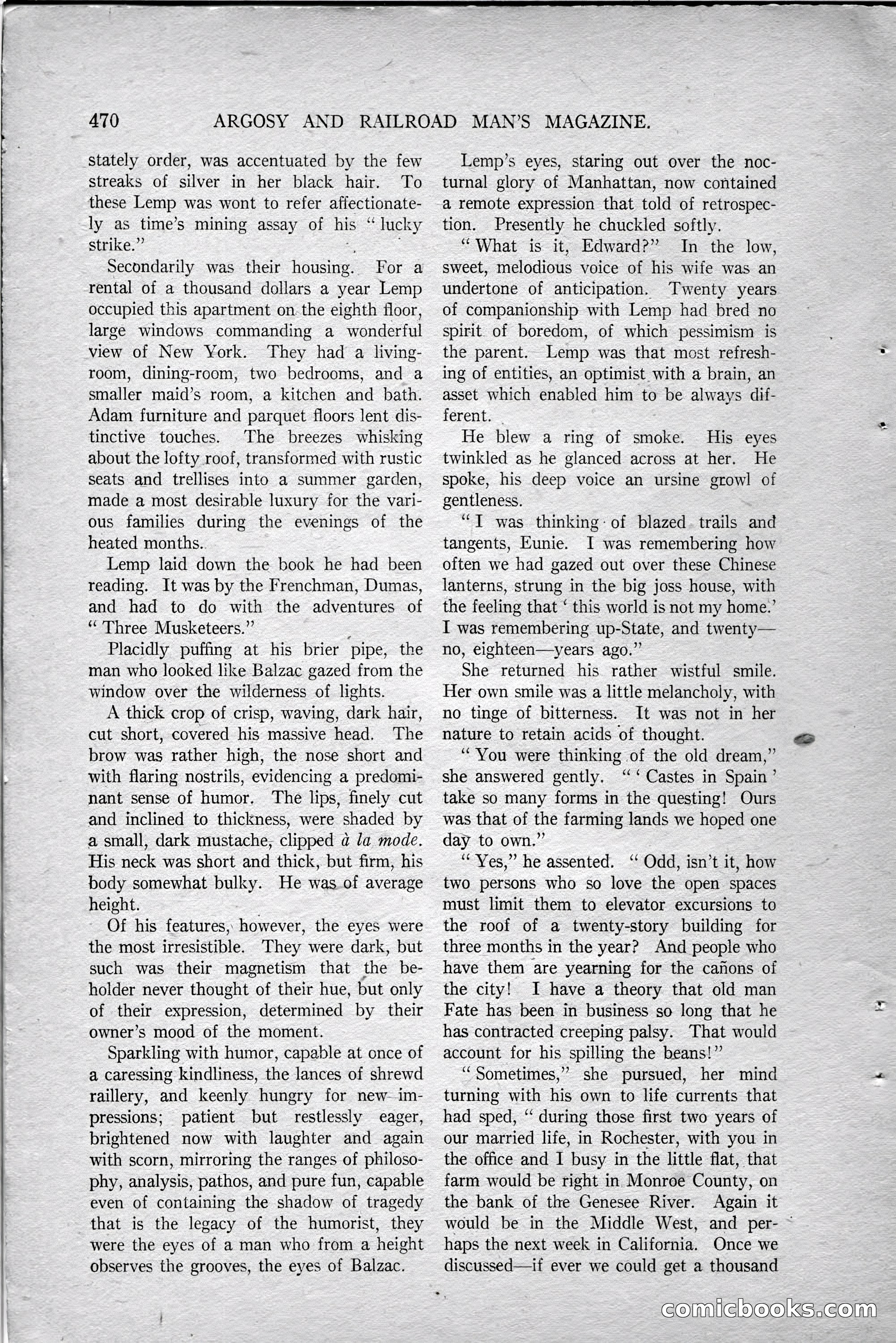
A restored page from Pulp Fiction, 1919. Page through the whole issue in the reader above.
📄 Transcribed text from this page (OCR, searchable)
Machine-transcribed from the original scan — historical spelling and the odd misread are preserved.
470 ARGOSY AND RAILROAD MAN’S MAGAZINE. stately order, was accentuated by the few streaks of silver in her black hair. To these Lemp was wont to refer affectionate- ly as time’s mining assay of his “ lucky strike.” me : Secondarily was their housing. For a rental of a thousand dollars a year Lemp occupied this apartment on. the eighth floor, large windows commanding a wonderful view of New York. They had a living- room, dining-room, two bedrooms, and a smaller maid’s room, a kitchen and bath. Adam furniture and parquet floors lent dis- tinctive touches. The breezes whisking about the lofty roof, transformed with rustic seats and trellises into a summer garden, made a most desirable luxury for the vari- ous families during the evenings of the heated months. Lemp laid down the book he had been reading. It was by the Frenchman, Dumas, and had to do with the adventures of “ Three Musketeers.” = Placidly puffing at his brier pipe, the man who looked like Balzac gazed from the window over the wilderness of lights. A thick crop of crisp, waving, dark hair, cut short, covered his massive head. The brow was rather high, the nose short and with flaring nostrils, evidencing a predomi- nant sense of humor. The lips, finely cut and inclined to thickness, were shaded by a small, dark mustache, clipped @ la mode. His neck was short and thick, but firm, his body somewhat bulky. He was of average height. Of his features, however, the eyes were the most irresistible. They were dark, but such was their magnetism that the be- holder never thought of their hue, but only of their expression, determined by their owner’s mood of the moment. Sparkling with humor, capable at once of a caressing kindliness, the lances of shrewd raillery, and keenly hungry for new-im- pressions; patient but restlessly eager, brightened now with laughter and again with scorn, mirroring the ranges of philoso- phy, analysis, pathos, and pure fun, capable even of containing the shadow of tragedy that is the legacy of the humorist, they were the eyes of a man who from a height observes the grooves, the eyes of Balzac. Lemp’s eyes, staring out over the noc- turnal glory of Manhattan, now contained a remote expression that told of retrospec- tion. Presently he chuckled softly. “What is it, Edward?” In the low, sweet, melodious voice of his wife was an undertone of anticipation. Twenty years of companionship with Lemp had bred no spirit. of boredom, of which pessimism is the parent. Lemp was that most refresh- ing of entities, an optimist with a brain, an asset which enabled him to be always dif- ferent. He blew a ring of smoke. His eyes twinkled as he glanced across at her. He spoke, his deep voice an ursine growl of gentleness. “T was thinking: of blazed. trails and tangents, Eunie. I was remembering how often we had gazed out over these Chinese lanterns, strung in the big joss house, with the feeling that ‘ this world is not my home.’ I was remembering up-State, and twenty— no, eighteen—years ago.” She returned his rather wistful smile. Her own smile was a little melancholy, with no tinge of bitterness. It was not in her nature to retain acids of thought. “You were thinking of the old dream,” she answered gently. ‘‘ Castes in Spain’ take so many forms in the questing! Ours was that of the farming lands we hoped one day to own.” “Yes,” he assented. ‘“ Odd, isn’t it, how two persons who so love the open spaces must limit them to elevator excursions to the roof of a twenty-story building for three months in the year? And people who have them are yearning for the cafions of the city! I have a theory that old man Fate has been in business so long that he has contracted creeping palsy. That would account for his spilling the beans!” “Sometimes,” she pursued, her mind turning with his own to life currents that had sped, ‘‘ during those first two years of our married life, in Rochester, with you in the office and I busy in the little flat, that farm would be right in Monroe County, on the bank of the Genesee River. Again it would be in the Middle West, and per- ~ haps the next week in California. Once we discussed—if ever we could get a thousand * ‘e 4 comicbooks-com