
Pulp Fiction, 1928 · page 49 of 99
Amazing Stories — page 49: what you’re looking at
A restored page from Pulp Fiction, 1928. Page through the whole issue in the reader above.
📄 Transcribed text from this page (OCR, searchable)
Machine-transcribed from the original scan — historical spelling and the odd misread are preserved.
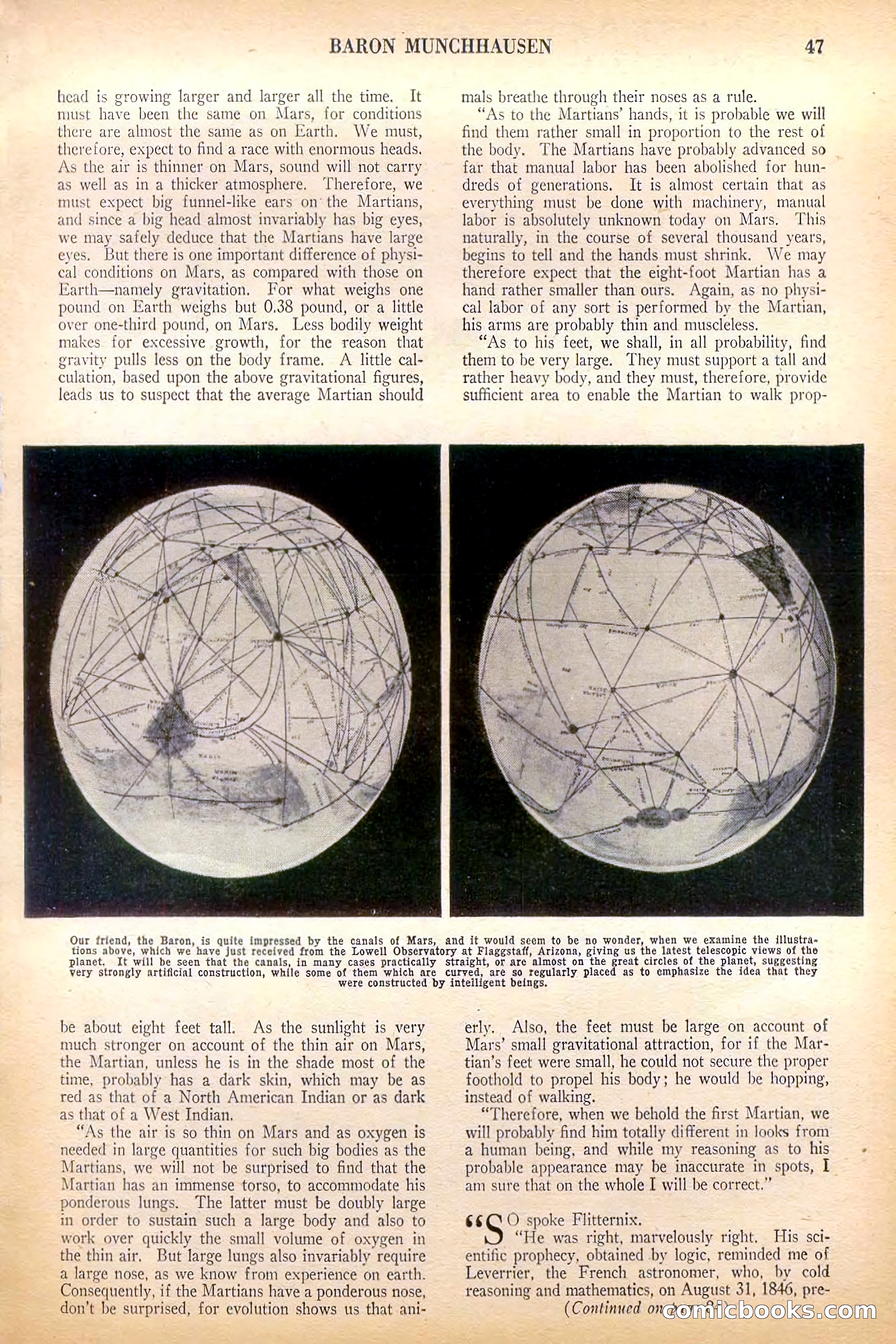
BARON MUNCHHAUSEN 47 head is growing larger and larger all the time. It must have been the same on Mars, for conditions there are almost the same as on Earth. We must, therefore, expect to find a race with enormous heads. As the air is thinner on Mars, sound will not carry as well as in a thicker atmosphere. Therefore, we must expect big funnel-like ears on’ the Martians, and since a big head almost invariably has big eyes, we may safely deduce that the Martians have large eves, But there is one important difference of physi- cal conditions on Mars, as compared with those on Earth—namely gravitation. For what weighs one pound on Earth weighs but 0.38 pound, or a little over one-third pound, on Mars. Less bodily weight makes for excessive growth, for the reason that gravity pulls less on the body frame. A little cal- culation, based upon the above gravitational figures, leads us to suspect that the average Martian should mals breathe through their noses as a rule. “As to the Martians’ hands, it is probable we will find them rather small in proportion to the rest of the body. The Martians have probably advanced so far that manual labor has been abolished for hun- dreds of generations. It is almost certain that as everything must be done with machinery, manual labor is absolutely unknown today on Mars. This naturally, in the course of several thousand years, begins to tell and the hands must shrink. We may therefore expect that the eight-foot Martian has a hand rather smaller than ours. Again, as no physi- cal labor of any sort is performed by the Martian, his arms are probably thin and muscleless. “As to his feet, we shall, in all probability, find them to be very large. They must support a tall and rather heavy body, and they must, therefore, provide sufficient area to enable the Martian to walk prop- Our friend, the Baron, is quite impressed by the canals of Mars, and it would seem to be no wonder, when we examine the jllustra- tions above, which we have just received from the Lowell Observatory at Flaggstaff, Arizona, giving us the latest telescopic views of the planet, It will be seen that the canals, in many cases practically straight, or are almost on the great circles of the planet, suggesting very strongly artificial construction, while some of them which are curved, are so regularly placed as to emphasize the idea that they were constructed by intelligent beings, be about eight feet tall. As the sunlight is very much stronger on account of the thin air on Mars, the Martian, unless he is in the shade most of the time, probably has a dark skin, which may be as red as that of a North American Indian or as dark as that of a West Indian, “As the air is so thin on Mars and as oxygen is needed in large quantities for such big bodies as the Martians, we will not be surprised to find that the Martian has an immense torso, to accommodate his ponderous lungs. The latter must be doubly large in order to sustain such a large body and also to work over quickly the small volume of oxygen in the thin air. But large lungs also invariably require a large nose, as we know from experience on earth. Consequently, if the Martians have a ponderous nose, don’t be surprised, for evolution shows us that ani- erly. Also, the feet must be large on account of Mars’ small gravitational attraction, for if the Mar- tian’s feet were small, he could not secure the proper foothold to propel his body; he would be hopping, instead of walking. “Therefore, when we behold the first Martian, we will probably find him totally different in looks from a human being, and while my reasoning as to his probable appearance may be inaccurate in spots, 1 am sure that on the whole I will be correct.” 66C\O spoke Fiitternix. “He was right, marvelously right. His sci- entific prophecy, obtained by logic, reminded me of Leverrier, the French astronomer, who, by cold : - is reasoning and mathematics, on August 31, 1846, pre- (Continued on eer atiel COOKS.COM