
Pulp Fiction, 1928 · page 48 of 99
Amazing Stories — page 48: what you’re looking at
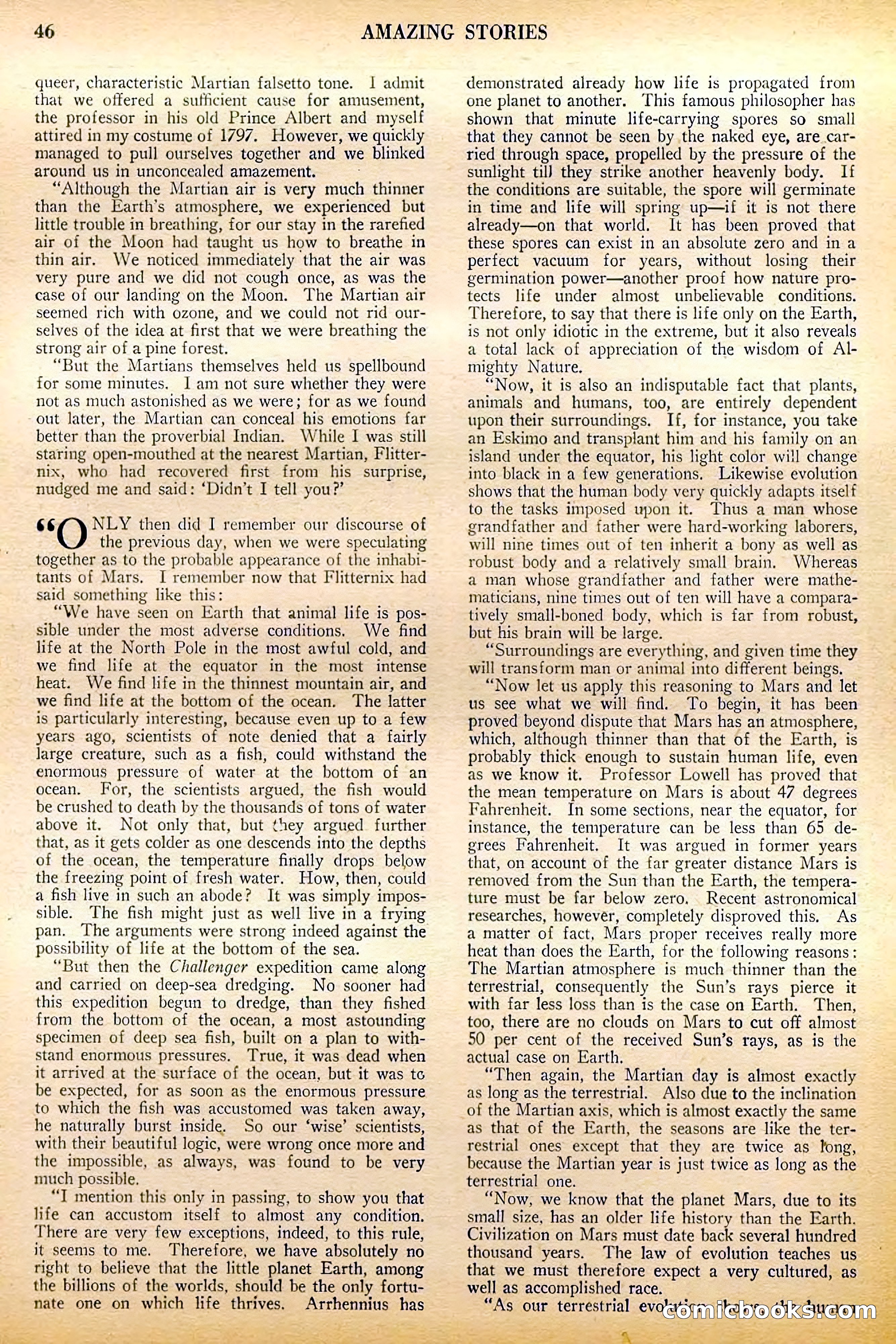
A restored page from Pulp Fiction, 1928. Page through the whole issue in the reader above.
📄 Transcribed text from this page (OCR, searchable)
Machine-transcribed from the original scan — historical spelling and the odd misread are preserved.
Seca — a 46 AMAZING STORIES queer, characteristic Martian falsetto tone. J admit that we offered a sufficient cause for amusement, the professor in his old Prince Albert and myself attired in my costume of 1797. However, we quickly managed to pull ourselves together and we blinked around us in unconcealed amazement. “Although the Martian air is very much thinner than the Earth’s atmosphere, we experienced but little trouble in breathing, for our stay in the rarefied air of the Moon had taught us how to breathe in thin air. We noticed immediately that the air was very pure and we did not cough once, as was the case of our landing on the Moon. The Martian air seetned rich with ozone, and we could not rid our- selves of the idea at first that we were breathing the strong air of a pine forest. “But the Martians themselves held us spellbound for some minutes, 1am not sure whether they were not as much astonished as we were; for as we found out later, the Martian can conceal his emotions far better than the proverbial Indian. While I was still staring open-mouthed at the nearest Martian, Flitter- nix, who had recovered first from his surprise, nudged me and said: ‘Didn't I tell you?’ 66 NLY then did I remember our discourse of the previous day, when we were speculating together as to the probable appearance of the inhabi- tants of Mars. I remember now that Flitternix had said something like this: “We have seen on Earth that animal life is pos- sible under the most adverse conditions. We find life at the North Pole in the most awful cold, and we find life at the equator in the most intense heat. We find life in the thinnest mountain air, and we find life at the bottom of the ocean. The latter is particularly interesting, because even up to a few years ago, scientists of note denied that a fairly large creature, such as a fish, could withstand the enormous pressure of water at the bottom of an ocean. For, the scientists argued, the fish would be crushed to death by the thousands of tons of water above it. Not only that, but they argued further that, as it gets colder as one descends into the depths of the ocean, the temperature finally drops below the freezing point of fresh water. How, then, could a fish live in such an abode? It was simply impos- sible. The fish might just as well live in a frying pan. The arguments were strong indeed against the possibility of life at the bottom of the sea. “But then the Challenger expedition came along and carried on deep-sea dredging. No sooner had this expedition begun to dredge, than they fished from the bottom of the ocean, a most astounding specimen of deep sea fish, built on a plan to with- stand enormous pressures. True, it was dead when it arrived at the surface of the ocean, but it was te be expected, for as soon as the enormous pressure to which the fish was accustomed was taken away, he naturally burst inside. So our ‘wise’ scientists, with their beautiful logic, were wrong once more and the impossible, as always, was found to be very much possible. “I mention this only in passing, to show you that life can accustom itself to almost any condition. There are very few exceptions, indeed, to this rule, it seems to me. Therefore, we have absolutely no right to believe that the little planet Earth, among the billions of the worlds, should be the only fortu- nate one on which life thrives. Arrhennius has ii a me a ni Poti ey demonstrated already how life is propagated from one planet to another. This famous philosopher has shown that minute life-carrying spores so small that they cannot be seen by the naked eye, are car- ried through space, propelled by the pressure of the sunlight til) they strike another heavenly body. If the conditions are suitable, the spore will germinate in time and life will spring up—if it is not there already—on that world. It has been proved that these spores can exist in an absolute zero and in a perfect vacuum for years, without losing their germination power—another proof how nature pro- tects life under almost unbelievable conditions. Therefore, to say that there is life only on the Earth, is not only idiotic in the extreme, but it also reveals a total lack of appreciation of the wisdom of Al- mighty Nature. “Now, it is also an indisputable fact that plants, animals and humans, too, are entirely dependent upon their surroundings. If, for instance, you take an Eskimo and transplant him and his family on an island under the equator, his light color will change into black in a few generations. Likewise evolution shows that the human body very quickly adapts itself to the tasks imposed upon it. Thus a man whose grandfather and father were hard-working laborers, will nine times out of ten inherit a bony as well as robust body and a relatively small brain. Whereas a man whose grandfather and father were mathe- maticians, nine times out of ten will have a compara- tively small-boned body, which is far from robust, but his brain will be large. “Surroundings are everything, and given time they will transform man or animal into different beings. “Now let us apply this reasoning to Mars and let us see what we will find. To begin, it has been proved beyond dispute that Mars has an atmosphere, which, although thinner than that of the Earth, is probably thick enough to sustain human life, even as we know it. Professor Lowell has proved that the mean temperature on Mars is about 47 degrees Fahrenheit. In some sections, near the equator, for instance, the temperature can be less than 65 de- erees Fahrenheit. It was argued in former years that, on account of the far greater distance Mars is removed from the Sun than the Earth, the tempera- ture must be far below zero, Recent astronomical researches, however, completely disproved this, As a matter of fact, Mars proper receives really more heat than does the Earth, for the following reasons: The Martian atmosphere is much thinner than the terrestrial, consequently the Sun’s rays pierce it with far less loss than is the case on Earth. Then, too, there are no clouds on Mars to cut off almost 50 per cent of the received Sun’s rays, as is the actual case on Earth. “Then again, the Martian day is almost exactly as long as the terrestrial. Also due to the inclination of the Martian axis, which is almost exactly the same as that of the Earth, the seasons are like the ter- restrial ones except that they are twice as long, because the Martian year is just twice as long as the terrestrial one. “Now, we know that the planet Mars, due to its small size, has an older life history than the Earth. Civilization on Mars must date back several hundred thousand years. The law of evolution teaches us — that we must therefore expect a very cultured, as well as accomplished race. ‘fiver “As our terrestrial Se OMCDOOKSIG. ni