
Pulp Fiction, 1927 · page 95 of 107
Amazing Stories, August 1927 — page 95: what you’re looking at
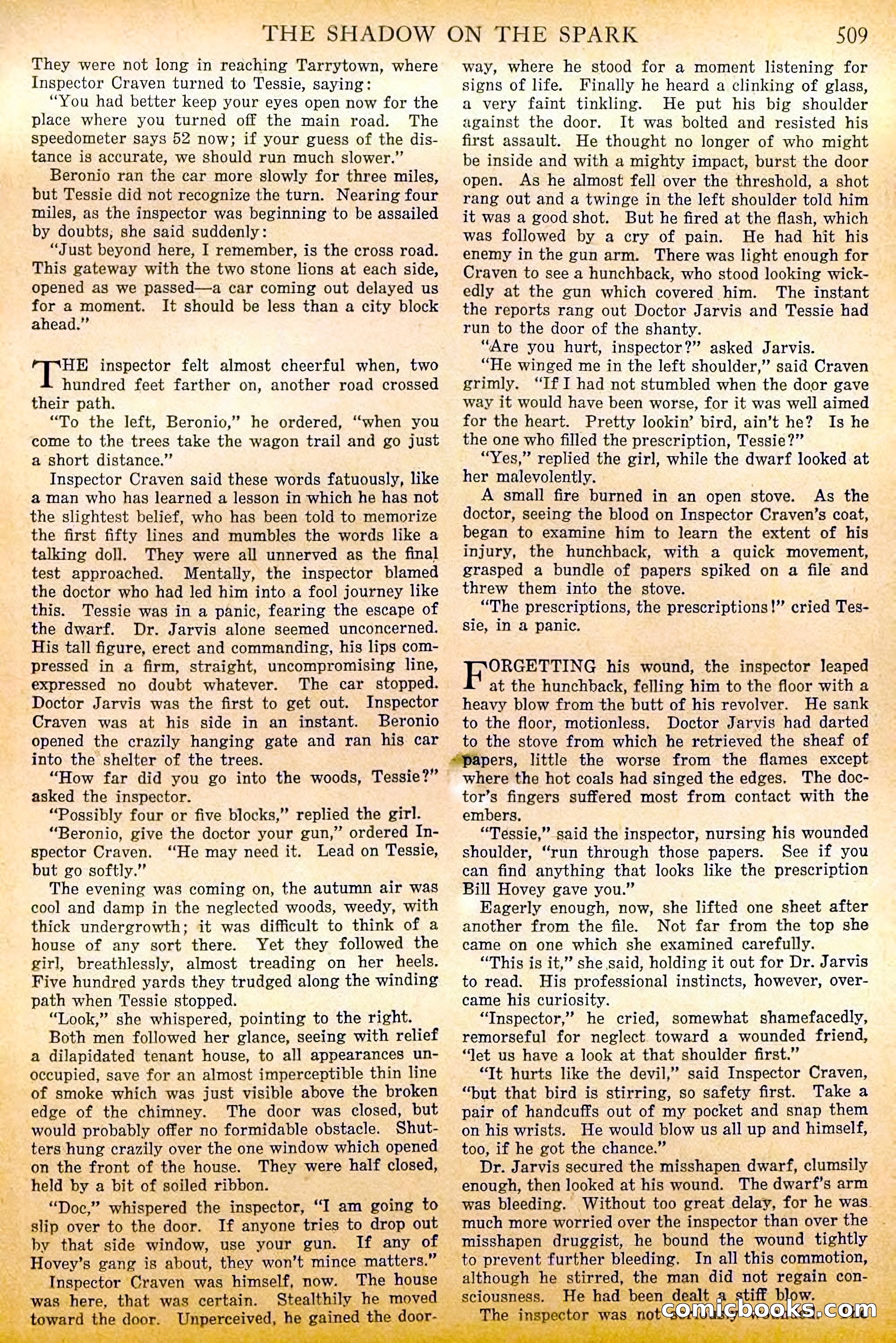
A restored page from Pulp Fiction, 1927. Page through the whole issue in the reader above.
📄 Transcribed text from this page (OCR, searchable)
Machine-transcribed from the original scan — historical spelling and the odd misread are preserved.
THE SHADOW ON THE SPARK They were not long in reaching Tarrytown, where Inspector Craven turned to Tessie, saying: “You had better keep your eyes open now for the place where you turned off the main road. The speedometer says 52 now; if your guess of the dis- tance is accurate, we should run much slower.” Beronio ran the car more slowly for three miles, but Tessie did not recognize the turn. Nearing four miles, as the inspector was beginning to be assailed by doubts, she said suddenly: “Just beyond here, I remember, is the cross road. This gateway with the two stone lions at each side, opened as we passed—a car coming out delayed us for a moment. It should be less than a city block ahead.” HE inspector felt almost cheerful when, two hundred feet farther on, another road crossed their path. “To the left, Beronio,’ he ordered, “when you come to the trees take the wagon trail and go just a short distance.” Inspector Craven said these words fatuously, like a man who has learned a lesson in which he has not the slightest belief, who has been told to memorize the first fifty lines and mumbles the words like a talking doll. They were all unnerved as the final test approached. Mentally, the inspector blamed the doctor who had led him into a fool journey like this. Tessie was in a panic, fearing the escape of the dwarf. Dr. Jarvis alone seemed unconcerned. His tall figure, erect and commanding, his lips com- pressed in a firm, straight, uncompromising line, expressed no doubt whatever. The car stopped. Doctor Jarvis was the first to get out. Inspector Craven was at his side in an instant. Beronio opened the crazily hanging gate and ran his car into the shelter of the trees. “How far did you go into the woods, Tessie?” asked the inspector. “Possibly four or five blocks,” replied the girl. “Beronio, give the doctor your gun,” ordered In- spector Craven. ‘He may need it. Lead on Tessie, but go softly.” The evening was coming on, the autumn air was cool and damp in the neglected woods, weedy, with thick undergrowth; it was difficult to think of a house of any sort there. Yet they followed the girl, breathlessly, almost treading on her heels. Five hundred yards they trudged along the winding path when Tessie stopped. “Look,” she whispered, pointing to the right. Both men followed her glance, seeing with relief a dilapidated tenant house, to all appearances un- occupied, save for an almost imperceptible thin line of smoke which was just visible above the broken edge of the chimney. The door was closed, but would probably offer no formidable obstacle. Shut- ters hung crazily over the one window which opened on the front of the house. They were half closed, held by a bit of soiled ribbon. “Doc,” whispered the inspector, “I am going to slip over to the door. by that side window, If anyone tries to drop out use your gun. If any of is about, they won't mince matters.” — 509 way, where he stood for a moment listening for signs of life. Finally he heard a clinking of glass, a very faint tinkling. He put his big shoulder against the door. It was bolted and resisted his first assault. He thought no longer of who might be inside and with a mighty impact, burst the door open. As he almost fell over the threshold, a shot rang out and a twinge in the left shoulder told him it was a good shot. But he fired at the flash, which was followed by a cry of pain. He had hit his enemy in the gun arm. There was light enough for Craven to see a hunchback, who stood looking wick- edly at the gun which covered him. The instant the reports rang out Doctor Jarvis and Tessie had run to the door of the shanty. “Are you hurt, inspector?” asked Jarvis. “He winged me in the left shoulder,” said Craven grimly. “IfI had not stumbled when the door gave way it would have been worse, for it was well aimed for the heart. Pretty lookin’ bird, ain’t he? Is he the one who filled the prescription, Tessie?” “Yes,” replied the girl, while the dwarf looked at her malevolently. A small fire burned in an open stove. As the doctor, seeing the blood on Inspector Craven’s coat, began to examine him to learn the extent of his injury, the hunchback, with a quick movement, grasped a bundle of papers spiked on a file and threw them into the stove. “The prescriptions, the prescriptions!” cried Tes- sie, in a panic. PpChGRT TING his wound, the inspector leaped at the hunchback, felling him to the floor with a heavy blow from the butt of his revolver. He sank to the floor, motionless. Doctor Jarvis had darted to the stove from which he retrieved the sheaf of papers, little the worse from the flames except where the hot coals had singed the edges. The doc- tor’s fingers suffered most from contact with the embers, “Tessie,” said the inspector, nursing his wounded shoulder, “run through those papers. See if you can find anything that looks like the prescription Bill Hovey gave you.” Eagerly enough, now, she lifted one sheet after another from the file. Not far from the top she came on one which she examined carefully. “This is it,” she said, holding it out for Dr. Jarvis to read. His professional instincts, however, over- came his curiosity. “Inspector,” he cried, somewhat shamefacedly, remorseful for neglect. toward a wounded friend, “let us have a look at that shoulder first.” “Tt hurts like the devil,” said Inspector Craven, “but that bird is stirring, so safety first. Take a pair of handcuffs out of my pocket and snap them on his wrists. He would blow us all up and himself, too, if he got the chance.” Dr. Jarvis secured the misshapen dwarf, clumsily enough, then looked at his wound. The dwarf’s arm was bleeding. Without too great delay, for he was. much more worried over the inspector than over the - misshapen druggist, he bound the wound tightly — _ to prevent further bleeding. In all this commotion, a